


The deductions small business owners miss most are not obscure. They are the home office, business use of a vehicle, client meals, health insurance for S-corp owners, small equipment purchases, and wages paid to family members. They get missed because each one has a specific record the IRS expects. A deduction you cannot document simply does not exist.
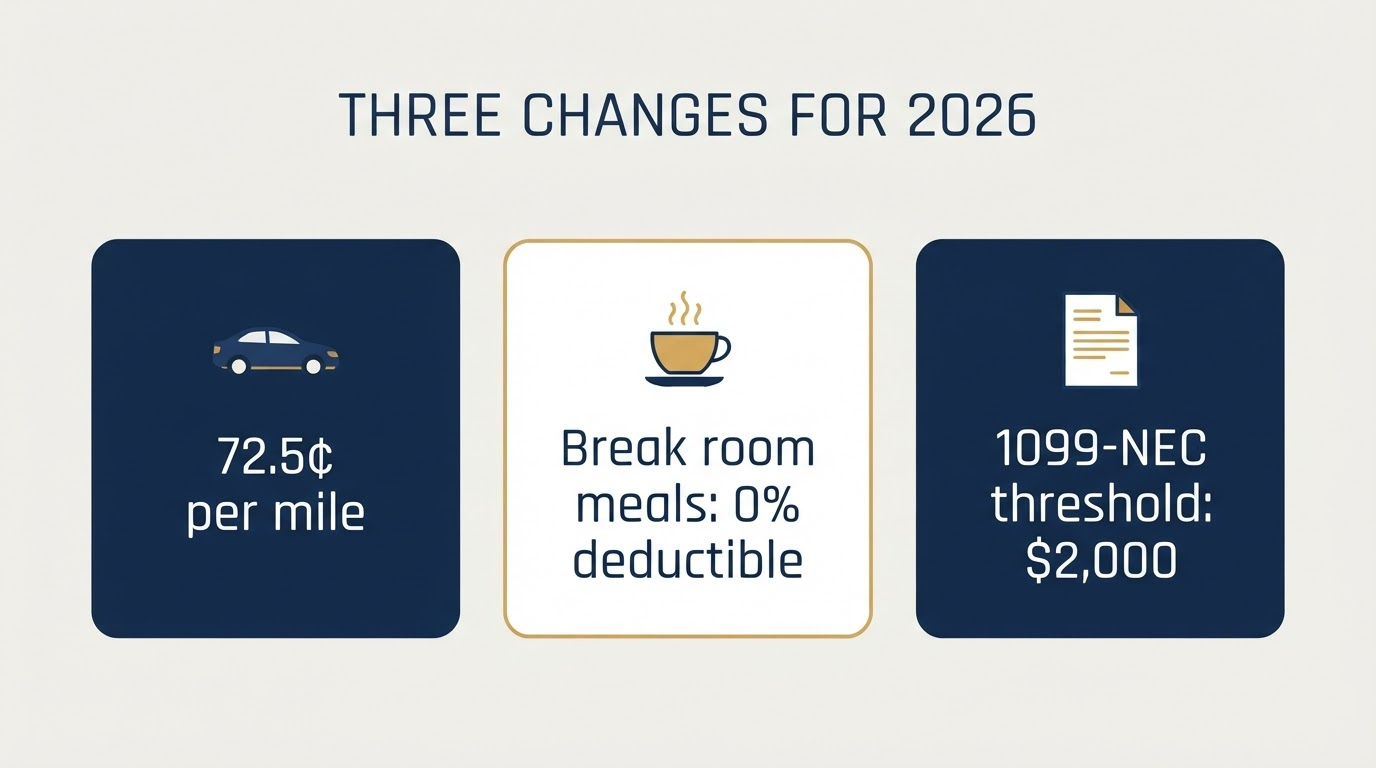
For 2026, the business mileage rate is 72.5 cents a mile, the simplified home office deduction is up to $1,500, and meals your business provides to employees on site are no longer deductible at all.
When we review a new client’s prior returns here in The Woodlands, the gap is rarely a missed loophole. It is usually a legitimate expense the owner paid, could have deducted, and left off because the record was not there or the rule was never explained. Here are the categories I see most, what each requires, and where the line is.
Why deductions get lost
It is not that the IRS is stingy. Most of these deductions are well established and nobody disputes them. The problem is that several categories carry their own documentation rules. These rules are much stricter than just keeping the receipt. Owners who were never told the rule do one of two things. They skip the deduction because it feels risky, or they take it without the support and hope for the best.
Both cost money. The first costs it every year. The second costs it all at once in an audit, complete with interest.
The home office: exclusive use and the S-corp trap
If you use part of your home regularly and exclusively for business, and it is your principal place of business, you can deduct it. “Principal place of business” includes a space where you handle the administrative and management side of the business, even if the actual work happens on job sites or at clients’ offices. That covers a lot of contractors, consultants, and service owners who assume they do not qualify.
There are two methods to choose from.
| Simplified method | Regular method | |
|---|---|---|
| How it works | $5 per square foot | Business share of actual home costs |
| Maximum | 300 sq ft, so $1,500 | No set maximum |
| What it includes | A flat amount | Mortgage interest, property tax, insurance, utilities, repairs, depreciation |
| Depreciation recapture on sale | None | Yes, on the depreciation claimed |
| Records | Square footage | Square footage plus all home expenses |
For a 200 square foot office in a 2,500 square foot house, the simplified method gives $1,000. The regular method, on a house with $18,000 of mortgage interest, $14,000 of property tax, $3,500 of insurance, and $5,000 of utilities, plus depreciation on the building, comes to roughly $4,000. Part of that is mortgage interest and property tax you might deduct anyway as an itemizer, but on Schedule C it also comes out of self-employment tax.
“Exclusively” means exclusively. A spare bedroom that is also the guest room does not qualify. A desk in the corner of the living room does not qualify. A room with a door that is used for nothing else does.
This brings us to a structural issue unique to S-corp owners. If you own an S-corp, the home office does not go on your personal return at all. You are an employee of your company, and since 2018 employees cannot deduct unreimbursed business expenses. The 2025 law made that permanent. The way to get the deduction is for the S-corp to reimburse you under an accountable plan. We will cover that setup below.
Your vehicle: mileage logs and the first-year lock
For 2026, the standard mileage rate is 72.5 cents per business mile. Twelve thousand business miles is $8,700 of deduction. The alternative is actual expenses, which means deducting the business share of fuel, insurance, repairs, registration, and depreciation.
Two rules decide most of this.
Commuting is not business mileage. Driving from home to your regular office or shop is personal. Driving from that office to a client, a supplier, or a job site is business. If your home office qualifies as your principal place of business, trips from home to clients count too. That is one more reason the home office matters.
The first year locks in your options. For a car you own, if you want the standard mileage rate at any point, you have to use it in the first year the car is used for business. After that you can switch to actual expenses. If you start with actual expenses and depreciation, you generally cannot switch to the mileage rate for that car later.
The record is a mileage log. You need the date, destination, business purpose, miles, and the odometer reading at the start and end of the year. It does not have to be paper. A phone app that tracks trips is fine, as long as you add the purpose. What does not work is reconstructing a year of driving from memory in March.
Heavier trucks and SUVs used in the business have their own depreciation rules, which are covered in our guide on Section 179 versus bonus depreciation.
Client meals and the 2026 shift on employee food
A meal with a client, prospect, or business contact where business is discussed is 50 percent deductible. So is a meal while you are traveling overnight for business. Entertainment, meaning the ballgame, the golf round, or the concert, has not been deductible since 2018, even if business was discussed.
What changed this year is meals your business provides to its own people. Starting in 2026, the cost of meals provided for the convenience of the employer is not deductible at all. That covers snacks and coffee in the break room, meals for employees working late, and an on-site cafeteria. There are exceptions, with the main one being restaurants feeding their own staff.
What is still 100 percent deductible includes a holiday party or company picnic for all employees, and meals you include in an employee’s taxable wages.
For a business meal, the receipt is not enough. Write down who was there and what business was discussed. Put it on the back of the receipt, in a note on the card transaction, or in your accounting software. It takes fifteen seconds at the table and it is the exact part that is missing from most files I see.
S-corp owners: health insurance and the accountable plan
This is the one I find missing most often on S-corp returns, and it is not small.
If you own more than 2 percent of an S-corp, your health insurance premiums are deductible, but only if they run through the company. The S-corp pays the premiums or reimburses you, the amount goes into your W-2 wages (it is not subject to Social Security and Medicare tax), and you then deduct it on your personal return. A family paying $18,000 a year in premiums, who has been paying them personally without that setup, is giving up roughly $4,300 a year at a 24 percent rate.
The second piece is an accountable plan. This is a written policy under which the S-corp reimburses you for business expenses you pay personally. That includes your home office, the business share of your cell phone, and mileage in your own car. The reimbursements are deductible to the company and not taxable to you. Without the plan, those costs have nowhere to go. You cannot deduct them personally, and the company has nothing to deduct.
Both are a matter of paperwork, not structure. They are also easy to set up before December 31 so the full year counts.
Small equipment and the de minimis safe harbor
The de minimis safe harbor lets you deduct items costing $2,500 or less per item or per invoice right away, instead of setting them up as assets and depreciating them. A laptop, a printer, office furniture, or a set of tools all fit here.
You need an accounting procedure in place at the start of the year treating items under that amount as expenses, and you need to make the election each year with a statement attached to your return. Many owners do not know it exists, so these purchases end up on a depreciation schedule for five or seven years.
For larger equipment, bonus depreciation is now permanent at 100 percent, and most purchases can be deducted in full the year they are placed in service.
Paying your children for real work
If your children work in the business, their wages are a deductible business expense. A child’s earned income up to the standard deduction, which is $16,100 for 2026, is not subject to federal income tax. If the business is a sole proprietorship, or a partnership owned only by the child’s parents, wages to a child under 18 are also exempt from Social Security and Medicare tax.
That exemption does not apply to an S-corp or a regular corporation. There, the wages are still deductible, but payroll taxes apply as they would for any employee.
The work has to be real, the pay has to be reasonable for that work, and the records have to look like any other employee’s. You need timesheets, a description of the job, payroll records, and a paycheck that actually goes to the child. Filing, cleaning the shop, social media, and data entry all count. Done properly, it moves income from your bracket to theirs and can fund a Roth IRA in the child’s name.
The long tail: smaller deductions that add up
Beyond the major categories, there are several smaller items that are easy to forget but highly valuable over the course of a year.
- Startup costs: You can deduct up to $5,000 in the first year, with the rest amortized over 15 years. This phases out if total startup costs exceed $50,000.
- Education: Courses that maintain or improve skills in your current business qualify. Education that qualifies you for a completely new profession does not.
- Software and subscriptions: Accounting platforms, industry databases, and professional memberships are fully deductible business expenses.
- Professional fees: Legal, accounting, and consulting fees paid for business purposes belong on the return.
- Business gifts: Deductible up to $25 per recipient per year. The limit is low, but it adds up quickly across a large client list.
- Processing fees: Bank and credit card processing fees often sit inside net deposits and never get recorded as an explicit expense.
- Retirement contributions: A massive deduction covered in detail in our guide on business retirement plans.
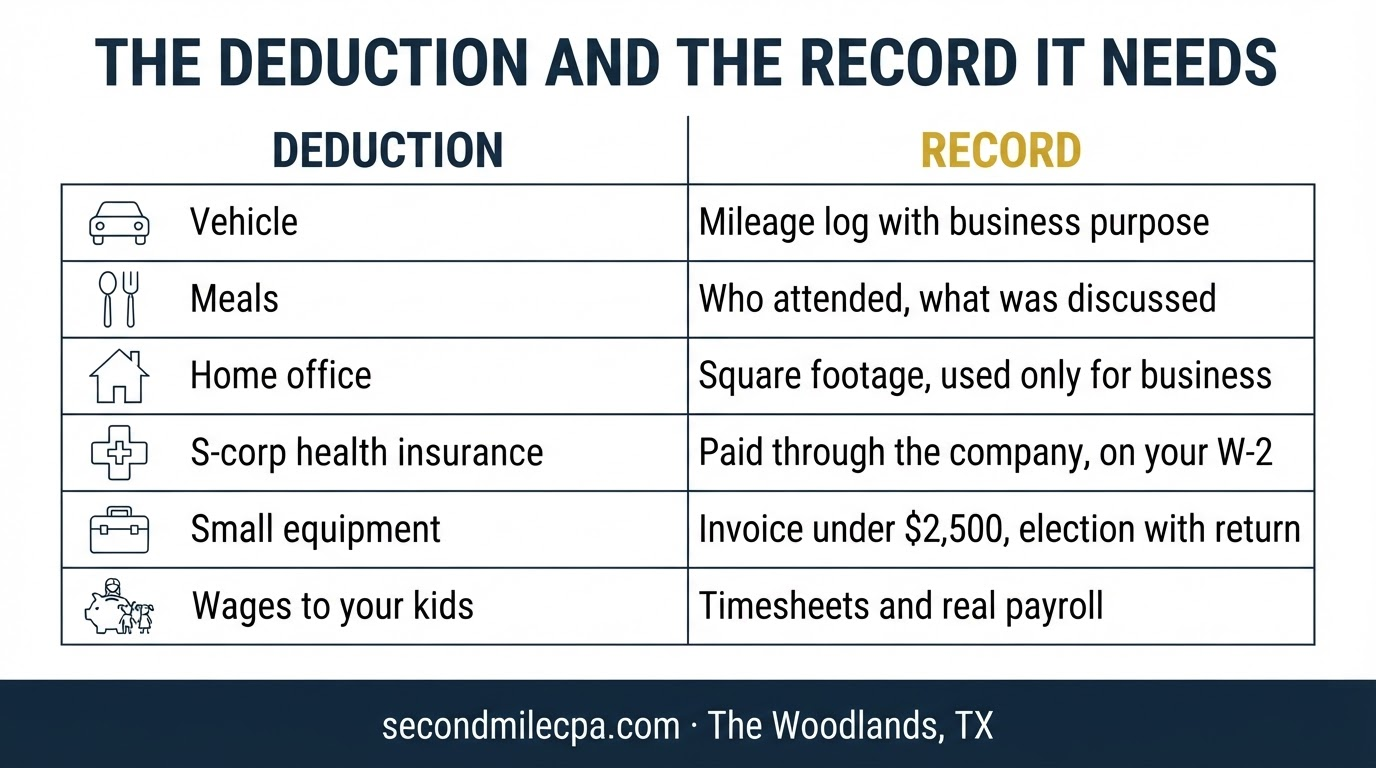
The records, category by category
| Category | What the IRS expects |
|---|---|
| Vehicle | Mileage log with date, destination, business purpose, miles; year start and end odometer |
| Meals | Receipt, plus who attended and what business was discussed |
| Travel | Dates, destination, business purpose; receipts for lodging and any expense of $75 or more |
| Home office | Square footage of the office and the home; home expenses if using the regular method |
| Gifts | Recipient, date, cost, business relationship |
| Wages to family | Timesheets, job description, payroll records, payment to the family member’s own account |
| Equipment | Invoice and the date it was placed in service |
| S-corp reimbursements | Written accountable plan; expense reports with receipts submitted within a reasonable time |
Keep records at least three years after you file the return they support. For equipment and property, keep them until three years after the year you sell or dispose of the asset. Payroll records should be kept for four years.
One change for 2026 that is sometimes misread involves contractors. The threshold for issuing a Form 1099-NEC went from $600 to $2,000 for payments made after 2025. That changes which forms you file. It does not change the records you need to deduct the payment.
What not to do
Our position at the firm is simple. We take the full legal deduction, not the gray zone. These are the patterns that turn a legitimate deduction into an audit adjustment.
- Claiming 100 percent business use of a vehicle that is also the family car. Almost nobody drives a car that is 100 percent business, and examiners know it.
- Counting the commute. Home to your regular office is personal, every day.
- Calling a family vacation a business trip because you had one meeting. The primary purpose of the trip has to be business.
- A home office in a room that has another use. The guest room, the kids’ homework room, or the room with the treadmill will not pass.
- Clothing you could wear outside work. A suit is not deductible, even if you only wear it to client meetings. Uniforms and protective gear are.
- Renting your home to your business for meetings that did not happen, or at rent nobody else would pay. Renting your home for up to 14 days a year can be legitimate. It needs real business use, a fair market rate, and the same records a third party would ask for.
- Paying children for work they did not do, or at a rate no outside employee would get.
- Round numbers. Claiming $5,000 for meals or $3,000 for supplies looks exactly like an estimate.
Before December 31
- Start a mileage log today if you do not have one. Two and a half months of real records beats a reconstructed year.
- Measure the home office and decide whether it qualifies as used regularly and exclusively.
- If you own an S-corp, make sure health insurance is running through payroll and set up an accountable plan so this year’s expenses can be reimbursed.
- Add notes to this year’s meal receipts while you still remember who was there.
- Check how small equipment purchases were recorded and whether you have a de minimis procedure in place for 2027.
- Review on-site meal spending for 2026, since most of it is no longer deductible.
Frequently asked questions
What tax deductions do small business owners most often miss?
The home office, business use of a personal vehicle, client meals, health insurance for S-corp owners, small equipment purchases that could be expensed under the de minimis safe harbor, and wages paid to family members. They are usually missed because of documentation, not eligibility. Each category has a specific record the IRS expects, and without it the deduction does not hold up.
What is the standard mileage rate for 2026?
72.5 cents per business mile, up from 70 cents in 2025. To use the standard rate for a car you own, you have to choose it in the first year you use the car for business. Commuting between home and your regular place of business does not count as business mileage.
How much is the home office deduction?
Under the simplified method, $5 per square foot for up to 300 square feet, so a maximum of $1,500. Under the regular method, you deduct the business share of actual home costs, including mortgage interest, property tax, insurance, utilities, and depreciation. This is often larger but requires more records and creates depreciation recapture when you sell. The space must be used regularly and exclusively for business.
Are business meals deductible in 2026?
Meals with clients or business contacts where business is discussed, and meals while traveling overnight for business, are 50 percent deductible. Starting in 2026, meals a business provides to employees for its own convenience, such as break room snacks or meals for staff working late, are no longer deductible, with exceptions such as restaurants. Holiday parties for all employees remain 100 percent deductible. Entertainment is not deductible.
Can an S-corp owner deduct health insurance?
Yes, if the S-corp pays or reimburses the premiums and includes them in the owner’s W-2 wages. Those amounts are not subject to Social Security and Medicare tax, and the owner deducts them on the personal return. Premiums paid personally without running through the company are generally not deductible this way.
Can I deduct business expenses I pay personally if I own an S-corp?
Not on your personal return. Unreimbursed employee business expenses are no longer deductible, and that rule is now permanent. The S-corp should reimburse you under a written accountable plan, which makes the expense deductible to the company and the reimbursement tax-free to you.
The bottom line
The missed deductions in most small businesses are ordinary ones. A home office that qualifies, miles that were driven, meals that were business, insurance that was paid. What is missing is the record, or the setup that puts the expense on the right return.
None of this is aggressive. It is the full deduction the law already allows, supported the way the law already requires. The best time to fix it is before the year closes, while there are still months of records to keep the right way.
Get in touch and we will review your last return and your current records in a 30-minute call. We will find what is being left off and set up the accountable plans or mileage logs that need to be in place before December 31.
Second Mile Financial Services is a licensed Texas CPA firm in The Woodlands, serving business owners across greater Houston and nationwide. Call (281) 826-0100 or email [email protected].
This article is general information, not individualized tax advice. Deduction rules depend on your facts, and figures change annually. Discuss your specific situation with a qualified professional before acting.