


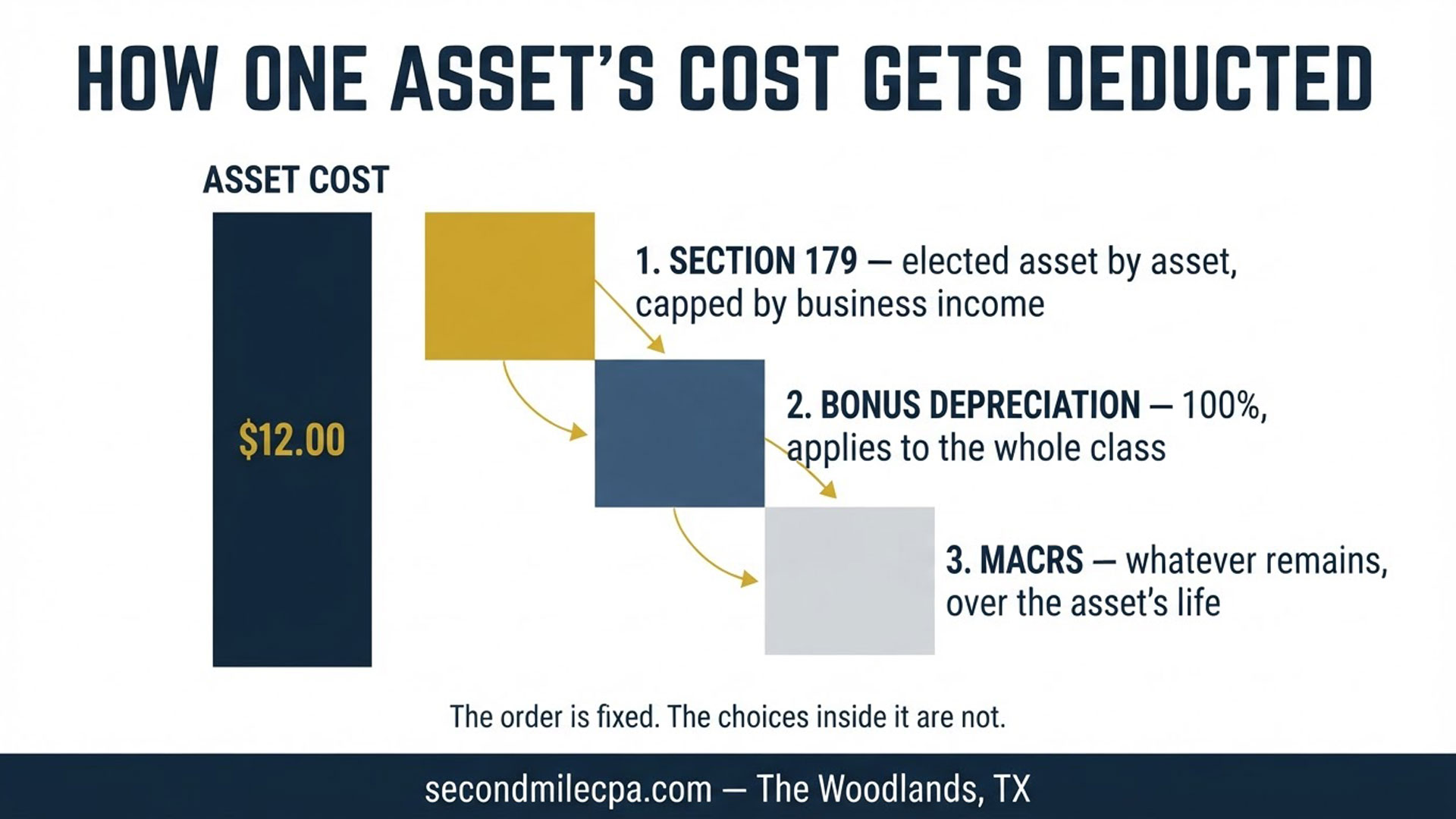
Section 179 and bonus depreciation are not alternatives. Section 179 applies first, asset by asset, capped by your business income. Bonus depreciation applies to what is left, across an entire class of property, and it can create a loss. Used together in the right order, they give you something neither gives you alone: precise control over which deductions land in which year.
For 2026 the Section 179 deduction limit is $2,560,000, with the phase-out beginning at $4,090,000 of qualifying property placed in service and full phase-out at $6,650,000. Bonus depreciation is 100% and permanent.
Here is how to use both.
The comparison, in one table
| Section 179 | Bonus depreciation | |
|---|---|---|
| Order of application | First | Second, on the remaining basis |
| How you choose | Asset by asset, and you may expense part of an asset | All or nothing for an entire class of property |
| 2026 limit | $2,560,000 | No dollar limit |
| Phase-out | Begins at $4,090,000 of property placed in service, gone at $6,650,000 | None |
| Can it create a loss? | No. Capped by business taxable income | Yes |
| Carryforward | Yes, disallowed amount carries to future years | No. Excess becomes a current-year loss |
| Expiration | None. Limits indexed for inflation | None, for property acquired on or after January 20, 2025 |
| State conformity | Widely followed, though not universally | Frequently decoupled |
| Used property | Qualifies | Qualifies, with conditions |
| Real property | Certain improvements, plus roofs, HVAC, fire and security systems on nonresidential buildings | Qualified improvement property and land improvements, not the building shell |
Two rows in that table do most of the work. Section 179 cannot create a loss, and bonus depreciation can. Everything else follows from those two facts.
Why the order matters
The sequence is fixed. Section 179 is elected first, then bonus depreciation applies to whatever basis remains, then regular MACRS depreciation applies to anything still left.
That ordering is what gives you control.
Suppose you place $400,000 of equipment in service and your business income is $250,000. If you did nothing but take bonus depreciation, you would deduct the full $400,000 and create a $150,000 loss. Sometimes that is exactly what you want. Often it is not, because a loss in a year with no income to absorb it is a deduction you have lent to the future at zero interest.
By electing Section 179 selectively on specific assets, then electing out of bonus depreciation for the relevant class, you can land the deduction closer to where your income actually is and carry the rest forward deliberately.
This is the part that separates a return from a plan. The software will happily take everything in year one. Whether that is the best outcome across three years is a different question, and it is not one the software asks.
What Section 179 is good at
Precision. You choose the assets, and you can even expense part of an asset’s cost and depreciate the rest. Bonus depreciation does not let you do that. Once you take it for a class, you take it for everything in that class placed in service that year.
Real property improvements. Section 179 reaches things bonus depreciation does not, including roofs, heating and air conditioning, fire protection and alarm systems, and security systems on nonresidential real property. For a building owner replacing an HVAC system, that is the provision that matters.
Predictability. No expiration, limits indexed annually. You can build a three-year or five-year capital plan around it without watching the calendar.
The business income cap, used on purpose. Because Section 179 cannot push you into a loss, it is self-limiting in a useful way. The disallowed portion carries forward rather than disappearing.
What bonus depreciation is good at
Volume. There is no dollar limit and no phase-out. A business placing $8 million of equipment in service gets nothing from Section 179 at that level, because the phase-out has eliminated it entirely. Bonus depreciation does not care.
Creating a loss when a loss is useful. Net operating losses carry forward. If you are in a high-growth year with heavy capital spending and expect much higher income in two years, generating a loss now to offset later income can be the right call.
Simplicity at scale. For a business placing hundreds of assets in service, electing class-wide is administratively far lighter than asset-by-asset elections.
The phase-out nobody notices until it bites
Section 179 has a feature that surprises growing businesses: it disappears as you spend more.
For 2026, once total qualifying property placed in service exceeds $4,090,000, the deduction limit is reduced dollar for dollar by the excess. At $6,650,000 of property placed in service, Section 179 is gone entirely.
Note what that threshold is measured against. Not the amount you elect to expense. The total qualifying property you placed in service that year. A business that buys $5 million of equipment and only wants to expense $500,000 of it still has its limit reduced by the amount over the threshold.
For most small businesses this never comes up. For a contractor in a heavy equipment year, or a manufacturer doing a line expansion, it comes up suddenly, and it is the moment when the planning shifts from Section 179 to bonus depreciation as the primary tool.
The state problem
This is the least interesting section in this article and one of the most expensive.
Section 179 is widely conformed to at the state level, though not universally and not always at the federal limit. Bonus depreciation is frequently decoupled, meaning the state requires an add-back of the federal bonus deduction and its own separate depreciation schedule for the same asset.
The consequence is that a choice that looks clean federally can create a second set of books at the state level, and a multi-state business can end up with several.
Texas does not impose a personal income tax, which removes a layer for individual owners here. Businesses operating across state lines do not get that simplification, and the state treatment should be modeled alongside the federal choice rather than discovered afterward.
When taking less deduction now is worth more in total
Here is the thinking that most year-end advice skips, because it does not fit the headline.
A deduction is worth your marginal rate. A deduction taken in a year when your marginal rate is low is worth less than the same deduction taken when your rate is high. Since both Section 179 and bonus depreciation are now permanent, you are no longer choosing between deducting now and losing the chance. You are choosing which year.
Situations where spreading it out wins:
Your income this year is unusually low. A big deduction against a small number is partly wasted. Regular depreciation across the asset’s life may put more of the deduction where your rate is higher.
The Qualified Business Income deduction is in play. QBI is calculated on qualified business income. A large current-year deduction reduces that income, which can reduce the QBI deduction. In some situations you lose more through QBI than you gain from the acceleration. This interaction is subtle and it is worth actually running.
You expect to be in a higher bracket soon. A business scaling up may be better served by depreciation deductions in the years the income arrives.
You are planning to sell. Accelerated depreciation increases recapture on disposition. If a sale is on the horizon, the timing of these deductions should be planned alongside it, not separately from it.
None of that is an argument against taking the deduction. It is an argument for deciding rather than defaulting.
What we actually do with clients
The sequence, in practice, in the third quarter:
- Project the year’s taxable income before any depreciation choices. This is the number everything else keys off, and it is the step most often skipped.
- List everything expected to be placed in service this year, with dates. Not order dates. See what placed in service actually means.
- Check the Section 179 phase-out. If total placed-in-service property is approaching $4,090,000, the planning changes shape.
- Identify the assets where Section 179 reaches further, particularly building systems like HVAC and roofing.
- Model at least two scenarios. Full acceleration versus a deliberate split, over three years rather than one.
- Check the QBI interaction on each scenario.
- Check state conformity for every state you file in.
- Then decide, and document the election properly on the return.
That is a couple of hours of work and it routinely changes the answer.
Frequently asked questions
What is the Section 179 limit for 2026?
The maximum Section 179 deduction for 2026 is $2,560,000. The phase-out begins once total qualifying property placed in service during the year exceeds $4,090,000, reducing the limit dollar for dollar, and the deduction is eliminated entirely at $6,650,000. Both figures are adjusted annually for inflation.
Which is better, Section 179 or bonus depreciation?
Neither, because they are not competing. Section 179 applies first and is elected asset by asset, which gives precision, but it cannot create a loss and it phases out above a spending threshold. Bonus depreciation applies afterward across an entire class of property, has no dollar limit, and can create a loss. Most well-planned years use both, with Section 179 applied selectively to the assets where it reaches further and bonus depreciation handling the remainder.
Can Section 179 create a business loss?
No. The Section 179 deduction is limited to your aggregate business taxable income for the year. Any amount disallowed by that limit carries forward to future years and can be used when income supports it. Bonus depreciation has no such cap and can create a net operating loss.
Does Section 179 expire?
No. Unlike the prior bonus depreciation schedule, Section 179 has no expiration date, and its limits are indexed for inflation each year. As of the One Big Beautiful Bill Act, 100% bonus depreciation is also permanent for qualifying property acquired on or after January 20, 2025, so neither tool is now racing a clock.
Can I use Section 179 on a roof or HVAC system?
Yes, for nonresidential real property. Section 179 reaches roofs, heating, ventilation and air conditioning, fire protection and alarm systems, and security systems installed on nonresidential buildings. This is one of the places where Section 179 covers ground that bonus depreciation does not, and it is frequently missed by building owners treating a major system replacement as a repair or as 39-year property.
Do I have to take the maximum deduction available?
No, and you should not assume you want to. Section 179 is elected, and you can expense part of an asset’s cost. Bonus depreciation can be declined by electing out for an entire class of property. Taking less now sometimes produces more total benefit, particularly when current income is low, when a large deduction would reduce the Qualified Business Income deduction, or when a sale is anticipated and recapture matters.
The bottom line
The question to bring to your accountant is not “should I take Section 179 or bonus depreciation.” It is “given what my income is going to look like this year and next, which deductions do I want in which year, and what is the cleanest way to put them there.”
Both tools are permanent now. That removes the urgency and replaces it with something more useful: the ability to plan across years instead of racing to the end of one.
The one thing that has not changed is that the asset still has to be in service before December 31 to count for this year.
Get in touch and we will model your capital spending across both tools and both years, before the delivery schedules are locked.
Second Mile Financial Services is a licensed Texas CPA firm in The Woodlands, serving businesses across greater Houston and nationwide. Call (281) 826-0100 or email [email protected].