


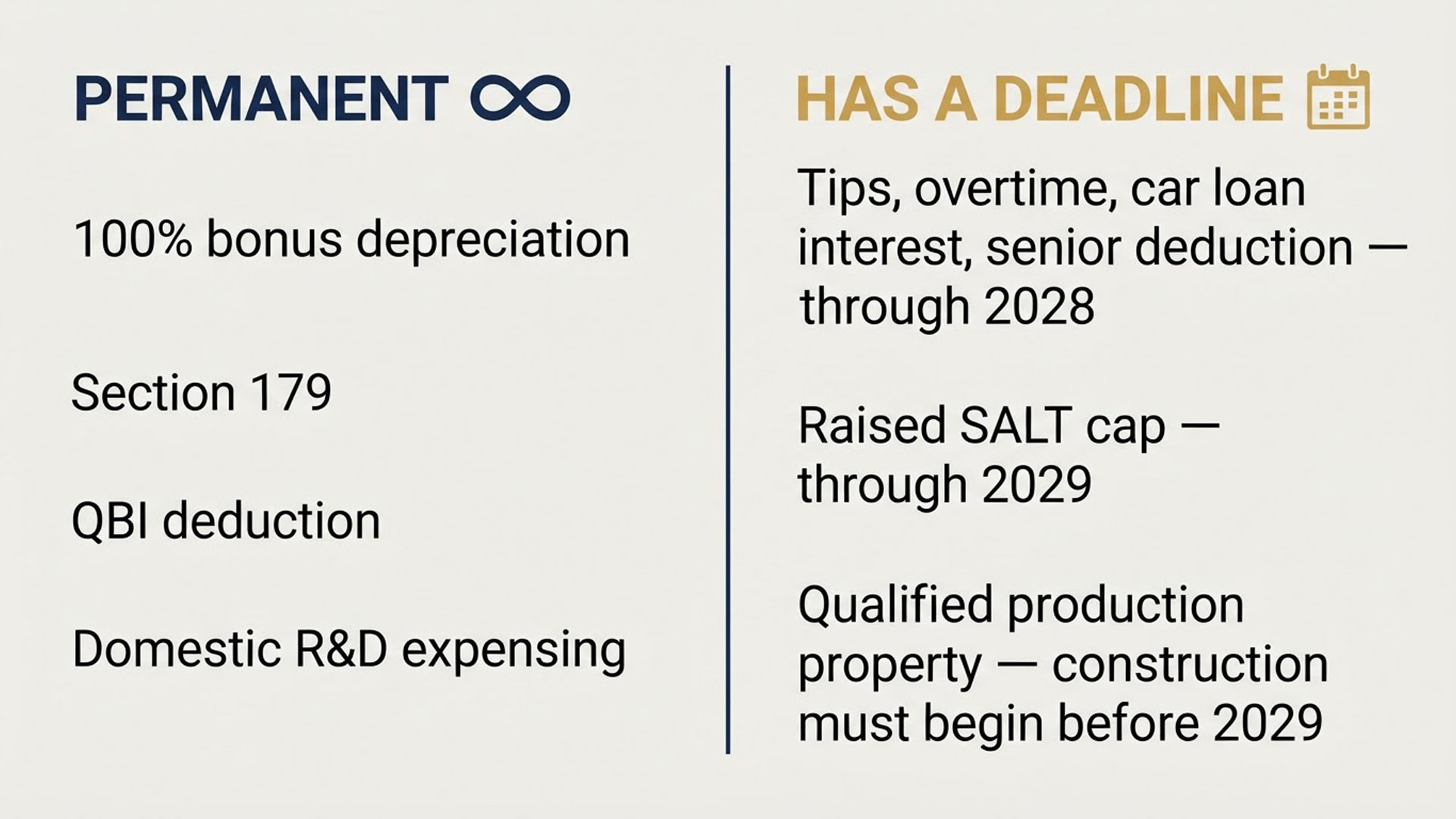
The One Big Beautiful Bill Act made 100% bonus depreciation permanent for qualifying property acquired on or after January 20, 2025. It does not step down in 2027, it does not end in 2029, and there is no cliff in 2030. What still has a hard deadline is the date the asset is placed in service, and that is a different thing from the date you ordered it, paid for it, or took delivery.
If you have been told to hurry, the reason you were given is out of date. Here is the current picture.

What actually changed
A short history, because it explains why so much of what you will read this fall is wrong.
The Tax Cuts and Jobs Act set bonus depreciation at 100% in 2017 and then wrote in a phase-down. It dropped to 80%, then 60%, and for 2025 it was scheduled to land at 40%. That schedule was real, it was law, and for several years the correct advice genuinely was to accelerate purchases while the percentage was higher.
The One Big Beautiful Bill Act, signed in July 2025, removed the phase-down entirely. Not extended it. Removed it. One hundred percent bonus depreciation now applies to qualifying property acquired on or after January 20, 2025, with no expiration written into the provision.
The IRS confirmed the treatment in Notice 2026-11, issued January 14, 2026, which also told taxpayers they can generally rely on the existing Tax Cuts and Jobs Act era regulations with the dates updated, and which added two elections we will come back to.
So when you read a year-end article telling you bonus depreciation is about to disappear, you are reading something that was true for several years and stopped being true. Corrections travel slower than the original claim. This one has not caught up yet.
The acquisition date, and the contract trap
The permanence attaches to property acquired on or after January 20, 2025.
That date does more work than it looks like. If you entered into a written binding contract for the property before January 20, 2025, the property is treated as acquired on that earlier contract date, which puts it under the old phase-down rules rather than the new permanent ones.
This catches people on long lead-time equipment. A machine ordered under contract in late 2024 and delivered in 2025 is not automatically in the new regime, even though it was placed in service well after the cutoff. The contract date governs the acquisition test.
If you have anything in that category, it is worth looking at the paperwork rather than assuming.
What qualifies
The general rule is tangible property with a class life of 20 years or less. In practice, for most businesses that means:
Machinery and equipment. The straightforward case.
Vehicles. Including work trucks and trailers. In farm and ranch operations, vehicles used more than 60% for business qualify, and so does a livestock trailer. Passenger automobiles carry their own separate limits, which is a different conversation.
Qualified improvement property. Interior improvements to nonresidential buildings you already own.
Land improvements. Driveways, parking areas, fencing, landscaping. This is the category owners most often forget they have.
Used property, which surprises people. It qualifies, provided you or a predecessor did not use it within the prior five years, you acquired it by purchase from an unrelated party, and the basis is not carried over from other property you held. A used machine bought at auction can carry full bonus depreciation. A machine bought from a company you control cannot.
What does not qualify: property you lease out under certain arrangements, property used predominantly outside the United States, and buildings themselves, with one significant exception we will get to.
Placed in service is the entire test
This is the part that costs real money, and it is the part almost nobody explains properly.
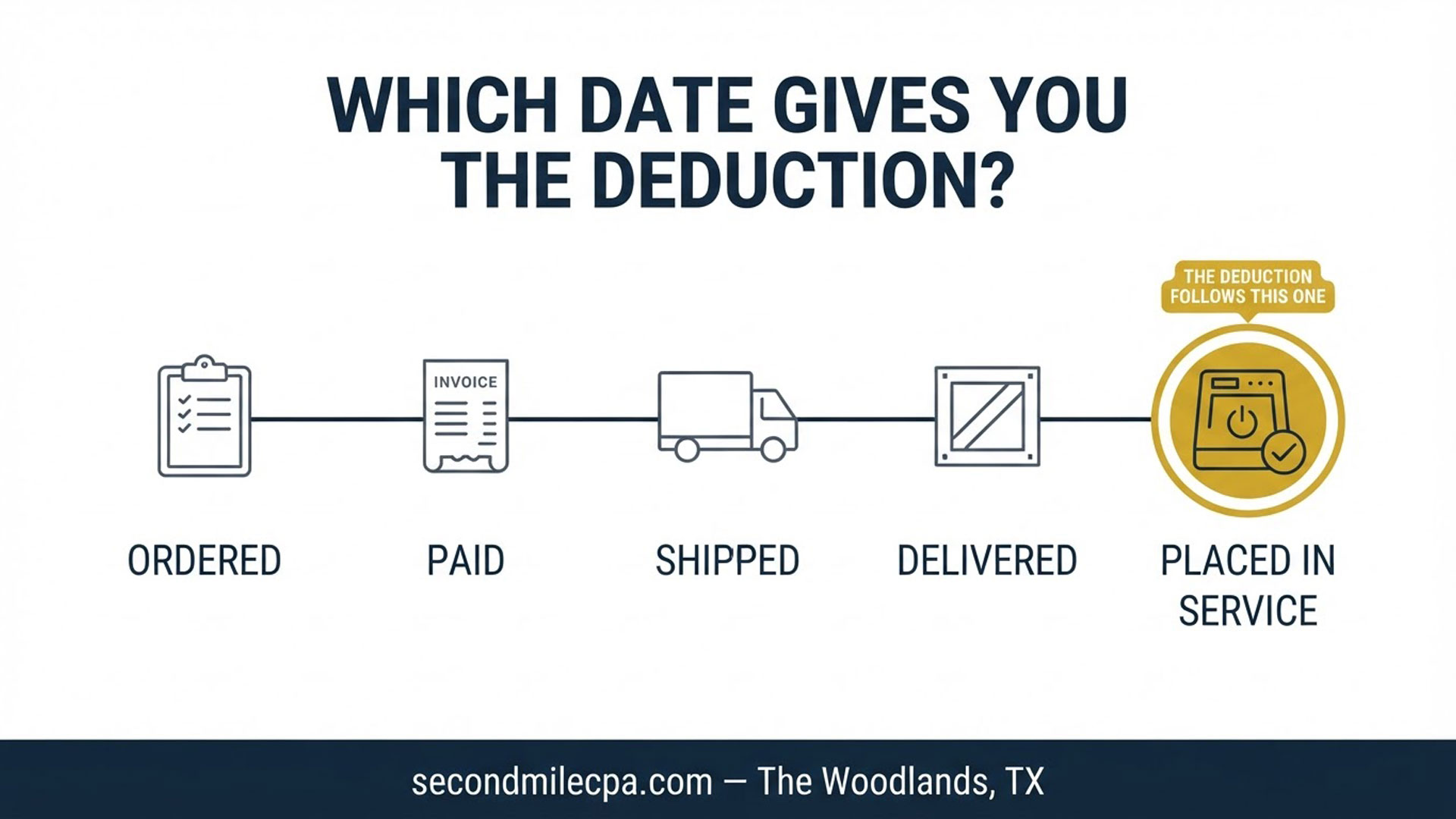
The deduction belongs to the year the asset is placed in service. Not the year you ordered it. Not the year you paid for it. Not the year it was delivered and left in the crate.
Placed in service means the asset is ready and available for its intended use in your business. For most equipment that means delivered, installed, connected, and capable of doing the work you bought it for. A machine sitting on a pallet in your own warehouse on December 31, still awaiting an electrician, is generally not placed in service.
Every January I have some version of the same conversation. An owner bought equipment in December, specifically to take the deduction, and it arrived on the sixth. Or it arrived on the twenty-eighth and the installer could not come until the second week of January. The money left in one year and the deduction landed in the next.
Nothing about that is recoverable after the fact. It is decided by logistics, which means it is decided in October and November, not on December 30.
What to actually do about it. If you are counting on a deduction this year, work backwards from December 31 through the installation, the delivery, the lead time, and the order date. Then add margin, because vendors miss dates in December more than any other month. If the schedule is tight, ask the vendor for a firm in-service date in writing and treat a verbal assurance as what it is.
What permanence changes about planning
Here is where I think the real value of this news sits, and it runs opposite to how most people will use it.
For several years, there was a legitimate argument for pulling purchases forward. The percentage was falling, so a dollar of equipment bought this year genuinely produced a better deduction than the same dollar next year. That argument is gone. One hundred percent this year, one hundred percent next year, one hundred percent the year after.
Which means the tax code has stopped giving you a reason to buy things early.
That is good news, even though it does not feel like a headline. The artificial urgency that pushed owners into December equipment purchases was never good for the businesses that acted on it. Now the question returns to where it belongs: does this asset earn its keep?
Which brings me to the thing I say in every webinar, and will keep saying here.
I’m not a proponent of someone going out and buying property or equipment just to have it, to take advantage of the tax benefit. There shouldn’t be a purchase of an asset unless there’s a genuine business need for it, something that helps you grow and expand the business.
A deduction returns a fraction of what you spent, determined by your rate. It never returns all of it. Spend $100,000 on equipment your business does not need and you have not saved money on taxes. You are $100,000 poorer and you own something that does not earn.
There is still a timing question, and it is a real one. It just is not the question people think it is. The question is no longer whether to buy before the rules change. It is which year you want the deduction in, and that depends on where your income is landing. A large deduction taken in a year when profit is unusually low is partly wasted. The same deduction in a high-income year is worth considerably more. That is a conversation worth having in the third quarter, with numbers.
Two elections most owners do not know they have
Because bonus depreciation is automatic unless you do something, many owners assume it is all or nothing. It is not.
Electing out. You can elect out of bonus depreciation for an entire class of property for a given year. The property then depreciates on its normal schedule instead.
Why would anyone do that? Because a very large deduction now is not always what you want. If taking it would push you into a loss you cannot use efficiently, or would compress your Qualified Business Income deduction, or would leave you with almost no depreciation deductions in future years when you expect to be in a higher bracket, spreading the deduction can be worth more in total.
Electing a reduced rate. Notice 2026-11 provides an election to take 40% rather than 100% for the first tax year ending after January 19, 2025, with a 60% figure for long production period property and certain aircraft.
Both elections have to be made properly and on time. Neither is something to decide casually, but both are worth knowing exist, because a firm that never mentions them is treating your return as a form rather than a decision.
The one deadline in this area that is real
There is a provision in the same law that does carry a hard calendar, and it is getting almost no coverage relative to how much money is attached to it.
Qualified production property. Certain domestic nonresidential real property used as an integral part of manufacturing, production, or refining can be fully expensed in the year it is placed in service, rather than depreciated over 39 years.
The deadlines:
- Construction must begin after January 19, 2025 and before January 1, 2029.
- The property must be placed in service before January 1, 2031.
The limitations matter too. Leased property does not qualify. The portions of a building used for offices, research, software development, or sales are excluded, so a mixed-use facility has to be allocated. The benefit has to be affirmatively elected.
For a manufacturer weighing a facility, the difference between expensing a building and depreciating it over thirty-nine years is not a rounding item. And unlike bonus depreciation, this one has a construction start date you can miss.
If you are in manufacturing, production, or refining anywhere in the Houston industrial corridor and a facility decision is anywhere on your horizon, this is worth modeling now rather than in 2028.
How this fits with Section 179
Short version, because it deserves its own treatment.
Section 179 and bonus depreciation are not alternatives. Section 179 applies first and is elective asset by asset, which is useful when you want immediate expensing on some purchases and a normal schedule on others. It is capped by business income, so it cannot create a loss. Bonus depreciation applies after, to the entire class rather than the items you pick, and it can create a loss.
Both are now permanent, which is a genuine change from the situation twelve months ago, and it means the two can be planned together over a multi-year horizon rather than raced against a clock.
Full comparison across eight points: Section 179 vs. bonus depreciation.
If you own rental or commercial property
Everything above applies, and there is more available than most property owners use.
Interior improvements, land improvements, and the shorter-lived components inside a building are frequently sitting on a 27.5 or 39 year schedule when the rules would allow five, seven, or fifteen. Separating them is what a cost segregation study does, and with bonus depreciation permanent at 100%, the accelerated portion can be taken immediately.
That is a larger conversation with real caveats, including depreciation recapture when you sell and passive activity limits on whether you can use the deduction at all.
A checklist before December 31
If you have purchases in motion this year, this is what we run with clients.
- List every asset you expect to place in service this year, with its expected in-service date, not its order date.
- Identify anything scheduled for December. For each one, confirm the delivery date and the installation date with the vendor, in writing.
- Check the acquisition date on anything contracted before January 20, 2025. The old rules may apply.
- Model the year’s income first. A deduction is worth what your rate makes it worth. Know the rate before you decide the timing.
- Decide the Section 179 and bonus split deliberately, rather than letting the software default decide it.
- Check your state. Not every state conforms to federal bonus depreciation, and the mismatch turns one clean federal number into two different calculations.
- Ask whether you would buy this asset if the deduction did not exist. If the answer is no, the deduction is not the reason to change it.
Frequently asked questions
Is bonus depreciation still 100% in 2026?
Yes. The One Big Beautiful Bill Act removed the scheduled phase-down and made 100% bonus depreciation permanent for qualifying property acquired on or after January 20, 2025. The IRS confirmed the treatment in Notice 2026-11 in January 2026. Property acquired under a written binding contract entered into before January 20, 2025 is treated as acquired on that earlier date and may fall under the prior rules.
Does bonus depreciation expire in 2030?
No. That was the schedule under prior law, and a great deal of published advice still describes it that way. The phase-down was eliminated rather than extended, so there is no 2029 final year and no 2030 cliff. The provision that does carry a hard calendar is qualified production property, where construction must begin before January 1, 2029 and the property must be placed in service before January 1, 2031.
What does placed in service actually mean?
It means the asset is ready and available for its intended use in your business. Delivered, installed, and capable of doing the work. It is not the date you ordered the asset, the date you paid for it, or necessarily the date it arrived. Equipment delivered in December but not installed until January is generally placed in service in January, and the deduction follows the in-service date rather than the payment date.
Can I take bonus depreciation on used equipment?
Yes, in most cases. Used property qualifies if you or a predecessor did not use it within the prior five years, you acquired it by purchase from an unrelated party, and its basis is not determined by reference to other property you held. Purchases from related parties and within controlled groups are excluded. This is one of the more valuable and least used provisions for businesses that buy equipment at auction or secondhand.
Do I have to take bonus depreciation if I do not want it?
No. You can elect out for an entire class of property in a given year, in which case that property depreciates on its ordinary schedule. There is also an election to take 40% instead of 100% for the first tax year ending after January 19, 2025. Electing out makes sense more often than people assume, particularly when a large current deduction would be inefficient against low income or would reduce the Qualified Business Income deduction.
Does my state follow the federal rules?
Not always, and the differences are significant. Some states decouple from federal bonus depreciation entirely, requiring an add-back and a separate state depreciation schedule. Texas does not impose a personal income tax, which simplifies matters for individual owners here, but businesses operating across state lines need the state treatment modeled alongside the federal. This is a routine part of planning rather than an exception.
Should I buy equipment before year-end to lower my taxes?
Only if you need the equipment. A deduction returns a fraction of what you spent, never all of it, so buying something you do not need leaves you poorer by the remainder. Now that bonus depreciation is permanent, the argument for accelerating a purchase purely for tax reasons is weaker than it has been in years. The legitimate timing question is which year you want the deduction in, given where your income is landing.
The bottom line
Bonus depreciation is permanent. The window everyone keeps warning you about closed the way windows do when they turn into doorways: it stopped being a constraint.
What is left is ordinary, unglamorous, and still worth money. The asset has to be in service before the year ends. The acquisition date has to be on the right side of January 20, 2025. The election you make should be a decision rather than a default. And the purchase itself should make sense for the business whether or not the deduction exists.
If you have capital spending planned for this year, the useful time to look at it is now, while delivery schedules can still be changed.
Get in touch and we will walk through what you have planned, what year each deduction lands in, and whether the timing is working for you or against you.
Second Mile Financial Services is a licensed Texas CPA firm in The Woodlands, serving businesses across greater Houston and nationwide. Call (281) 826-0100 or email [email protected]..