
For 2026, the federal deduction for state and local taxes (SALT) is capped at $40,400, up from $10,000 before 2025, for taxpayers with modified adjusted gross income under $505,000. In Texas, where there is no state income tax, the deduction is made up of property taxes plus either actual or estimated sales tax. It only helps if you itemize, it shrinks above $505,000 of income, and it rises 1 percent a year through 2029 before dropping back to $10,000 in 2030.
Most of what you read about the higher cap is written for New York and California, where the conversation is about state income tax. For our clients in The Woodlands and across greater Houston, it is a property tax conversation. Here is how it works for a Texas household, and the one timing decision worth making before December 31.
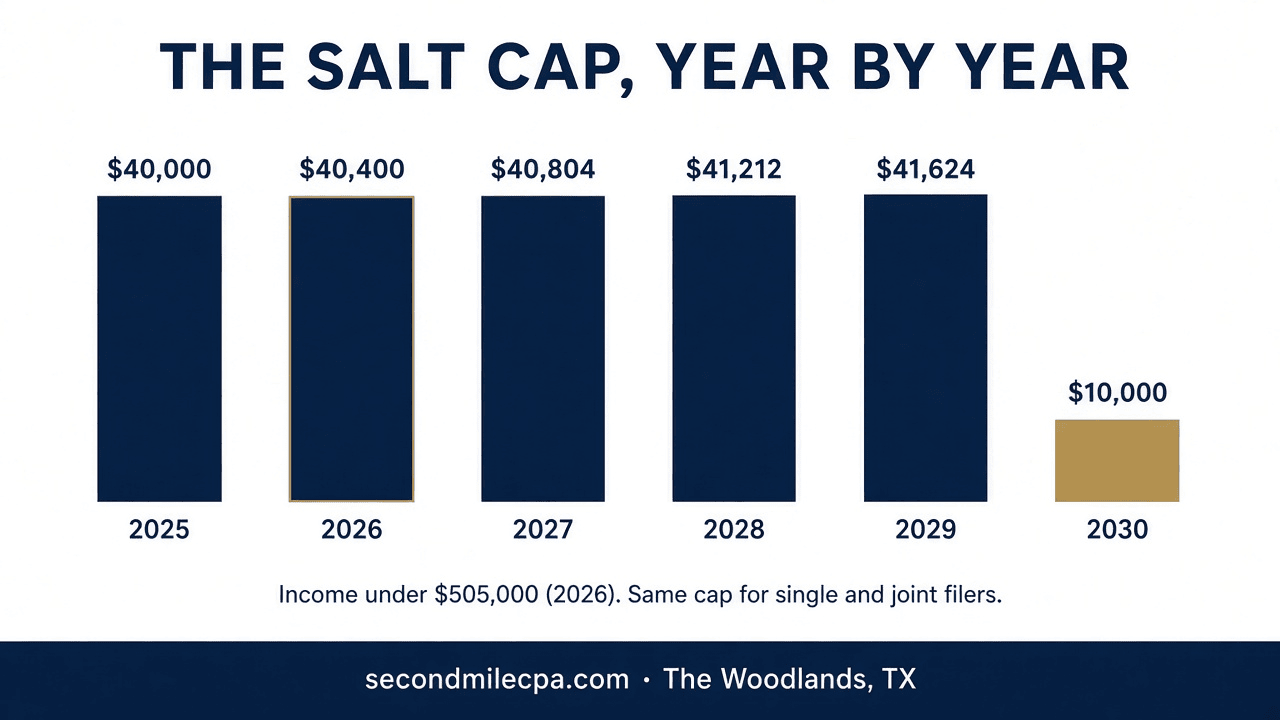
The numbers, year by year
| Tax year | SALT cap | Phase-down starts at MAGI | Cap at its lowest |
|---|---|---|---|
| 2025 | $40,000 | $500,000 | $10,000 |
| 2026 | $40,400 | $505,000 | $10,000 |
| 2027 | $40,804 | about $510,000 | $10,000 |
| 2028 | $41,212 | about $515,000 | $10,000 |
| 2029 | $41,624 | about $520,000 | $10,000 |
| 2030 on | $10,000 | no phase-down | $10,000 |
The cap is the same for single filers and married couples filing jointly. If you are married filing separately, every figure is cut in half: $20,200 for 2026, with the phase-down starting at $252,500.
What counts as SALT in Texas
Without a state income tax, a Texas household has two pieces to work with.
Property tax on your home. Your bill may include the county, the school district, a hospital district, a municipal utility district (MUD), an emergency services district, and in The Woodlands the Township. All of those are property taxes based on value, and all of them count. HOA assessments do not, even when they feel like a tax.
Sales tax, in place of income tax. Federal law lets you deduct either state and local income tax or state and local sales tax, not both. In Texas the choice makes itself. You can use your actual receipts, which almost nobody keeps, or the IRS optional sales tax table based on your income and household size, plus local rate.
The part people miss is the add-on. On top of the table amount, you can add the sales tax you paid on a car, truck, boat, aircraft, or a home or home building materials. Texas charges 6.25 percent motor vehicle sales tax, so a $90,000 pickup bought this year adds $5,625 to your SALT total.
One exception. If that truck is a business vehicle you depreciate, the sales tax goes into its cost basis and comes back through depreciation. You do not get it twice. (How that depreciation works is covered in Section 179 vs. bonus depreciation.)
The higher cap only matters if you itemize
This is where most of the excitement ends. The 2026 standard deduction is $32,200 for a married couple filing jointly and $16,100 for a single filer. Your SALT, mortgage interest, and charitable gifts together have to beat that number before the cap makes any difference at all.
Here is a Woodlands couple, filing jointly, with $300,000 of income:
| Under the old $10,000 cap | Under the 2026 cap | |
|---|---|---|
| Property tax | $14,000 | $14,000 |
| Sales tax (IRS table) | $3,000 | $3,000 |
| SALT allowed | $10,000 | $17,000 |
| Mortgage interest | $18,000 | $18,000 |
| Charitable gifts ($6,000, less the new 0.5% of AGI floor) | $4,500 | $4,500 |
| Total itemized | $32,500 | $39,500 |
| Above the $32,200 standard deduction by | $300 | $7,300 |
Under the old cap they were barely itemizing. Under the new one, they deduct $7,300 more than the standard deduction, which is worth about $1,750 at their 24 percent bracket.
A household with no mortgage and a $9,000 property tax bill gets nothing from any of this. They take the standard deduction, as they did before. That describes a lot of retirees who have paid off the house, and it is worth knowing before you plan around a deduction you will not use.
A note on charity, since it shows up in the table. Starting in 2026, itemizers can deduct only the part of their gifts above 0.5 percent of AGI. Non-itemizers, for the first time, can deduct up to $1,000, or $2,000 on a joint return, of cash gifts to a public charity. Gifts to a donor-advised fund do not count for that.
The December move: paying your 2026 property tax bill early
Texas taxing units start mailing property tax bills in October. Payment is due by January 31 and becomes delinquent February 1.
That gap gives you a choice most of the country does not have. Pay the 2026 bill by December 31, 2026, and it is a 2026 deduction. Pay it in January 2027, and it is a 2027 deduction. Same bill, same amount, different tax year.
The IRS rule is that a property tax is deductible in the year it is both assessed and paid. Your 2026 bill is assessed in 2026, so paying it in December is fine. What you cannot do is send extra money now for the 2027 bill, which has not been assessed yet.
If your mortgage company pays through escrow, you do not control the date. The deduction follows the date the servicer paid the tax office, not your monthly deposits. Check your escrow statement or Form 1098 before assuming which year it lands in.
Bunching: two bills in one year, the standard deduction the next
The December payment matters most when your itemized total sits close to the standard deduction. Take the same couple. Like many Texans, they paid their 2025 bill in January 2026.
Option A, one bill a year. They pay the 2026 bill in January 2027. Each year looks like the table above: $39,500 itemized in 2026 and roughly the same in 2027. Two-year total: about $79,000.
Option B, bunch. They pay the 2026 bill in December 2026, so two bills land in 2026.
2026: SALT of $31,000 (two bills plus sales tax, still under the cap), plus $18,000 interest and $4,500 charity, for $53,500 itemized.
2027: no property tax payment falls in the year, so itemizing drops to $25,500. They take the standard deduction instead, about $32,200 before the 2027 inflation adjustment, plus the new $2,000 deduction for cash gifts. Call it $34,200.
Two-year total: $87,700. That is $8,700 more in deductions than Option A, worth roughly $2,100 at a 24 percent rate. In 2028 they repeat it: pay the 2027 bill in January and the 2028 bill in December.
It works when four things are true. Two property tax bills plus sales tax fit under the cap. You have the cash to pay a second bill in one year. You itemize in the bunched year and come close to the standard deduction in the off year. And you are not paying through escrow, or your servicer will work with you on timing.
If you already itemize well above the standard deduction every year, bunching does very little. It moves the deduction from one year to another without adding to it.
Above $505,000: the phase-down
Once modified AGI passes $505,000, the cap is reduced by 30 cents for every dollar over the threshold. It never falls below $10,000.
For 2026, the cap reaches $10,000 at $606,333 of modified AGI. At $560,000, it is $23,900.
The effect inside that band is easy to miss. If your SALT is larger than the reduced cap, every extra dollar of income costs you tax on that dollar and also 30 cents of deduction. In the 35 percent bracket, that works out to about 45.5 percent on each extra dollar between $505,000 and roughly $606,000.
The same math works in reverse. A $20,000 pre-tax retirement contribution made by someone in that band saves about $9,100 instead of $7,000, because it lowers income and restores part of the SALT deduction at once. If you are near the threshold, the plan comparison in Business Retirement Plans: The Deduction You Keep is worth reading with this in mind.
Modified AGI here is your regular AGI plus any foreign earned income you excluded. For most of our clients the two are the same.
If you own a business: taxes that never touch the cap
The SALT cap applies to the personal itemized deduction. Taxes that belong to a business or a rental are deducted on that return instead, with no cap at all.
Property tax on business property. An office building, a shop, equipment subject to business personal property tax, or a rental house. These are deducted on Schedule C, Schedule E, or the business return.
Home office. If you use the regular method, the business share of your home’s property tax moves to Schedule C. With the simplified method, it stays on Schedule A under the cap.
Texas franchise tax. A business tax, deducted by the entity.
Income tax in other states. If your S-corp or partnership earns income in a state that has an income tax, most of those states now offer an elective pass-through entity tax. The entity pays the state tax and deducts it, outside the cap. The 2025 law left that route open.
Most owners never think about which return a tax belongs on. For someone in the phase-down, putting it in the right place can be worth more than the December payment.
Two cautions before you count the savings
The alternative minimum tax. SALT is not deductible for AMT purposes. For 2026, the AMT exemption is $140,200 for a joint return and starts to phase out at $1,000,000 of income. A large SALT deduction combined with other AMT items can bring some households back into AMT, which takes part of the benefit away. Run the AMT calculation before you write a large check in December.
The top bracket. Starting in 2026, itemized deductions for taxpayers in the 37 percent bracket are worth 35 cents on the dollar instead of 37. That is a small effect, and by that income level your SALT cap is already $10,000, but it belongs in the projection.
The year to circle: 2029
The higher cap is scheduled to run through 2029. In 2030 it drops to $10,000 for everyone.
That makes the 2029 bill worth thinking about now. Paid in December 2029, it is deductible under a $41,624 cap. Paid in January 2030, it competes for a $10,000 cap, and much of it may not be deductible at all. If you bunch, it is worth arranging the pattern so 2029 is a bunched year: the 2028 bill paid in January 2029 and the 2029 bill in December 2029.
Congress can change any of this before then. For now, plan on the law as written and revisit each fall.
Before December 31
- Check whether you itemize at all this year. Property tax, sales tax, mortgage interest, and charity against $32,200 joint or $16,100 single.
- Find your 2026 property tax bill. Note when you paid the 2025 bill. If it was January 2026, a December payment of the 2026 bill puts two bills in this year.
- If you pay through escrow, ask your servicer when they pay the tax office.
- Add up major purchases this year. A vehicle, a boat, or home building materials all add to the sales tax figure.
- If your income is near $505,000, look at retirement contributions before year-end. In that band they do double duty.
- If you own a business or rental, make sure each property tax bill is deducted on the right return.
- Run AMT before you prepay anything large.
Frequently asked questions
What is the SALT deduction cap for 2026?
$40,400 for single filers and married couples filing jointly, and $20,200 for married filing separately. The cap is reduced by 30 percent of modified AGI above $505,000 ($252,500 for married filing separately), but not below $10,000. It rises 1 percent a year through 2029 and returns to $10,000 in 2030.
Does the SALT deduction help if I live in Texas?
Yes, if you itemize. Texas has no state income tax, so the deduction is your property taxes plus your sales tax, either from receipts or from the IRS optional table, with sales tax on major purchases like a vehicle added on top. Households that take the standard deduction get no benefit from the higher cap.
Can I deduct my 2026 Texas property taxes if I pay them in December?
Yes. A property tax is deductible in the year it is both assessed and paid, and the 2026 bill is assessed in 2026. Texas bills are mailed starting in October and are due by January 31, so paying by December 31 makes it a 2026 deduction. You cannot deduct an advance payment toward 2027 taxes that have not been assessed. If you pay through escrow, the deduction follows the date the servicer paid.
Should I deduct sales tax or income tax?
In Texas, sales tax, because there is no state income tax. You can use actual receipts or the IRS optional sales tax table, and you can add sales tax paid on a car, truck, boat, aircraft, or home building materials. Texas motor vehicle sales tax is 6.25 percent. If the vehicle is used in your business and depreciated, the sales tax goes into its cost instead.
What happens to the SALT deduction if I earn more than $505,000?
The cap is reduced by 30 cents for every dollar of modified AGI over $505,000, down to a minimum of $10,000. For 2026 the cap reaches $10,000 at about $606,333. Inside that range, each extra dollar of income also reduces the deduction, so the effective tax rate on that income is higher than the bracket suggests.
Are business property taxes subject to the SALT cap?
No. Property taxes on business property or rental property are deducted on Schedule C, Schedule E, or the business’s own return and are not limited by the SALT cap. The business share of home property tax also moves to Schedule C if you claim a home office using the regular method.
The bottom line
In Texas, the higher SALT cap is a property tax and sales tax story. It helps homeowners who itemize, and it can help more if you time the December payment of your property tax bill on purpose rather than by habit.
It helps nobody who takes the standard deduction, and it starts to disappear above $505,000. Before you write a check in December, run the numbers both ways. It takes about twenty minutes with the right figures in front of you.
Get in touch and we will run your 2026 itemized deduction against the standard deduction, including whether paying your property tax bill in December or January comes out ahead.
Second Mile Financial Services is a licensed Texas CPA firm in The Woodlands, serving individuals and business owners across greater Houston and nationwide. Call (281) 826-0100 or email [email protected].
This article is general information, not individualized tax advice. Figures reflect 2026 law and inflation adjustments and may change. Discuss your specific situation with a qualified professional before acting.