
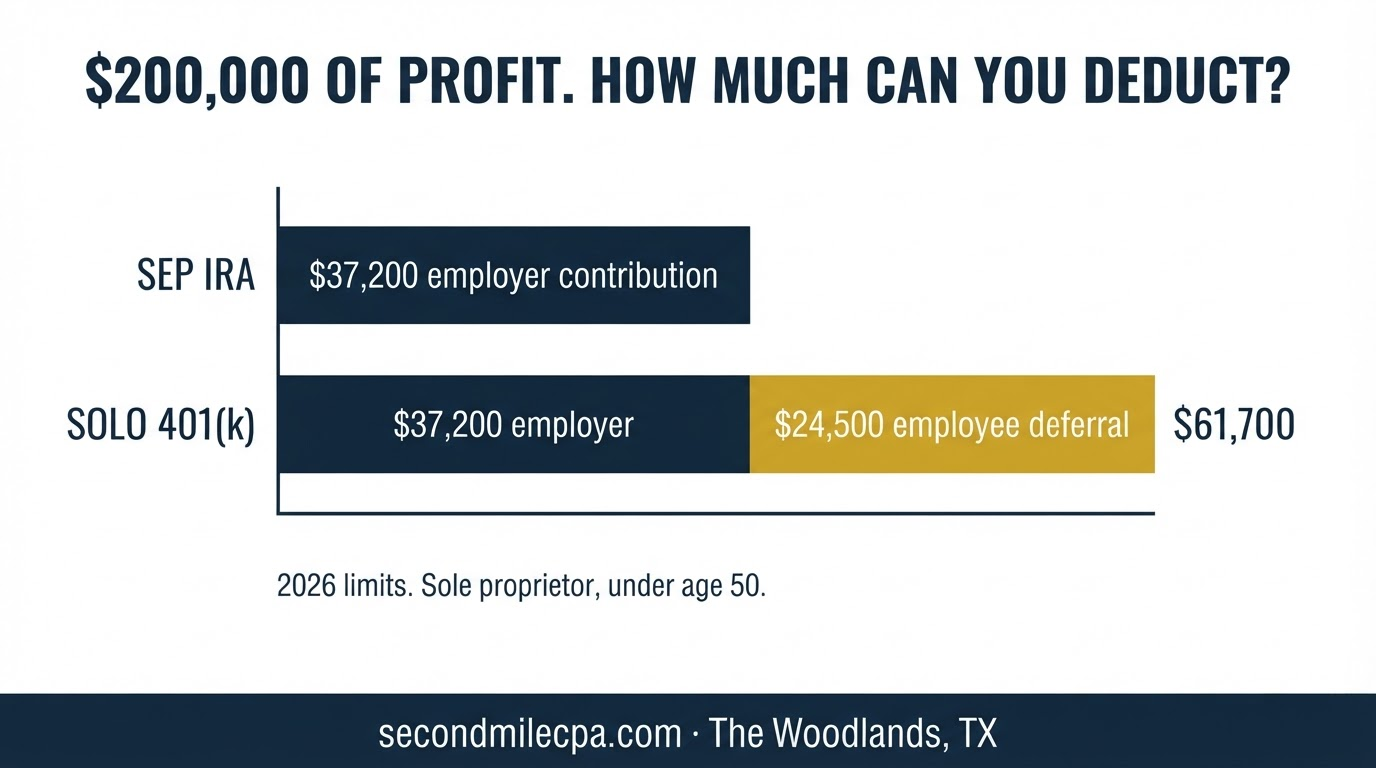
A retirement contribution is the only major business deduction where the money stays yours afterward. For 2026, a self-employed owner with $200,000 of net profit can deduct about $37,000 through a SEP IRA, or about $61,700 through a Solo 401(k), before any catch-up contribution.
Which plan fits depends on your income, your age, whether you have employees, and how your business is taxed. While most plans can now be set up after December 31, a few important pieces cannot.
Here is how the options compare, and what has to happen before the year closes.
Why this deduction is different
Every other write-off returns a fraction of money you spent and no longer have. Spend $50,000 on equipment, deduct $50,000, and you keep the tax on it. You are still down the $50,000.
A retirement contribution works the other way. The deduction reduces this year’s taxable income. The money goes into an account in your name, where it grows tax-deferred until you take it out.
Business owners skip it more than any other deduction I see. The reasons are usually the same. Operations take all the attention, and the business itself feels like the retirement plan. Sometimes it is. More often it is a large, illiquid bet on a single asset, which nobody would recommend to a client as their only plan.
The four plans that matter for most small businesses
| SEP IRA | Solo 401(k) | SIMPLE IRA | Cash balance / defined benefit | |
|---|---|---|---|---|
| Best fit | Simple, flexible, few or no employees | Owner-only business wanting the most room per dollar of income | Small business with employees wanting a low-cost plan | Consistently high profit, owner in their late 40s or older |
| How contributions work | Employer contribution only | Employee deferral plus employer contribution | Employee deferral plus required employer match or contribution | Actuarially set contribution to fund a target benefit |
| 2026 limits | Up to 25% of compensation, max $72,000 | $24,500 deferral plus employer contribution, max $72,000 combined | $17,000 deferral | Benefit up to $290,000 a year at retirement age |
| Age 50+ catch-up | None | $8,000; $11,250 at ages 60 to 63 | $4,000; $5,250 at ages 60 to 63 | Built into the calculation |
| Employees | Same percentage for every eligible employee | Owner and spouse only | Required contribution for eligible employees | Must cover eligible employees |
| Annual cost and paperwork | Minimal | Low; Form 5500-EZ once assets pass $250,000 | Low | Highest: actuary, annual funding, filings |
Two numbers in that table drive most decisions. The $24,500 employee deferral is what makes a Solo 401(k) more generous than a SEP at the same income. The $290,000 annual benefit limit is what lets a cash balance plan accept contributions far larger than any of the others.
SEP vs. Solo 401(k): the same income, very different totals
This is the comparison most self-employed owners need, so here it is with numbers.
A sole proprietor has $200,000 of net profit on Schedule C in 2026.
For a self-employed person, the employer contribution is calculated on net earnings after subtracting half of self-employment tax. The 25 percent rate works out to an effective 20 percent of that figure. Self-employment tax on $200,000 is about $28,200, so half is about $14,100, leaving about $185,900 of net earnings.
SEP IRA: 20 percent of $185,900 is about $37,200.
Solo 401(k): the same $37,200 employer contribution, plus a $24,500 employee deferral. Total about $61,700. At age 50 or older, add an $8,000 catch-up for about $69,700.
Same income, same business, about $24,500 more deductible room. The difference is the employee deferral, which a SEP simply does not have.
So why would anyone choose a SEP? Because it is the simplest plan available. It can be set up and funded entirely after the year ends. For owners whose income makes the employer contribution alone enough, the extra room in a Solo 401(k) does not matter. The Solo 401(k) also stops being available the moment you have a non-spouse employee who qualifies for coverage.
There is one more advantage to the Solo 401(k) for high-income owners planning a Backdoor Roth IRA. If you hold pre-tax money in any Traditional IRA, including a SEP IRA, the Pro-Rata Rule applies when you convert after-tax contributions to Roth. This creates an unexpected tax bill. A Solo 401(k) is not treated as an IRA for this purpose, so it keeps the Backdoor Roth strategy completely clean.
If you own an S-corp, the math changes
For S-corporation owners, contributions are calculated on your W-2 salary, not on the business’s profit. Distributions do not count.
With a $100,000 salary:
SEP IRA: 25 percent of salary, so $25,000.
Solo 401(k): $24,500 deferral plus $25,000 employer contribution, so $49,500.
That is a real interaction with the reasonable salary decision we wrote about in sole proprietor vs. S-corp. A lower salary saves employment tax but shrinks what you can put into a plan. A higher salary costs employment tax and opens more room. For owners who want to save aggressively, those two decisions should be made together.
There is one more point for S-corp owners with higher salaries. Starting in 2026, anyone whose wages from the employer exceeded $150,000 in the prior year has to make catch-up contributions as Roth, not pre-tax. The catch-up is still allowed. It just does not reduce this year’s taxes.
Cash balance plans: the largest deduction most owners have never heard of
For a business with consistent high profit and an owner in their late forties, fifties, or sixties, a cash balance plan can allow contributions well beyond what any SEP or 401(k) permits. For owners closer to retirement age, annual contributions in the six figures are common, often layered on top of a 401(k).
The contribution is not a percentage you choose. An actuary calculates it each year based on your age, your compensation, and the benefit the plan is designed to provide, within the limit of a $290,000 annual benefit at retirement age.
What you take on in exchange:
A funding obligation. The plan has to be funded every year. It is not a contribution you skip in a slow year without consequences.
Employee coverage. Eligible employees have to be included, which is part of the cost to model.
Real administration. An actuary, annual filings, and fees that run into the thousands of dollars a year.
A multi-year commitment. These plans are expected to run for several years, not one.
For the right owner, the deduction dwarfs the cost. For an owner with uneven income, it can become a burden in exactly the year cash is tight. This is a plan to model carefully, not to buy because the first-year number looks good.
The deadlines: fewer on December 31 than you think
A few years ago, most plans had to be signed by December 31 to count for that year. The SECURE Act changed that. Today, the deadlines look like this for tax year 2026:
| What | Deadline |
|---|---|
| SEP IRA: set up and fund | Your tax return due date, including extensions |
| New profit sharing, 401(k) employer contribution, or defined benefit plan: adopt | Your tax return due date, including extensions |
| Solo 401(k) employee deferral, sole proprietor, first year | Your tax return due date, without extensions (April 15, 2027 for most) |
| Solo 401(k) employee deferral, S-corp owner | Through payroll, by your last 2026 pay run |
| 401(k) deferrals for employees | Only on pay earned after the plan is in place |
| New SIMPLE IRA for 2026 | October 1, 2026. Passed. A new SIMPLE can start for 2027. |
For reference, return due dates for 2026: March 15, 2027 for S-corps and partnerships, extendable to September 15; April 15, 2027 for sole proprietors and C-corps, extendable to October 15.
The honest answer to “is it too late?” is usually no. But three things on that list do fall in 2026.
If you own an S-corp, your deferral has to run through payroll this year. The employee side of a Solo 401(k) comes out of your W-2 wages, and wages paid in 2026 are the only wages that count for 2026. That means the plan and your deferral election need to be in place before your last payroll of the year. This is the deadline I see missed most.
If you have employees, a new 401(k) only covers pay going forward. Employee deferrals cannot be made retroactively. A plan set up in March 2027 does nothing for 2026 deferrals.
If you wanted a SIMPLE for 2026, it is too late. The October 1 deadline has passed. Plan for 2027 now if that is the right fit.
And one more thing that is not a legal deadline but behaves like one. You need to know your 2026 numbers to choose well. The plan that makes sense depends on profit, salary, and how much cash you can commit. That is a fourth-quarter conversation, because it often affects what salary you run through payroll in December.
One interaction to know about: QBI
For sole proprietors and partners, contributions you make for yourself reduce your qualified business income. That reduces the Qualified Business Income deduction. In the $200,000 example, a $37,200 SEP contribution reduces the QBI deduction base by the same amount.
That does not make the contribution a bad idea. The deferral is still worth more than the QBI you give up in most cases. But it means the true tax saving is somewhat smaller than “contribution times tax rate,” and it is one of several reasons to model the plan with your actual numbers rather than a rule of thumb.
Which plan fits
Owner-only, wants simplicity, moderate savings: SEP IRA.
Owner-only, wants to save as much as possible relative to income: Solo 401(k).
S-corp owner: Solo 401(k), coordinated with your salary decision.
Small business with employees, wants a low-cost plan: SIMPLE IRA starting 2027, or a 401(k) if you want more room.
High, steady profit, owner in their late 40s or older: Look at a cash balance plan alongside a 401(k).
Before the year closes
- Estimate 2026 net profit, or your W-2 salary if you are an S-corp owner. Every limit keys off it.
- If you are an S-corp owner, decide now whether you want a Solo 401(k) deferral for 2026, because it has to run through your remaining payrolls.
- Compare the plans with your numbers, including the QBI effect.
- If you have employees, decide whether a SIMPLE for 2027 or a 401(k) makes more sense, and when it needs to be in place.
- If profit is high and steady, ask for a cash balance illustration. It takes an actuary a short time to produce one, and it tells you whether the conversation is worth having.
- Fund on time. SEP and employer contributions can wait until the return is filed, but a plan you meant to fund and did not is the most common way this deduction is lost.
Frequently asked questions
Is a Solo 401(k) better than a SEP IRA?
For most self-employed owners who want to save as much as possible, yes. A Solo 401(k) adds an employee deferral of up to $24,500 in 2026 on top of the same employer contribution a SEP allows. At $200,000 of net profit, that means about $61,700 of deductible contributions instead of about $37,200. A SEP is simpler and can be opened and funded entirely after year-end. A Solo 401(k) is only available when the owner and spouse are the only participants. Additionally, a Solo 401(k) avoids the Pro-Rata Rule, keeping the Backdoor Roth IRA strategy clean for high-income earners.
What are the 2026 contribution limits for small business retirement plans?
The 401(k) employee deferral limit is $24,500, with an $8,000 catch-up at age 50 and $11,250 at ages 60 to 63. Total contributions to a defined contribution plan such as a SEP or Solo 401(k) are capped at $72,000, not counting catch-ups. SIMPLE IRA deferrals are capped at $17,000. The defined benefit limit is an annual benefit of $290,000. Compensation above $360,000 is not counted.
Can I still set up a retirement plan for 2026 after December 31?
Usually yes. A SEP IRA, and new profit sharing or defined benefit plans, can be adopted up to the tax return due date including extensions. A sole proprietor setting up a first-year Solo 401(k) can make employee deferrals up to the return due date without extensions. The exceptions are S-corp owners, whose 401(k) deferrals must come out of 2026 payroll; employee deferrals in plans with staff, which cannot be retroactive; and new SIMPLE IRAs, which had to be established by October 1, 2026.
How much can I contribute to a cash balance plan?
The contribution is set by an actuary each year based on age, compensation, and the plan’s target benefit, which is limited to $290,000 a year at retirement age. For owners in their fifties and sixties with consistent high income, annual contributions in the six figures are common. The plan must be funded every year and must cover eligible employees, so it suits steady, high-profit businesses rather than uneven ones.
How do retirement contributions work for an S-corp owner?
Contributions are based on the owner’s W-2 salary from the S-corp, not on distributions or profit. With a $100,000 salary, a SEP allows $25,000 and a Solo 401(k) allows up to $49,500 in 2026. The employee deferral portion of a 401(k) must be withheld from wages paid during the year, so it has to be in place before the last payroll. Owners whose prior-year wages exceeded $150,000 must make any catch-up contributions as Roth.
Do retirement contributions reduce the QBI deduction?
For sole proprietors and partners, contributions to a retirement plan for the owner reduce qualified business income, which reduces the Qualified Business Income deduction. The net tax saving from the contribution is therefore somewhat smaller than the contribution times the marginal rate, though the contribution usually still comes out ahead.
The bottom line
The retirement contribution is the deduction you get to keep. It is also the one owners postpone most, usually for the reason that there is always next year.
For 2026, most of the deadlines are more forgiving than they used to be. A SEP or a new defined benefit plan can still be set up next spring. But if you own an S-corp and want a 401(k) deferral, or you want employee deferrals in a plan with staff, the window is the rest of this year’s payroll.
The right plan depends on your numbers. That is worth an hour now, while there is still payroll left to work with.
Get in touch and we will compare the plans against your actual income, salary, and goals, including the QBI effect, before your last payroll of the year.
Second Mile Financial Services is a licensed Texas CPA firm in The Woodlands, serving business owners across greater Houston and nationwide. Call (281) 826-0100 or email [email protected].
This article is general information, not individualized tax, legal, or investment advice. Retirement plan rules are detailed and limits change annually. Verify current figures and discuss your specific situation with a qualified professional before acting.