


Tax planning for a small business is a calendar, not a deadline. By the time a return is prepared in March or April, the decisions that shaped it were made months earlier. What you bought and when, what you paid yourself, what you put into a retirement plan, how the business was structured. Planning means looking at those decisions four times a year, while they can still change.
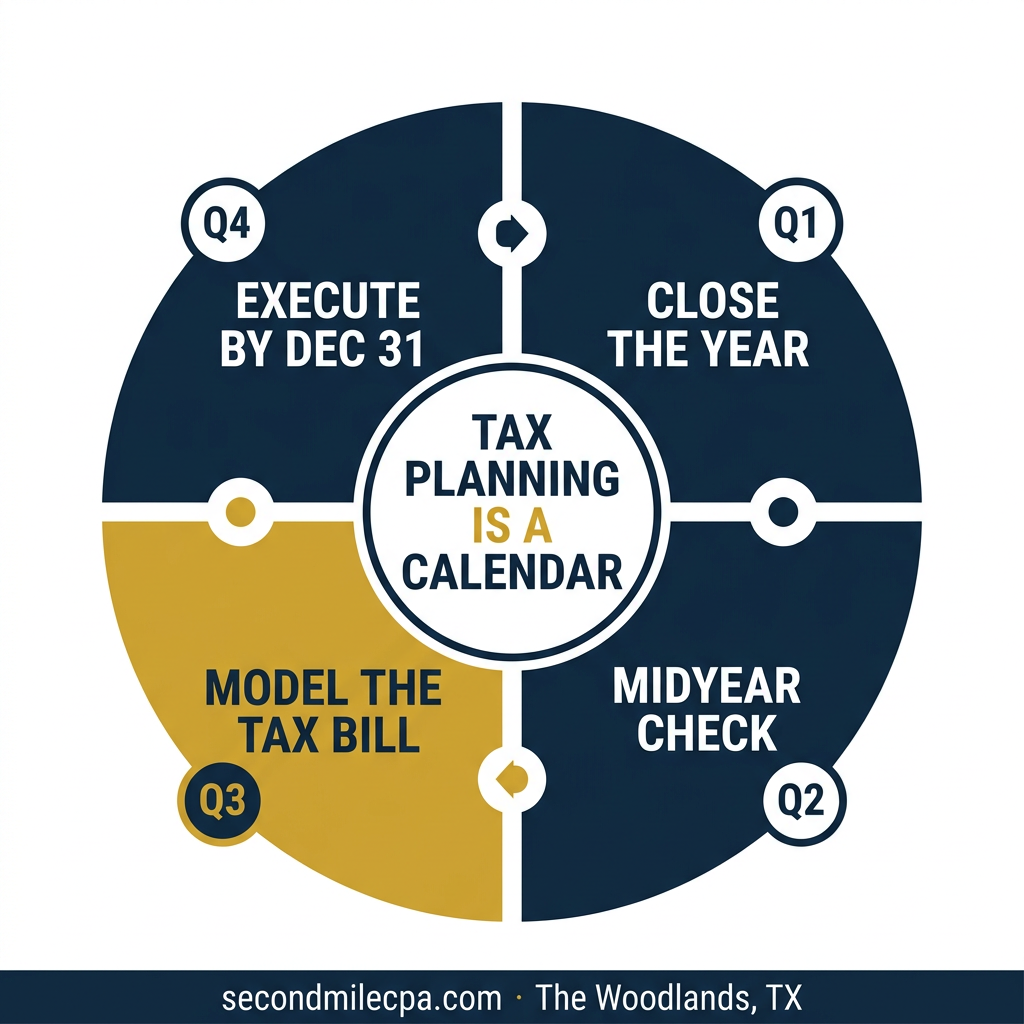
The first quarter closes the prior year. The second checks the course. The third models the tax bill. The fourth executes before December 31.
Most owners we meet in The Woodlands and across greater Houston talk to their accountant once a year, usually in the spring. That conversation is useful, but it is a report on a year that is already finished. Here is what the other three conversations are for, with the 2027 dates that anchor them and a short list of what still works this year.
Why April is a report, not a plan
When the calendar year closes, most of your tax result is fixed. The equipment was either placed in service or it was not. The salary either ran through payroll or it did not. The retirement contribution either came out of a paycheck or it did not. Your accountant in March is not planning anything. He is writing down decisions you already made, usually without him.
That is the first mistake in the five tax mistakes we see most, and it is the one that causes most of the others. The fix is not working harder in April. It is moving three of the conversations to other parts of the year.
If you are reading this in November 2026: what still works before December 31
The calendar below starts in January. If you are reading this before year-end, these are the 2026 moves that are still open, with the article that explains each one.
| Before December 31, 2026 | Why the date matters | Details |
|---|---|---|
| Place equipment and vehicles in service | Bonus depreciation is permanent, but the asset has to be in use by December 31 to count for 2026 | Bonus depreciation, Section 179 vs. bonus |
| S-corp owners: run 401(k) deferrals through payroll | Only wages paid in 2026 count for 2026 | Business retirement plans |
| S-corp owners: check salary and health insurance on the W-2 | Both have to be in 2026 payroll | Sole proprietor vs. S-corp, Missed deductions |
| Track qualified tips and overtime in payroll | The 2026 W-2 has new boxes, and the data has to exist | Tips and overtime, Payroll checklist |
| Decide when to pay your 2026 property tax bill | Paid in December it is a 2026 deduction, paid in January a 2027 one | SALT cap in Texas |
| Close on rental or commercial property, log your hours | The cost segregation study can wait. The purchase and the hours cannot | Cost segregation |
| Start a mileage log, set up an accountable plan | Records kept now beat records rebuilt in March | Missed deductions |
The fourth estimated tax payment for 2026 is due Friday, January 15, 2027.
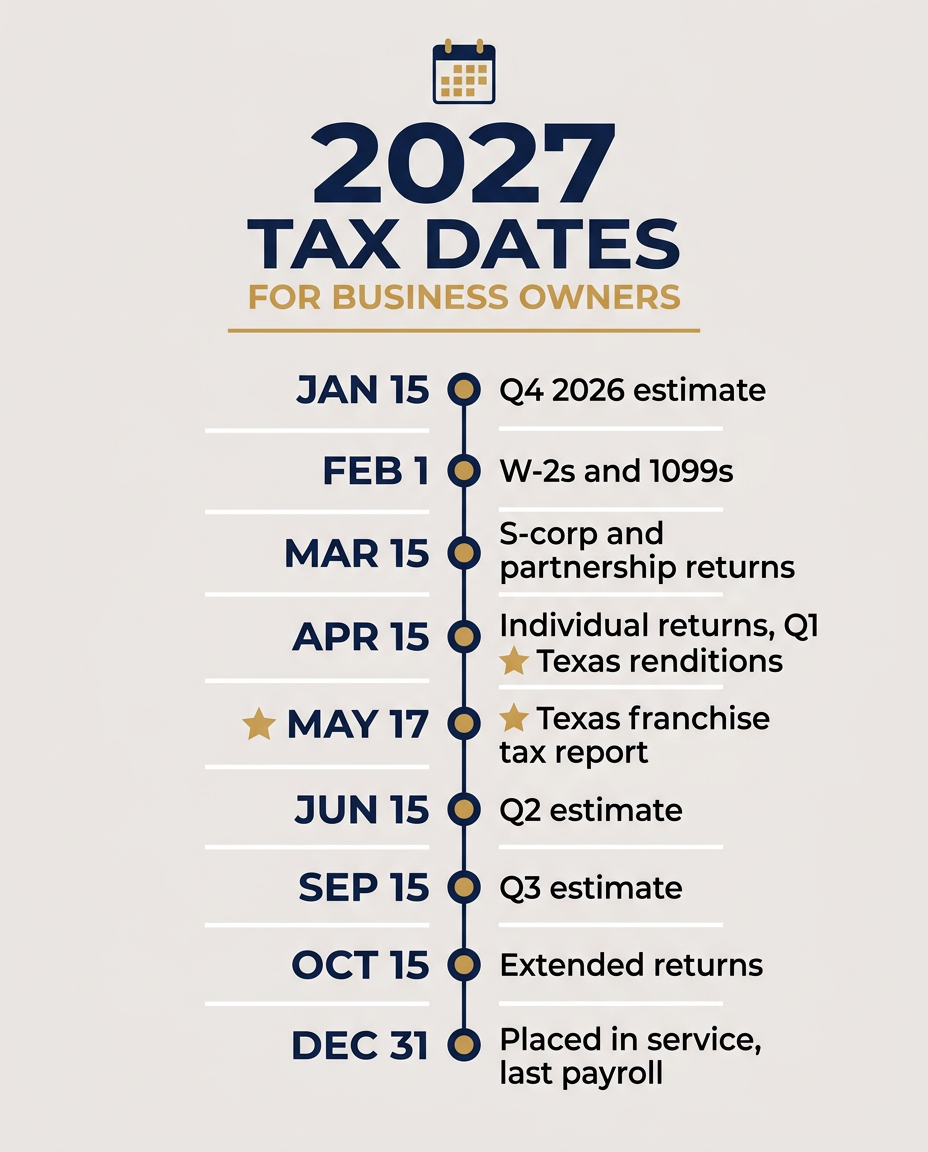
The 2027 dates that anchor the year
| Date | What is due |
|---|---|
| Fri, Jan 15, 2027 | Fourth-quarter 2026 estimated tax payment |
| Mon, Feb 1, 2027 | 2026 W-2s and 1099-NECs to workers and to the government (January 31 is a Sunday). Texas property tax for 2026 is still on time if paid that Monday |
| Mon, Mar 15, 2027 | S-corp and partnership returns for 2026, or extension. Form 2553 deadline for an S election effective for 2027 |
| Thu, Apr 15, 2027 | Individual and C-corp returns for 2026, or extension. First-quarter 2027 estimated tax. Last day for 2026 IRA and HSA contributions. Texas business personal property renditions due to the appraisal district |
| Mon, May 17, 2027 | Texas franchise tax report (May 15 is a Saturday). Most Texas property value protests are due around May 15, or 30 days after your appraisal notice, whichever is later |
| Tue, Jun 15, 2027 | Second-quarter 2027 estimated tax |
| Wed, Sep 15, 2027 | Third-quarter 2027 estimated tax. Extended S-corp and partnership returns |
| Fri, Oct 1, 2027 | Last day to set up a new SIMPLE IRA for 2027 |
| Fri, Oct 15, 2027 | Extended individual and C-corp returns |
| Fri, Dec 31, 2027 | Placed-in-service date for 2027 assets. Last 2027 payroll for S-corp owner deferrals and salary |
| Tue, Jan 18, 2028 | Fourth-quarter 2027 estimated tax (January 15 is a Saturday and January 17 is Martin Luther King Jr. Day) |
Two of those are easy to forget because they are not IRS dates. Texas businesses file a franchise tax report every year, even when no tax is due. For 2026 reports, no tax was due below $2.65 million of revenue, but the entity still had to file a Public Information Report or Ownership Information Report. If your business owns equipment, furniture, or inventory, the appraisal district expects a rendition by April 15. You can request an extension to May 15 in writing.
Prefer the whole year on one page?
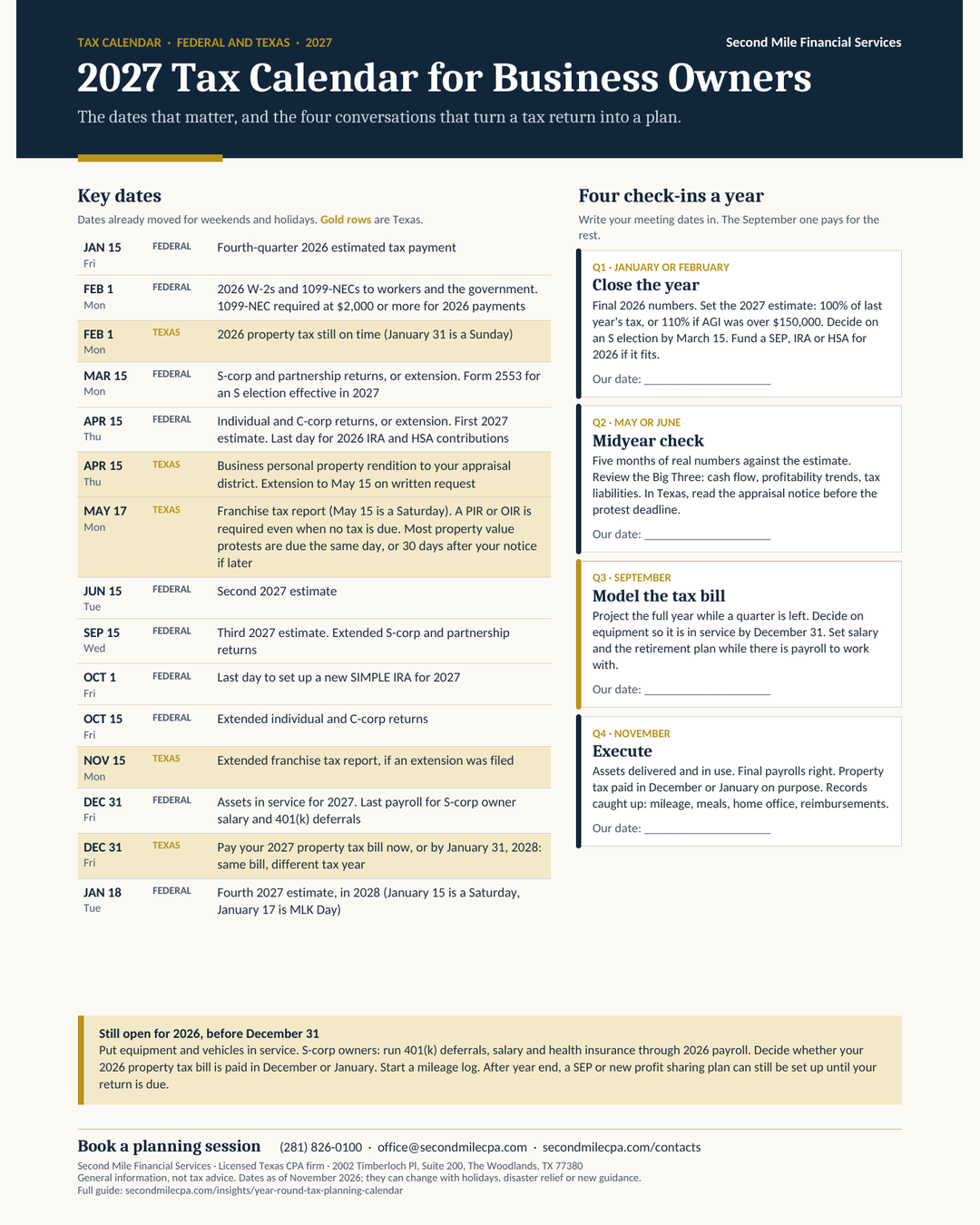
Download the printable 2027 TaxCalendar for Business Owners ➚. Every federal and Texas date from the table above, already moved for weekends and holidays, with the Texas rows marked in gold. Alongside it, the four planning check-ins each get a blank line for your meeting date. Print it, hang it where payroll and purchasing decisions get made, and write the dates in.
Quarter 1: close the year and set the baseline
January through March is about finishing 2026 cleanly and setting up 2027 so it can be planned at all.
Close the books. Every planning conversation later in the year depends on knowing where you actually stand. If the books are three months behind in April, the June conversation is a guess. If you are not sure your books are reliable, start here.
File the information returns. W-2s and 1099-NECs go out by February 1. For payments made in 2026, a 1099-NEC is required at $2,000 rather than the old $600.
Use what is still open for 2026. A SEP IRA can be opened and funded for 2026 up to the extended due date of your return. So can a new profit sharing or defined benefit plan. IRA and HSA contributions for 2026 can be made up to April 15. Elections that belong on the return, such as electing out of bonus depreciation on a class of property, are made when it is filed.
Make the structure decision. If 2026 showed that an S election makes sense, the deadline to elect for 2027 is March 15. Sole proprietor vs. S-corp walks through where that line is.
Set the 2027 estimate. The simplest safe approach for most owners is to pay at least 100 percent of last year’s total tax through estimates and withholding, or 110 percent if last year’s adjusted gross income was over $150,000. That protects you from an underpayment penalty even if 2027 turns out much bigger.
Quarter 2: the midyear check
April through June is the quarter most owners skip, because the return just got filed and nobody wants to think about taxes again.
That is exactly why it is useful. By the end of May you have five months of real numbers. The question for this meeting is simple: is the year turning out the way the estimate assumed?
We look at what we call the Big Three: cash flow, profitability trends, and tax liabilities. If profit is running well ahead of last year, the estimates need to go up now, not in January. If it is running behind, you may be overpaying. Either way, you want to know in June.
This is also the quarter for Texas property. Appraisal notices arrive in April and May, and the protest deadline is usually May 15. A business that owns real estate or files a rendition should look at both with the same attention it gives to the federal return.
Quarter 3: model the tax bill
July through September is where real planning happens. You have most of the year’s data and enough time left to act on it.
Project the full year. Take actual results through the summer, add a realistic estimate for the fall, and calculate what the full-year tax bill will be. Without that number, every other decision is made blind.
Decide on equipment. If you are going to buy, this is when to decide, so delivery and installation happen before December. The deduction depends on the date an asset is placed in service, not the date it is ordered or paid for. Bonus depreciation is now permanent, so the question is no longer whether to buy before it expires. It is which year you actually need the deduction in.
Review salary and structure. For S-corp owners, this is the time to check that your salary is reasonable and that it is the right number for your retirement contributions. Both are much easier to adjust over five remaining months of payroll than over one.
Choose the retirement plan. Most plans can be set up after year-end now, but an S-corp owner’s 401(k) deferrals have to come out of this year’s paychecks. Deciding in September gives you a full quarter of payroll to work with.
Quarter 4: execute before December 31
October through December is not for deciding. It is for doing what the third quarter decided.
- Assets delivered, installed, and in use before December 31
- Final payroll runs reflecting the right salary, retirement deferrals, and, for S-corp owners, health insurance on the W-2
- Property tax paid in December or January on purpose, not by habit
- Records caught up: mileage, meals, home office, reimbursements
- Charitable giving decided with the new 2026 rules in mind. Itemizers now lose the first 0.5 percent of AGI, and non-itemizers can deduct up to $1,000, or $2,000 on a joint return, of cash gifts to a public charity
- The fourth estimate, due in mid-January, set from the projection
If the third-quarter conversation happened, the fourth quarter is calm. If it did not, December is when most of the expensive mistakes get made, usually in a hurry.
What still works after December 31
Less than people hope, more than nothing.
| Still possible after year-end | Deadline |
|---|---|
| Open and fund a SEP IRA for 2026 | Return due date, with extensions |
| Adopt a new profit sharing or defined benefit plan for 2026 | Return due date, with extensions |
| Sole proprietor’s first-year Solo 401(k) deferrals | Return due date, without extensions |
| IRA and HSA contributions for 2026 | April 15, 2027 |
| Commission a cost segregation study on property placed in service in 2026 | Before the return is filed |
| Elections made on the return (for example, electing out of bonus depreciation for a class of property) | With a timely filed return |
| S election for 2027 | March 15, 2027 |
| Amend a prior return when something was missed | Generally three years from filing |
What cannot be fixed after December 31: wages and deferrals that did not run through 2026 payroll, assets that were not in service, payments that were not made, and records that were not kept at the time.
What a planning year looks like in practice
Four meetings. Not long ones.
| When | Meeting | What you leave with |
|---|---|---|
| January or February | Year-end close | Final 2026 numbers, 2027 estimate, structure decision |
| May or June | Midyear check | Updated projection, estimate adjustments if needed |
| September | Planning session | Full-year tax projection, decisions on equipment, salary, retirement |
| November | Execution check | A short list of what has to happen before December 31 |
Each one is easier because the one before it happened. The September meeting is the one that pays for the rest.
Frequently asked questions
When should a small business do tax planning?
Throughout the year, with the most important work in the third quarter. A useful rhythm is four check-ins: closing the prior year in January or February, a midyear review in May or June, a full-year projection in September, and an execution check in November. By the time a return is prepared in the spring, most of the year’s tax result is already fixed.
What are the estimated tax due dates for 2027?
For the 2027 tax year: April 15, 2027, June 15, 2027, September 15, 2027, and January 18, 2028, because January 15, 2028 falls on a Saturday and the following Monday is Martin Luther King Jr. Day. The last payment for 2026 is due January 15, 2027.
What tax moves can I still make after December 31?
A SEP IRA and new profit sharing or defined benefit plans can be set up and funded for 2026 up to the return due date, including extensions. IRA and HSA contributions for 2026 can be made until April 15, 2027. Some elections are made on the return itself, and a cost segregation study can be done after year-end. What cannot be changed is anything that had to happen in 2026: payroll, assets placed in service, and payments.
When are 2026 W-2s and 1099s due?
February 1, 2027, both to workers and to the government, because January 31 falls on a Sunday. For payments made in 2026, a Form 1099-NEC is required when you paid a contractor $2,000 or more, up from $600.
When is the Texas franchise tax report due in 2027?
The report is due May 15 each year. In 2027 May 15 falls on a Saturday, so the deadline moves to Monday, May 17. Businesses below the no-tax-due threshold, which was $2.65 million of revenue for 2026 reports, still have to file a Public Information Report or Ownership Information Report.
How often should I meet with my CPA?
For a profitable small business, four times a year is a good rhythm, with the September meeting being the most valuable. A once-a-year meeting in the spring is tax preparation, not tax planning. It records decisions after they were made.
The bottom line

The return you file next spring will describe 2026. The planning for 2027 starts in January, and the conversation that changes the result happens in September, when there is still a quarter left to act.
If 2026 has been a year of looking at taxes only in April, the fix is simple. Put four dates on the calendar for 2027 and keep them.
Get in touch to set up a planning session. We will go through what can still be done before December 31, 2026, and lay out the four check-ins for 2027.
Second Mile Financial Services is a licensed Texas CPA firm in The Woodlands, serving business owners across greater Houston and nationwide. Call (281) 826-0100 or email [email protected].
Not ready to book a session yet? Start with the one-page 2027 Tax Calendar ➚ and put the four dates on the wall today.
*This article is general information, not individualized tax advice. Deadlines can change because of holidays, disaster relief, or new guidance. Confirm current dates and discuss your situation with a qualified professional before acting.