


As a sole proprietor, self-employment tax applies to your entire net business income. An S-corporation splits that income into a reasonable salary, which carries employment tax, and a distribution, which does not. The savings are real and they recur every year. So do the costs of running the entity, and below a certain profit level the costs win.
There is a crossover point. It depends on your profit, your reasonable salary, your employee situation, and a Qualified Business Income interaction that most articles skip entirely. Here is how to find yours.
What you are actually paying now
Self-employment tax is 15.3%, made up of 12.4% for Social Security and 2.9% for Medicare. It applies to 92.35% of your net business profit.
For 2026, the Social Security portion applies to net earnings up to $184,500. Above that, only the 2.9% Medicare portion continues, with an additional 0.9% Medicare tax on earnings above $200,000 for single filers and $250,000 for joint filers.
That wage base matters more than most owners realize, and we will come back to it, because it bends the savings curve in a way that surprises people.
Run a business with $180,000 of net profit as a sole proprietor and the self-employment tax is roughly $25,400. That sits on top of income tax, not instead of it. You do get to deduct half of it against income, which softens the blow, but the cash still leaves.
What changes in an S-corp
The business pays you a salary, which runs through payroll and carries the usual employment taxes. Whatever profit remains after that salary can be distributed to you as an owner, and distributions do not carry Social Security or Medicare tax.
Same total money to you. Different treatment on part of it.
Here is what that looks like at four profit levels, using a reasonable salary that would be defensible in a typical owner-operated service business. Your own salary figure will differ, and that is the whole ballgame, which we get to next.
| Net profit | SE tax as sole proprietor | Salary | Employment tax on salary | Difference |
|---|---|---|---|---|
| $60,000 | $8,478 | $40,000 | $6,120 | $2,358 |
| $120,000 | $16,955 | $65,000 | $9,945 | $7,010 |
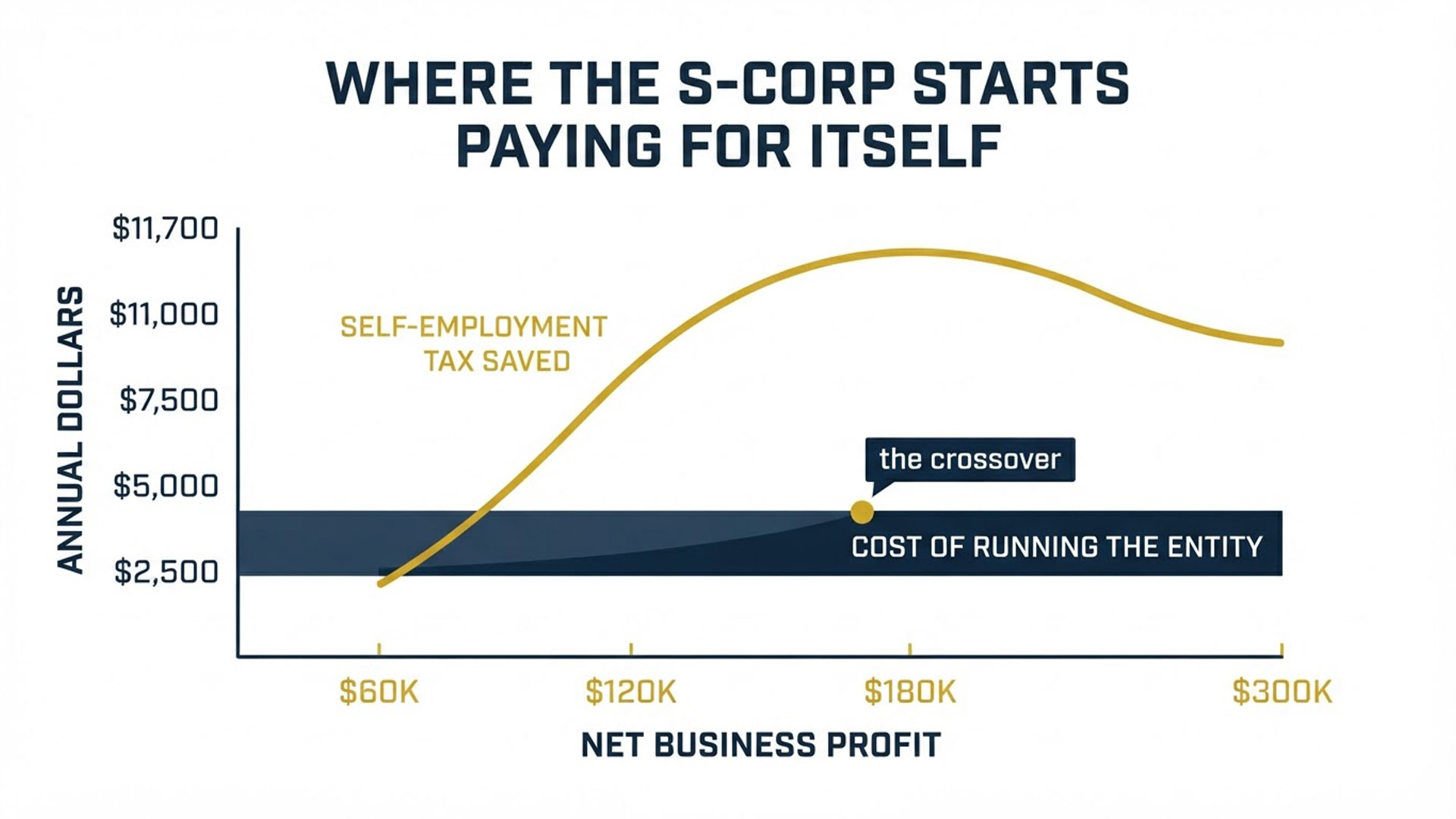
| $180,000 | $25,433 | $90,000 | $13,770 | $11,663 |
| $300,000 | $30,912 | $140,000 | $21,420 | $9,492 |
Look at the last row carefully, because it is the part almost nobody mentions.
The savings do not keep growing with profit. They peak and then decline. Once your net earnings pass the Social Security wage base, additional profit is only carrying the 2.9% Medicare portion, so there is far less tax to move out of. Meanwhile a defensible salary at that income level is higher in absolute terms, which carries the full 15.3% up to the wage base.
For a business well above the wage base, the entity decision stops being primarily about self-employment tax and starts being about retirement plan design, fringe benefits, and eventual sale. Those are good reasons. They are different reasons.
Reasonable salary is where owners get into trouble
The distribution side of the split is tax-advantaged, so the temptation is obvious: pay yourself a small salary, take the rest as distributions.
The law requires the salary to be reasonable compensation for the work you actually perform. This is a facts-and-circumstances test, not a formula, and it looks at your duties, your hours, your experience, what the business would have to pay someone else to do your job, what comparable positions pay in your market, and what the business can support.
Two things worth saying plainly.
This is examined. Reclassification of distributions as wages is a well-established adjustment, and it arrives with back employment taxes, interest, and penalties. A salary that would embarrass you to defend is not a strategy.
There is no safe percentage. You will see 50/50 and 60/40 quoted as rules. They are not rules. They are averages that happened to hold in some cases, and an average is not a defense. The defensible number comes from comparable compensation data for your role, your market, and your hours, documented at the time you set it rather than reconstructed later.
The numbers in the table above use roughly half of profit as salary because it makes the arithmetic readable. Treat it as illustration, not guidance.
The costs, honestly
An S-corp is not free, and the recurring costs are what determine the crossover.
Payroll. You now have to run it, file quarterly employment tax returns, issue a W-2, and remit on schedule. A payroll service handles this for a few hundred to somewhat over a thousand dollars a year depending on frequency and features.
A separate return. Form 1120-S, plus a K-1 to you, plus the interaction with your personal return. This costs more than adding a Schedule C to a 1040, typically by four figures.
Higher bookkeeping standards. Basis tracking, an accountable plan for reimbursements, distributions recorded properly, payroll reconciled to the general ledger. Books that were adequate for a Schedule C often are not adequate here.
Unemployment taxes. Federal and state, on your own wages now that you are an employee.
Texas franchise tax. This one is local and gets missed by national articles. A sole proprietorship owned by a natural person is not subject to the Texas franchise tax. An LLC or corporation is. Most small businesses fall under the no-tax-due revenue threshold and owe nothing, but the entity is now inside a regime it was previously outside of, and that has administrative consequences.
Your own time. Payroll deadlines do not move because you are busy.
Add it up and the realistic all-in recurring cost for a small owner-operated S-corp runs from roughly $2,500 to $5,000 a year, depending on complexity and who does the work.
Put that against the savings column in the table and the shape becomes clear. At $60,000 of profit, saving $2,358 against $2,500 to $5,000 of cost is a net loss. At $120,000, saving $7,010 against the same costs is clearly worth doing. Somewhere between those two, for most owner-operated businesses, sits the crossover.
The QBI interaction that changes the answer
This is the part that gets left out of nearly every article on this question, and it can reverse the conclusion.
The Qualified Business Income deduction lets eligible owners deduct up to 20% of qualified business income. The One Big Beautiful Bill Act made it permanent, which finally makes it sensible to structure around rather than treat as a two-year bet.
For 2026 the taxable income thresholds are $201,750 for single filers and $403,500 for joint filers. The phase-in ranges above those thresholds were widened to $75,000 and $150,000 respectively. There is also a new minimum deduction of $400 for taxpayers with at least $1,000 of qualified business income from an active business.
Here is the interaction. Wages you pay yourself are not qualified business income. Every dollar you move from distribution to salary reduces the base your QBI deduction is calculated on.
Below the threshold, where the wage limitation does not apply, that is pure loss. You save self-employment tax on the distribution and you give back part of a 20% deduction on the salary. The net can still be positive, but it is smaller than the self-employment arithmetic alone suggests, and for some owners it flips negative.
Above the threshold, the calculation inverts. The deduction becomes limited by reference to W-2 wages paid by the business, and now having wages on the books helps rather than hurts. An owner above the threshold with no W-2 wages can lose the deduction entirely.
So the honest summary is this. Below the QBI threshold, converting to an S-corp costs you part of your QBI deduction. Above it, having W-2 wages may be what preserves the deduction. That is not a detail. For businesses near the threshold it is the deciding factor, and it has to be modeled with your actual numbers rather than reasoned about in the abstract.
Service businesses have an additional layer, because specified service trades and businesses face their own phase-out of the deduction entirely above the threshold. That deserves its own treatment and gets it in a separate article.
Three situations where converting is the wrong move
We tell owners not to convert more often than you might expect from a firm that would be paid to do the conversion. The common cases:
Profit is not there yet, and is not obviously coming. If net profit is under roughly $60,000 to $80,000 and stable, the costs eat the savings. Revisit it when profit moves, not before.
The business income is irregular. Payroll is a fixed obligation. A business with genuinely lumpy profit, where a bad year is a real possibility, takes on a commitment that does not flex. That matters more than the tax arithmetic in a downturn.
Most of the profit is not from your labor. If profit comes largely from capital, equipment, or the work of employees rather than your personal services, the reasonable salary is lower, which is good, but the whole framing of the decision changes and other structures may fit better.
There is also a timing consideration. An S-corporation election has filing deadlines, and a mid-year conversion brings its own complications with payroll and basis. This is a decision that belongs in the third or fourth quarter, planned for the following year, not one made in April while a return is being prepared.
What to actually do
- Get your books to a state you trust. The whole calculation runs on net profit. If that number is unreliable, so is everything downstream of it. Here is how to tell whether yours can be trusted.
- Project this year’s net profit and next year’s, honestly.
- Establish a defensible salary figure from comparable compensation data, before modeling anything. This number drives the result.
- Calculate the self-employment tax saving at that salary, remembering the wage base.
- Calculate the QBI effect in both structures. This step is the one most commonly skipped and the one most likely to change the answer.
- Add the real recurring costs, including the ones specific to Texas.
- Compare over three years, not one. Conversion has one-time costs and recurring benefits, so a single-year view understates it.
- If the answer is close, wait. A marginal conversion is a lot of new obligation for very little money.
Frequently asked questions
At what income does an S-corp start making sense?
For most owner-operated service businesses the crossover falls somewhere between roughly $60,000 and $100,000 of net profit, but that range is a starting point rather than an answer. The actual point depends on your defensible reasonable salary, the recurring cost of running the entity in your situation, and the effect on your Qualified Business Income deduction. Two businesses with identical profit can land on opposite sides of the line.
How much does an S-corp actually save on self-employment tax?
The saving equals the employment tax you would have paid on the profit you now take as a distribution rather than salary. At $180,000 of net profit with a $90,000 salary, that is roughly $11,700 in 2026. The saving peaks and then declines as profit rises well past the Social Security wage base of $184,500, because income above that level only carries the 2.9% Medicare portion.
What is a reasonable salary for an S-corp owner?
Reasonable compensation for the services you actually perform, judged on your duties, hours, experience, what the business would pay someone else to do your job, comparable market pay, and what the business can support. There is no safe percentage, and the 50/50 and 60/40 figures commonly quoted are averages rather than rules. The defensible approach is to document comparable compensation data at the time you set the salary.
Does an S-corp reduce my QBI deduction?
It can. Wages are not qualified business income, so salary you pay yourself reduces the base the deduction is calculated on. Below the 2026 taxable income thresholds of $201,750 for single filers and $403,500 for joint filers, that is a straight cost that partly offsets the self-employment tax saving. Above the thresholds the calculation inverts, because the deduction becomes limited by reference to W-2 wages, and having wages can be what preserves it.
Do I have to pay Texas franchise tax as an S-corp?
The entity becomes subject to the Texas franchise tax regime, unlike a sole proprietorship owned by a natural person, which is outside it. Most small businesses fall under the no-tax-due revenue threshold and owe nothing, but the filing and administrative obligations change. This is a routine part of the conversion rather than an obstacle, and it is one of several Texas-specific items national comparisons omit.
Can I switch back if it does not work out?
Revoking an S-election is possible, but it is not a decision to make casually. There are consequences for timing, for basis, and there are restrictions on re-electing S status afterward for a period of years. The practical answer is to model the decision carefully enough that reversing it does not come up.
The bottom line
An S-corporation does not save you taxes in general. It saves employment tax on the portion of profit you take as a distribution rather than salary, and it costs you real money every year to maintain.
At low profit, the costs win. At moderate profit, the savings win clearly. At high profit, the savings flatten and the reasons to incorporate shift to retirement plan design and eventual exit. Underneath all of it, the Qualified Business Income interaction can move the line in either direction depending on which side of the threshold you sit on.
None of that can be settled by a rule of thumb. It takes an hour with your actual numbers.
Get in touch and we will run the crossover for your business, including the QBI effect and the Texas-specific costs. If the answer is that you should stay a sole proprietor for now, we will tell you that, and we will tell you what would have to change for the answer to flip.
Second Mile Financial Services is a licensed Texas CPA firm in The Woodlands, serving businesses across greater Houston and nationwide. Call (281) 826-0100 or email [email protected].