

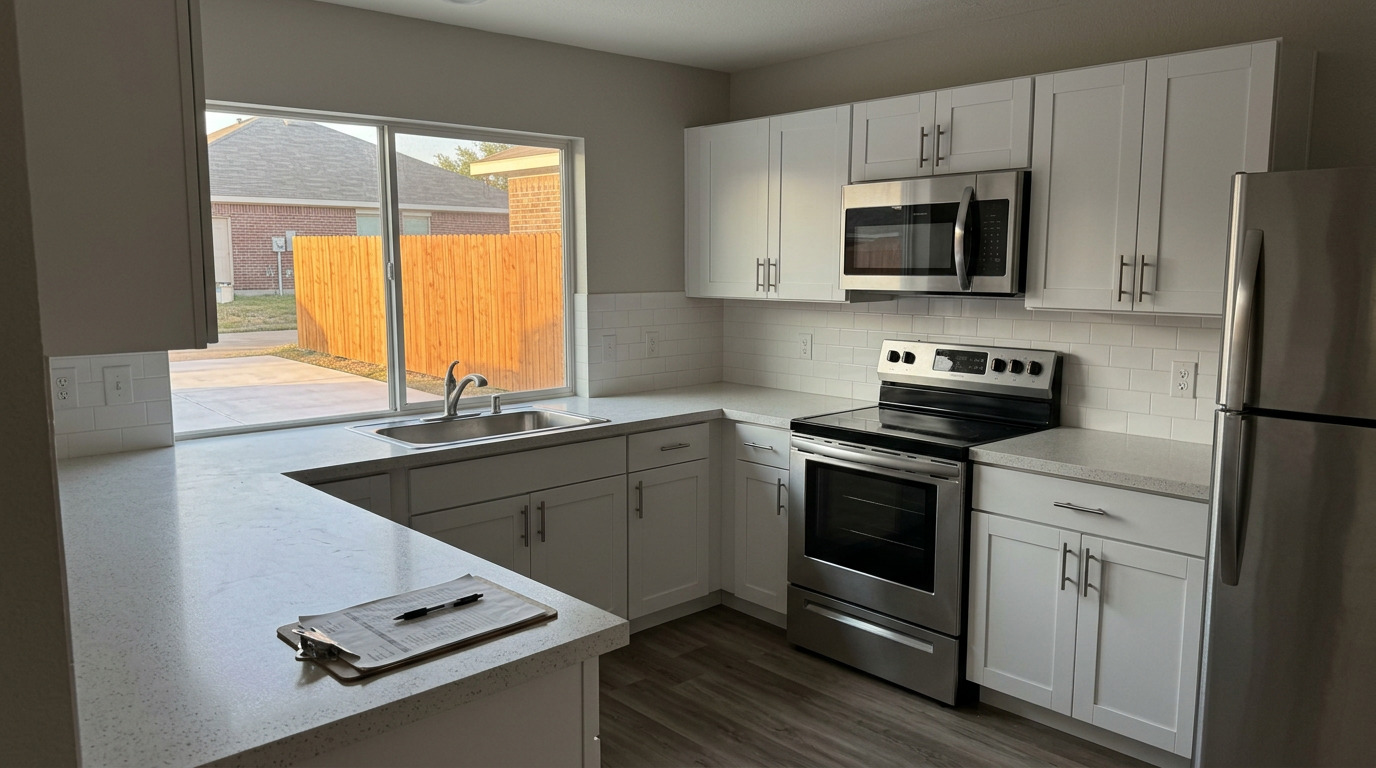
On a residential rental, a kitchen or bathroom remodel is generally depreciated over 27.5 years, the same as the building. It does not qualify for bonus depreciation. What you can write off in the year it goes into service includes true repairs, small costs covered by the safe harbors, appliances, carpet and furniture, and land improvements such as driveways, fences, and landscaping.
On commercial property the rules are friendlier. Improvements to the interior of a nonresidential building are 15-year property and qualify for 100 percent bonus depreciation.
That difference surprises a lot of landlords, including some who have been told that 100 percent bonus depreciation covers “improvements” in general. It covers some of them. Here is how to tell which, how to split a project so you deduct what you can this year, and what to keep in the file. We see these questions constantly from rental owners in The Woodlands and across greater Houston, where a lot of single-family rentals are owned by people who also run a business.
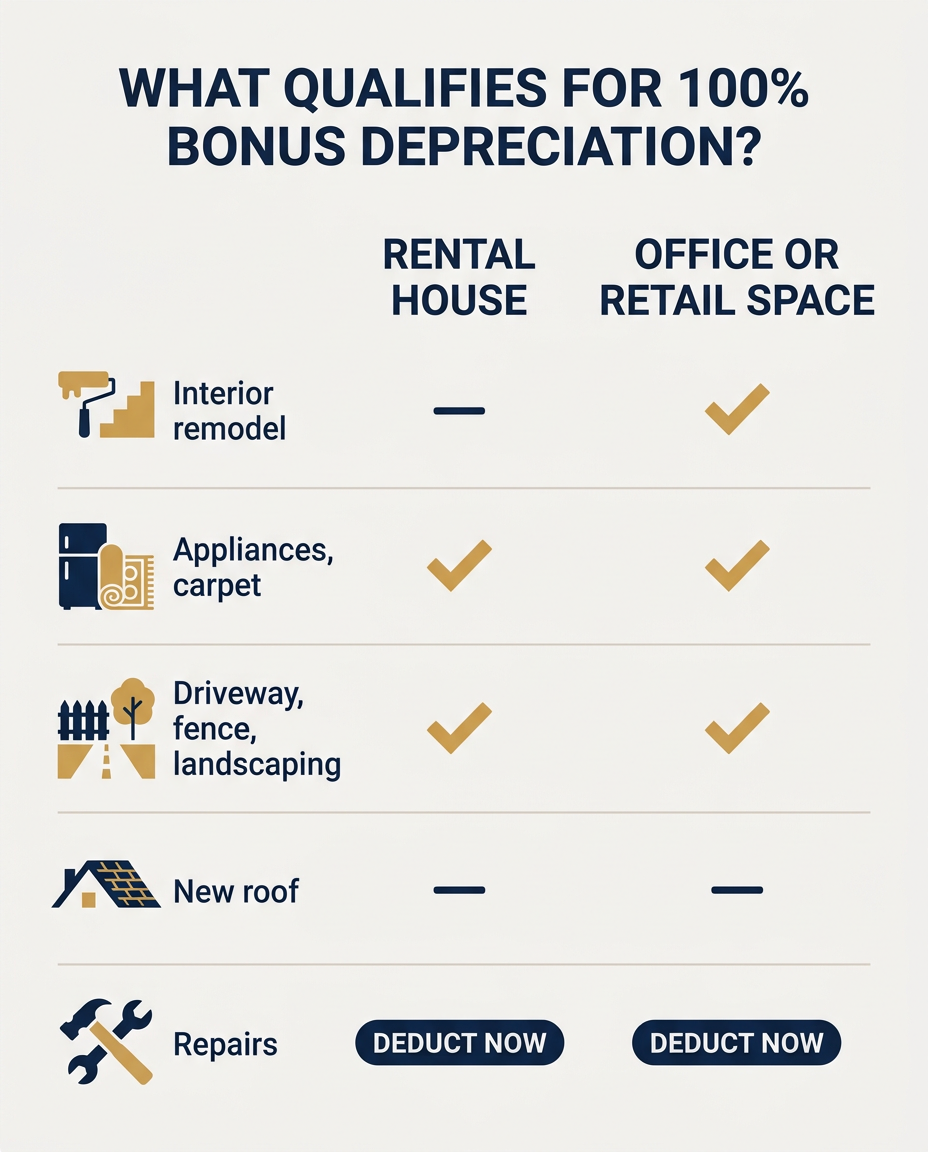
The short answer, by type of work
| Work on the property | Residential rental | Commercial (nonresidential) |
|---|---|---|
| Repair that keeps it in working order | Deduct this year | Deduct this year |
| Kitchen or bathroom remodel, flooring other than carpet, new interior walls | 27.5 years, no bonus | Interior improvement: 15 years, 100% bonus |
| New roof, windows, siding, HVAC | 27.5 years, no bonus | 39 years, no bonus (Section 179 may apply) |
| Appliances, carpet, furniture | 5 years, 100% bonus | 5 or 7 years, 100% bonus |
| Driveways, sidewalks, fences, landscaping, parking areas | 15 years, 100% bonus | 15 years, 100% bonus |
| Building addition | 27.5 years, no bonus | 39 years, no bonus |
The reason for the split is simple. Bonus depreciation only applies to property with a recovery period of 20 years or less. A residential rental building is 27.5-year property, and almost anything that becomes part of the building takes on the same life. Interior improvements to a commercial building were given their own 15-year life, which is why they qualify.
First question: is it a repair or an improvement?
Before depreciation matters at all, decide whether the cost is a repair. A repair is deductible in full this year, with no depreciation schedule and no bonus rules.
The IRS test is whether the work is a betterment (fixes a defect that existed when you bought it, enlarges, or materially upgrades), a restoration (replaces a major component or returns something to working order after it was out of service), or an adaptation to a new use. If it is none of those, it is generally a repair.
- Patching a section of roof after a storm: repair. Replacing the whole roof: improvement.
- Fixing a leaking pipe: repair. Re-plumbing the house: improvement.
- Repainting between tenants: repair. Repainting as part of a full remodel: part of the improvement.
- Replacing a broken window: repair. Replacing every window with an upgraded model: improvement.
Three safe harbors make the line easier for small landlords.
Routine maintenance. Work you reasonably expect to do more than once every ten years on a building, such as repainting or servicing the HVAC, can be deducted even if it would otherwise look like an improvement.
De minimis. Items costing $2,500 or less per item or per invoice can be expensed if you elect it each year on your return and have the policy in place at the start of the year.
Small taxpayer safe harbor. If your average gross receipts are $10 million or less and the building’s unadjusted basis is $1 million or less, you can elect to deduct all repairs, maintenance, and improvements on that building for the year, as long as the total does not exceed the lesser of $10,000 or 2 percent of the building’s unadjusted basis. A $400,000 rental house has an $8,000 limit. The election is made each year, building by building.
Residential rentals: split the project before it starts
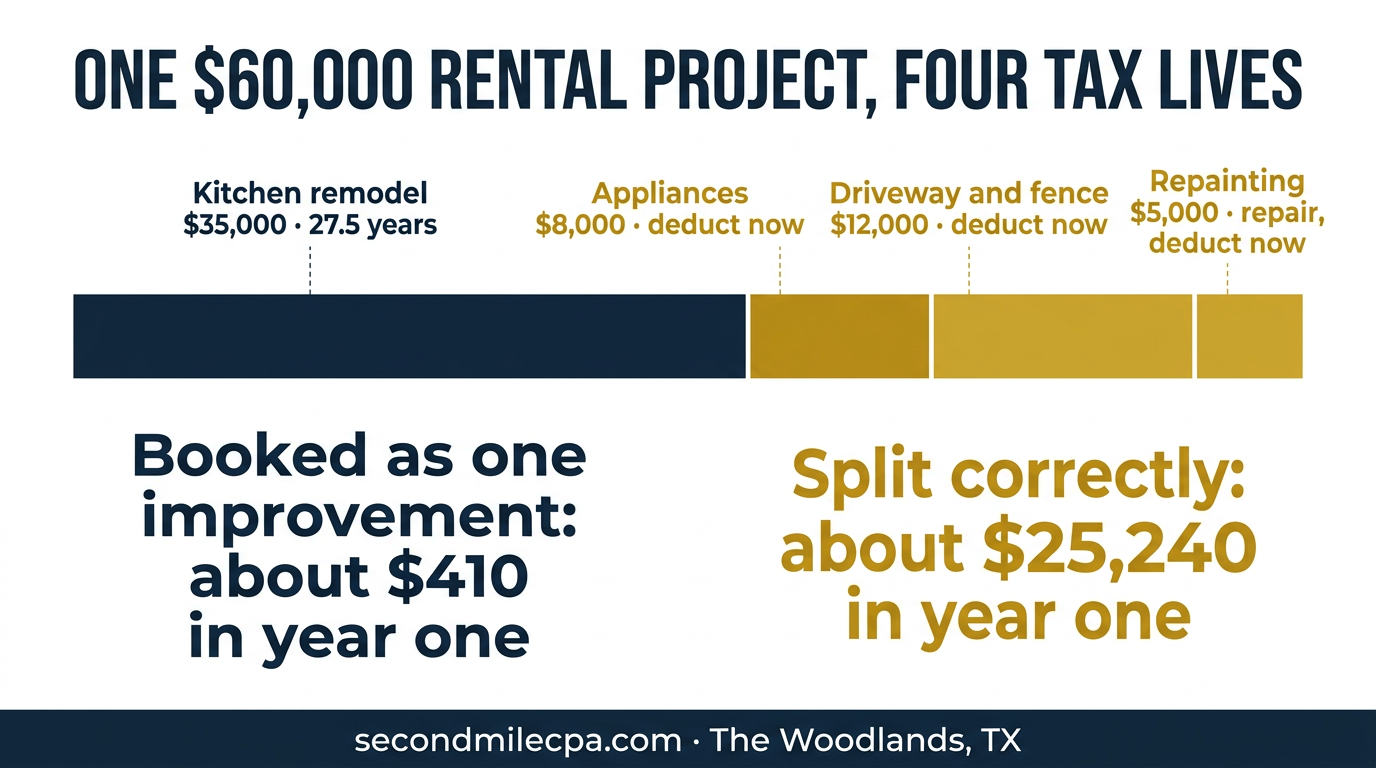
Most remodels are not one thing. They are several things with different tax lives, sitting on one contractor’s invoice. Take a $60,000 project on a rental house that goes back into service in October:
| Part of the project | Cost | Treatment | First-year deduction |
|---|---|---|---|
| Kitchen remodel: cabinets, counters, tile, plumbing | $35,000 | 27.5 years | about $240 |
| New appliances | $8,000 | 5 years, 100% bonus | $8,000 |
| New driveway and fence | $12,000 | 15 years, 100% bonus | $12,000 |
| Interior repainting between tenants | $5,000 | Repair | $5,000 |
| Total | $60,000 | about $25,240 |
Booked as one $60,000 improvement, the same project would produce about $410 of depreciation in its first year. Split correctly, it produces about $25,240. Nothing aggressive happened. The pieces were simply put where they belong.
The practical step is on the invoice. Ask the contractor to itemize appliances, flooring by type, and exterior site work separately. Reconstructing that split a year later from a single lump-sum bill is where most of the value gets lost.
If you have a lot of capital tied up in a building you already own, a cost segregation study does the same exercise for the whole property, identifying the 5-, 7-, and 15-year components inside what was booked as a 27.5-year building.
Land improvements: the category most landlords overlook
Land itself is never depreciable. Improvements to land are, and they are 15-year property that qualifies for 100 percent bonus depreciation on residential and commercial properties alike.
That includes driveways, sidewalks, parking areas, fences, retaining walls, landscaping and shrubbery, outdoor drainage, and site lighting. On a rental house, a new driveway and fence are often the largest items you can deduct in full this year, and they are routinely lumped into the building by default.
Commercial property: build-outs and qualified improvement property
If you own a commercial building, or you are a tenant who paid for your own build-out, the interior is where the opportunity is.
Qualified improvement property is any improvement to the interior of a nonresidential building made after the building was first placed in service. It is 15-year property and qualifies for 100 percent bonus depreciation. That covers new walls and partitions, ceilings, interior doors, lighting, flooring, and restrooms in an office, retail space, or restaurant, with no limit on the size of the project.
Three things are excluded: enlarging the building, elevators and escalators, and the internal structural framework. And the rule only applies to nonresidential buildings. Improvements to an apartment building or a rental house are not qualified improvement property, however similar the work looks.
For commercial buildings, Section 179 can also cover roofs, HVAC, fire protection, and security systems, which bonus depreciation cannot. Section 179 has its own limits for landlords, so it is worth checking before you count on it.
When you replace something, write off what you removed
When you put on a new roof, the old roof is still sitting on your depreciation schedule as part of the building. Unless you do something about it, you keep depreciating a roof that no longer exists for the rest of the 27.5 years.
The partial disposition election fixes that. In the year you replace the component, you can treat the old one as disposed of and deduct its remaining undepreciated cost. On a building held for ten or fifteen years, that can be a meaningful number. The election has to be made on a timely filed return for the year of the replacement, so it belongs in the conversation when the work is done, not two years later.
Where it shows up, and whether you can use it
For a rental you own personally, the depreciation goes on Schedule E. In a partnership or S-corp, it goes on the entity’s return and flows through to you. The depreciation rules are the same whether the property is a rental or used in your own business.
Being able to take the deduction is a different question from being able to use it. Rental losses are passive for most owners, and if your income is above $150,000 and you do not qualify as a real estate professional, a large first-year deduction may be suspended and carried forward. That is covered in detail in the cost segregation article, and it applies here the same way.
One more caution for short-term rental owners. A property rented mostly for short stays may not be classified as residential rental property at all, which can change the recovery period and the bonus answer. That is a facts-and-circumstances question worth settling before the project, not after.
Before December 31
- Get the work finished and the unit ready to rent. A rental improvement is placed in service when it is ready and available for its use, not when the invoice is paid.
- Ask for an itemized invoice separating appliances, carpet, other flooring, interior work, and exterior site work.
- Separate repairs from improvements in your records, with a short note on what each was for.
- If you replaced a roof, HVAC, or other component, note what was removed so the partial disposition election can be made.
- For each building, check whether this year’s total repair and improvement spending fits under the small taxpayer safe harbor.
- Take before-and-after photos. They are the simplest proof of what was repaired and what was replaced.
Frequently asked questions
Can I deduct a bathroom or kitchen remodel on a rental property?
Not all at once if it is a residential rental. A remodel that becomes part of the building is generally depreciated over 27.5 years and does not qualify for bonus depreciation, because bonus only applies to property with a recovery period of 20 years or less. Parts of the project can be written off sooner: appliances and carpet are 5-year property eligible for 100 percent bonus depreciation, and genuine repairs are deductible in the year paid.
Do land improvements qualify for bonus depreciation?
Yes. Land improvements such as driveways, sidewalks, parking areas, fences, landscaping, and outdoor drainage are 15-year property and qualify for 100 percent bonus depreciation on both residential and commercial properties. The land itself is never depreciable.
What is qualified improvement property?
Qualified improvement property is an improvement to the interior of a nonresidential building made after the building was first placed in service. It has a 15-year recovery period and qualifies for 100 percent bonus depreciation. It excludes enlargements, elevators and escalators, and the internal structural framework, and it does not include improvements to residential rental property.
What is the difference between a repair and an improvement on a rental?
A repair keeps the property in ordinary working condition and is deductible in the year paid. An improvement is a betterment, a restoration, or an adaptation to a new use, and has to be depreciated. Patching a roof is a repair, while replacing the roof is an improvement. Safe harbors let small landlords deduct routine maintenance, items under $2,500, and, for buildings with a basis of $1 million or less, up to the lesser of $10,000 or 2 percent of basis in total yearly spending.
Is a new roof on a rental property deductible?
A full roof replacement is an improvement, not a repair, and is depreciated over 27.5 years on a residential rental or 39 years on a commercial building. On a commercial building, Section 179 may allow a faster deduction. In either case, the partial disposition election lets you deduct the remaining undepreciated cost of the old roof in the year it is replaced.
When is a rental improvement placed in service?
When the improved property is ready and available for rent, not when the invoice is paid or the work is ordered. A remodel finished and ready for a tenant in December counts for that year even if the unit is not leased until January.
The bottom line
100 percent bonus depreciation is real, and it is permanent. It just does not reach everything a landlord spends money on. On a residential rental, the remodel itself stays on the 27.5-year schedule, while the appliances, the carpet, the driveway, the fence, and the true repairs can come off this year’s income.
The difference between those outcomes is usually decided before the work starts, on the contractor’s invoice and in how the costs are recorded. That is the conversation worth having now, while there is still time to finish projects in 2026.
Get in touch before you sign off on a project, and we will tell you which parts can be deducted this year and how to document them.
Second Mile Financial Services is a licensed Texas CPA firm in The Woodlands, serving property owners and business owners across greater Houston and nationwide. Call (281) 826-0100 or email [email protected].
*This article is general information, not individualized tax advice. Depreciation classification depends on the facts of each property and project. Discuss your situation with a qualified professional before acting.