


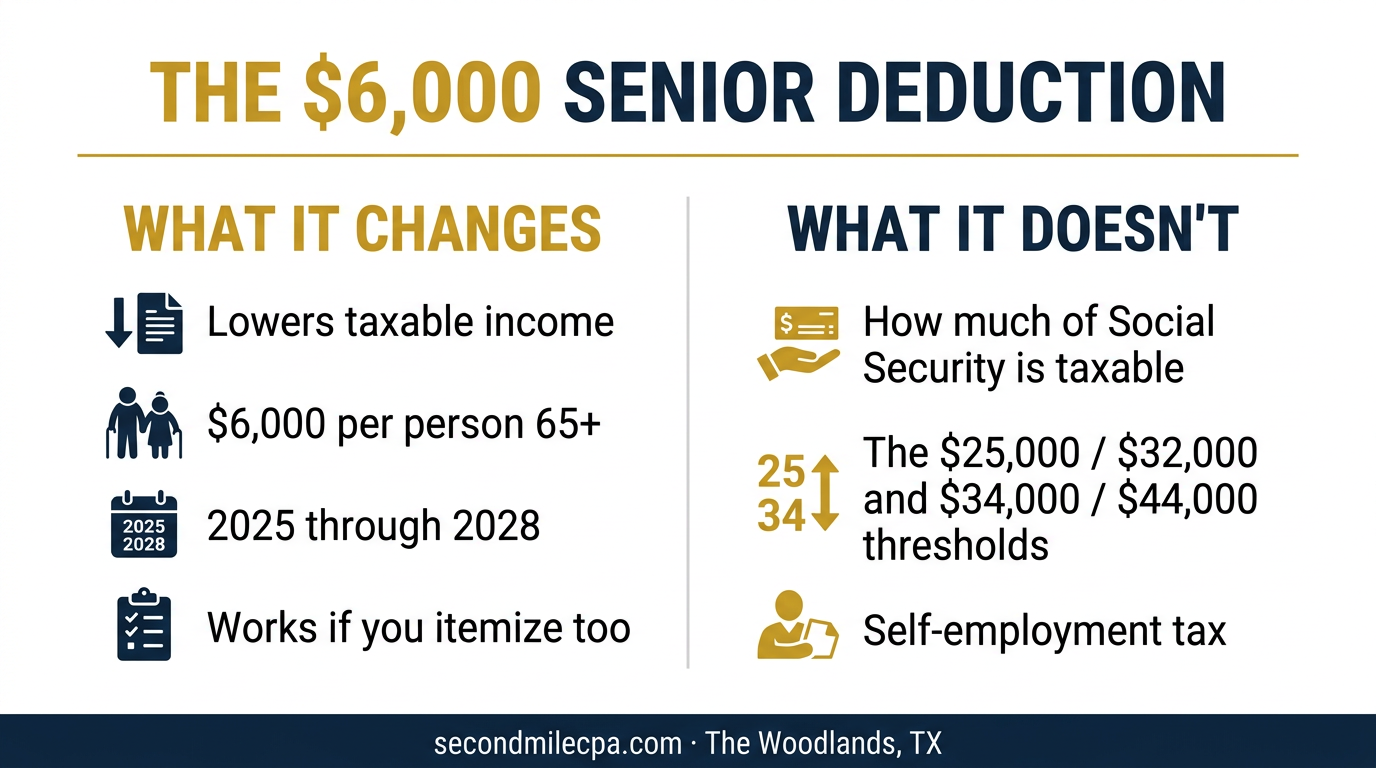
For tax years 2025 through 2028, anyone 65 or older can deduct an extra $6,000, or $12,000 for a married couple when both spouses are 65 or older. It comes on top of the standard deduction or your itemized deductions, and it shrinks by 6 percent of modified adjusted gross income above $75,000 ($150,000 on a joint return).
What it does not do is change how Social Security is taxed. The formula that decides how much of your benefit is taxable is exactly what it was. The new deduction lowers the tax on your income, including the taxable part of your benefits, which for many retirees works out to a smaller bill. But not a tax-free check.
That distinction matters for planning. In The Woodlands, where a lot of our clients are retired or close to it, the questions we hear are practical ones: how much IRA money can I take out this year, should I convert to a Roth, and does selling the rental now ruin the deduction? The answers all start with how the pieces fit together.
How Social Security is actually taxed
Social Security benefits are taxed based on a number most retirees have never heard of: provisional income. It is your adjusted gross income without Social Security, plus any tax-exempt interest, plus half of your Social Security benefits.
| Provisional income | Single | Married filing jointly | Taxable share of benefits |
|---|---|---|---|
| Below the first threshold | under $25,000 | under $32,000 | None |
| Between the thresholds | $25,000 to $34,000 | $32,000 to $44,000 | Up to 50% |
| Above the second threshold | over $34,000 | over $44,000 | Up to 85% |
Those thresholds were set in 1983 and 1993 and have never been adjusted for inflation. That is why most retirees with any IRA or pension income pay tax on part of their benefits, and why none of it changed in 2025. The most that can ever be taxable is 85 percent of your benefit.
What the new deduction does
It reduces taxable income. That is all, and it is worth a lot.
| Who | 2026 deductions available | Total |
|---|---|---|
| Single, 65 or older | $16,100 standard + $2,050 additional for age + $6,000 senior | $24,150 |
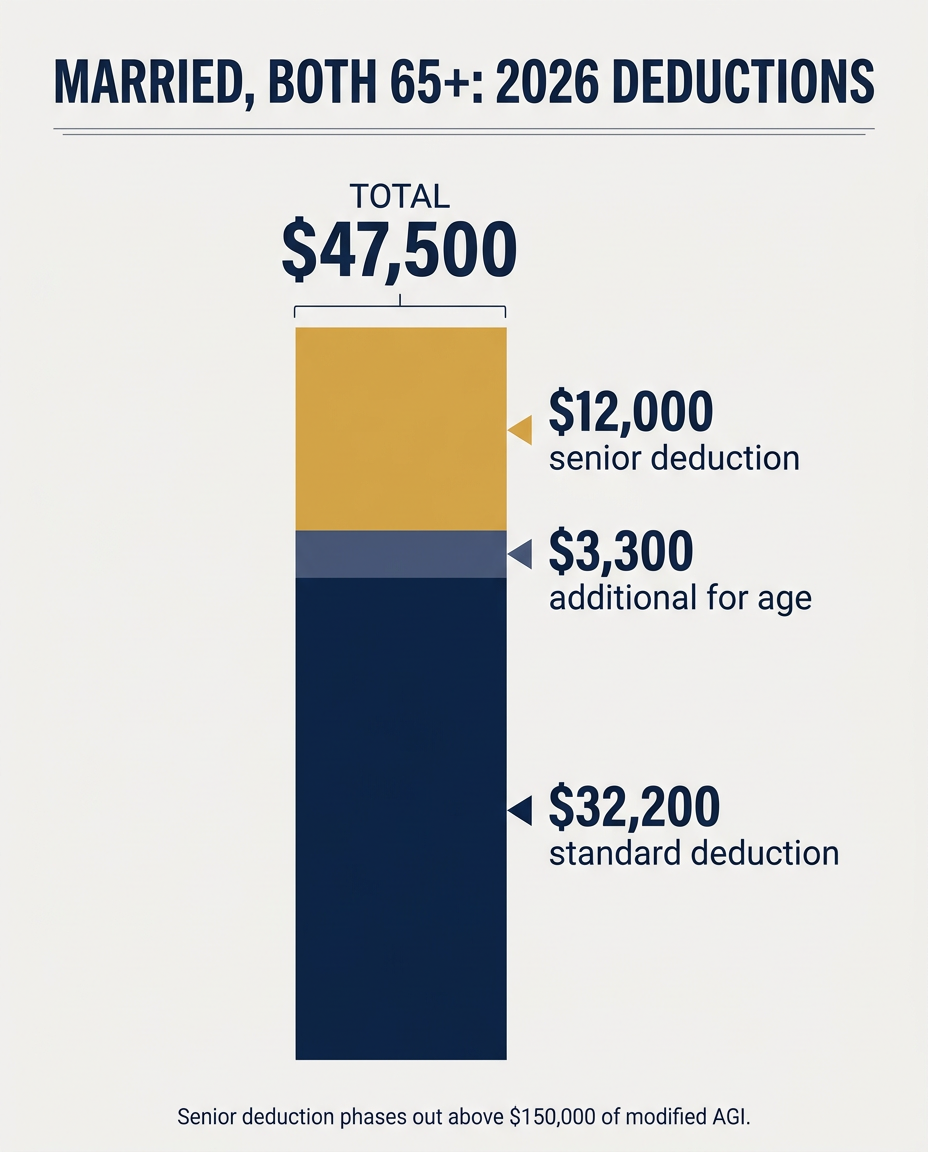
| Married, both 65 or older | $32,200 standard + $3,300 additional for age + $12,000 senior | $47,500 |
The senior deduction is separate from the older additional standard deduction for age, and you get both. Unlike the standard deduction, it is also available if you itemize. You need a valid Social Security number, and married couples have to file jointly.
Here is a married couple, both 67, with $48,000 of combined Social Security, $40,000 of IRA withdrawals, and $5,000 of interest for 2026.
Provisional income: $40,000 + $5,000 + half of $48,000 = $69,000
Taxable Social Security under the unchanged formula: $27,250
Adjusted gross income: $72,250
| Without the senior deduction | With it | |
|---|---|---|
| Deductions | $35,500 | $47,500 |
| Taxable income | $36,750 | $24,750 |
| Federal income tax | about $3,914 | about $2,475 |
They save about $1,440. And $27,250 of their Social Security is still taxable, exactly as before. The deduction offset it. It did not exempt it.
The phase-out, and the tax torpedo hiding below it
The $6,000 is reduced by 6 cents for every dollar of modified AGI over $75,000, or over $150,000 on a joint return. For a single filer it is gone at $175,000. For a couple where both qualify, each spouse’s $6,000 phases out separately, and the combined $12,000 is gone at $250,000.
Inside that range, an extra dollar of income costs you the tax on the dollar plus 6 cents of deduction. At a 22 percent bracket, that is about 23.3 percent instead of 22 percent. Not dramatic on its own.
The bigger effect for most retirees happens lower down, in the Social Security range. Once your provisional income is past the second threshold, each extra $1,000 taken from an IRA can add up to $1,850 of taxable income: the $1,000 itself, plus $850 more of your benefit becoming taxable. In the 12 percent bracket that is a 22 percent effective rate on the withdrawal. In the 22 percent bracket, about 41 percent. This is what planners call the tax torpedo, and it is the reason the order and size of withdrawals matter more than the senior deduction itself.
Managing income while the deduction lasts
The deduction runs from 2025 through 2028. These are the decisions that move the numbers.
Qualified charitable distributions. If you are 70½ or older and give to charity, giving directly from your IRA keeps the money out of your adjusted gross income entirely. For 2026 you can give up to $111,000 this way. It lowers provisional income, keeps more of the senior deduction, counts toward your required minimum distribution, and works whether or not you itemize. For a retiree who gives regularly, this is usually the cleanest move on this list.
Roth conversions. A conversion is taxable income in the year you do it, so it raises provisional income and modified AGI together. That does not make conversions a bad idea. It means the size of each year’s conversion should be chosen with the thresholds in view, often filling a bracket and stopping before the next phase-out starts. Conversions have to be completed by December 31 to count for that year.
Required minimum distributions. For most people now retiring, they begin at 73. The first one can be delayed to April 1 of the following year, but then two land in the same year, which can push income past a threshold that one would not have.
Capital gains. For 2026, long-term gains are taxed at 0 percent while taxable income stays under $98,900 on a joint return or $49,450 single. The senior deduction lowers taxable income, which leaves more room under that line. Gains still count in AGI, though, so they can increase how much of your Social Security is taxable even when the gain itself is taxed at zero.
Medicare premiums. Medicare surcharges for higher-income beneficiaries are based on your income from two years earlier. A large conversion or sale in 2026 can show up in your 2028 premiums.
A Texas footnote that is not small
Texas has no state income tax, so none of your Social Security or IRA withdrawals are taxed by the state. The bigger state number for most retirees here is property tax.
If you are 65 or older and own your home, you are entitled to an additional homestead exemption for school district taxes on top of the general one, raised by voters in 2025, and a ceiling that freezes the school district portion of your tax at the level of the year you qualified. None of that happens automatically. You apply through your appraisal district, and if you turned 65 this year and have not filed, it is worth doing now.
For the federal side of property tax, see our guide on the SALT cap in Texas. Many retirees with a paid-off house take the standard deduction, and the senior deduction makes that even more likely.
If you are 65 and still running a business
The senior deduction applies to you the same way. It reduces income tax, but not self-employment tax, which is calculated on business profit before any deductions on your personal return. Your business profit also counts in modified AGI, so a strong year can phase the deduction down. If you are close to the threshold, a retirement plan contribution lowers AGI and can recover part of it. Our guide on business retirement plans covers the options, including catch-up contributions for owners 60 to 63.
Before December 31
- Estimate your 2026 modified AGI and provisional income. Everything else depends on where you land.
- If you give to charity and are 70½ or older, make this year’s gifts as qualified charitable distributions from your IRA.
- Decide on a Roth conversion for 2026, sized to the thresholds, before December 31.
- Take your required minimum distribution if one is due this year.
- Review realized capital gains against the 0 percent bracket and against your Social Security thresholds.
- In Texas, confirm your over-65 homestead exemption is on file with the appraisal district.
Frequently asked questions
Does the new senior deduction make Social Security tax-free?
No. The senior deduction does not change how much of your Social Security benefit is taxable. That is still determined by provisional income and the same thresholds as before: $25,000 and $34,000 for single filers, $32,000 and $44,000 for joint filers. The deduction lowers your taxable income, which reduces the tax on all your income, including the taxable part of your benefits. For many retirees the result is a lower tax bill, but the benefits themselves are not exempt.
How much is the senior deduction and who qualifies?
$6,000 per person age 65 or older, for tax years 2025 through 2028, so $12,000 for a married couple when both spouses qualify. You need a valid Social Security number, and married couples must file jointly. It is available whether you take the standard deduction or itemize, and it is in addition to the existing additional standard deduction for age.
At what income does the senior deduction phase out?
It is reduced by 6 percent of modified adjusted gross income above $75,000 for single filers and $150,000 for joint filers. It is fully phased out at $175,000 for a single filer and at $250,000 for a couple where both spouses qualify. These thresholds are not adjusted for inflation.
What is the total standard deduction for seniors in 2026?
A married couple who are both 65 or older can deduct $47,500 in 2026: the $32,200 standard deduction, $3,300 of additional standard deduction for age, and the $12,000 senior deduction, assuming income below the phase-out. A single filer 65 or older can deduct $24,150.
How is Social Security taxed?
Up to 85 percent of Social Security benefits can be taxable, depending on provisional income, which is adjusted gross income without Social Security, plus tax-exempt interest, plus half of your benefits. Below $25,000 single or $32,000 joint, none is taxable. Between those amounts and $34,000 single or $44,000 joint, up to 50 percent is taxable. Above that, up to 85 percent is taxable.
Do qualified charitable distributions reduce taxes on Social Security?
Yes, indirectly. A qualified charitable distribution from an IRA, available from age 70½, is excluded from adjusted gross income. That lowers provisional income, which can reduce how much of your Social Security is taxable, and lowers modified AGI, which can preserve more of the senior deduction. The 2026 limit is $111,000 per person.
The bottom line
The senior deduction is real money for most people 65 and older, and it lasts four years. It is not an exemption for Social Security, and the old formula that taxes your benefits is still the part that most affects your bill.
The planning happens in the gap between those two facts: how much you withdraw, when you convert, how you give, and when you sell. Those decisions are made before December 31, not when the return is prepared.
Get in touch and we will map your 2026 income against the Social Security thresholds and the senior deduction phase-out, and size a Roth conversion or withdrawal plan before year-end.
Second Mile Financial Services is a licensed Texas CPA firm in The Woodlands, serving individuals and business owners across greater Houston and nationwide. Call (281) 826-0100 or email [email protected].
*This article is general information, not individualized tax or investment advice. Retirement income decisions involve tax, investment, and Medicare considerations. Discuss your situation with a qualified professional before acting.