

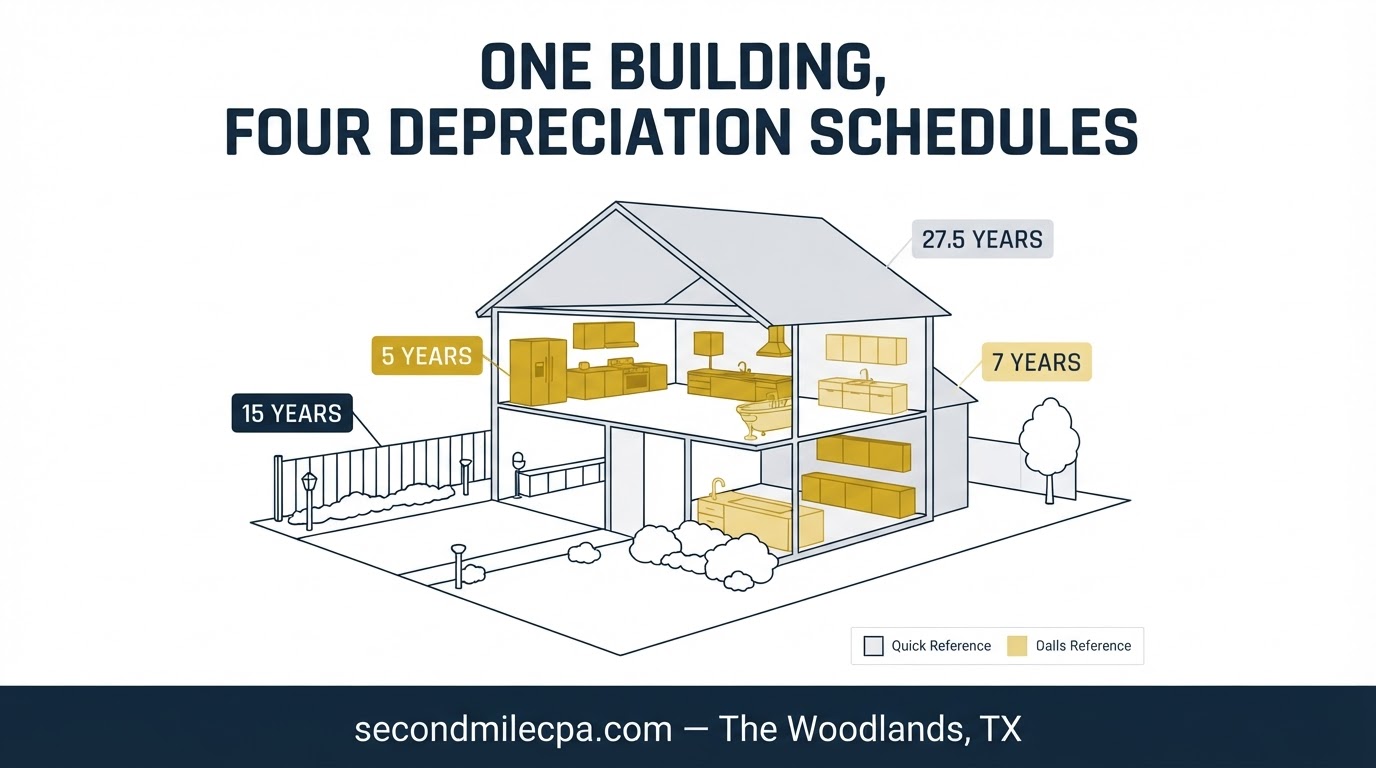
A cost segregation study breaks a building down into its pieces. The ones that qualify get moved off the standard 27.5 or 39 year schedule and reclassified as 5, 7, or 15 year property. Thanks to 100 percent bonus depreciation, now permanent for property acquired on or after January 20, 2025, that accelerated portion can be written off in year one.
Whether a study is worth paying for depends less on the property than on two things the people selling studies rarely lead with. Can you actually use the deduction this year, and what happens when you sell?
This is the full picture. Including the parts that actually decide the answer.
What most owners are doing now
When I get asked about capital improvements on a rental, the conversation usually turns into a different one.
Most owners take residential rental property on the standard 27.5 year straight-line schedule and leave it there. Commercial property goes on 39 years. The whole building, one number, three or four decades.
Inside that building, though, are things the tax rules treat very differently. Appliances, carpet, cabinetry, certain electrical and plumbing serving specific equipment, decorative lighting, window treatments. Outside it, parking areas, driveways, sidewalks, fencing, landscaping, site lighting. Those are 5, 7, and 15 year property. In most returns I review for new clients, they are sitting in the 27.5 year bucket because nobody separated them.
Here is what I told people at a recent webinar when the question came up. I would say it the same way here:
I think it is worth considering a cost segregation study to see if there is an opportunity to accelerate and depreciate some of those items, especially now that bonus depreciation is back at 100 percent.
That is still my view. With a qualification, which is most of this article.
What the numbers look like
A simple example, so the scale is clear.
You buy a rental in March 2026 for $650,000. The land is worth $150,000, which is never depreciable, so the building basis is $500,000.
Without a study. $500,000 over 27.5 years is about $18,200 a year. Because the property went into service in March, the first year is partial, roughly $14,400.
With a study. Suppose the engineering review finds that 25 percent of the building basis, or $125,000, is really 5, 7, and 15 year property. That share qualifies for 100 percent bonus depreciation and comes off in the first year. The remaining $375,000 stays on the 27.5 year schedule. First-year depreciation is roughly $135,800.
The difference is about $121,000 of additional deduction in year one. At a 35 percent marginal rate, that is roughly $42,000 of federal tax that stays in your account this year rather than going out. At 24 percent, about $29,000.
That is the number people quote. Now the parts that decide whether you actually see it.
The part sellers skip, number one: can you use the deduction?
Rental real estate is a passive activity by default. Losses from passive activities can generally only offset passive income. They cannot offset your salary, your business income, or your investment income.
So that $121,000 deduction creates a rental loss. The question becomes whether the tax code lets you use that loss against anything this year. There are four ways it can.
The $25,000 allowance. If you actively participate in managing the rental, meaning you approve tenants, set rents, and authorize repairs in a real sense, you can deduct up to $25,000 of rental losses against other income. That allowance starts shrinking at $100,000 of modified adjusted gross income and is gone entirely at $150,000. For most of the owners thinking about cost segregation in the first place, it is already gone.
Real estate professional status. If you spend more than 750 hours a year in real property trades or businesses, and that is more than half of all the time you spend working, and you materially participate in the rentals, the losses are not passive. On a joint return, one spouse has to meet both tests alone. This is a high bar and the IRS examines it, so the hours have to be documented as you go, not reconstructed afterward.
Short-term rentals. If the average guest stay is seven days or less, the property is not treated as a rental activity for these rules. If you materially participate, which usually means meeting specific hour tests, the losses can be nonpassive without real estate professional status. This is the route most often discussed online. It is also the one most often claimed without the documentation to support it.
Other passive income. If you have income from other rentals or passive investments, the loss can offset that.
If none of those apply, the loss is not wasted. It is suspended and carried forward. It can be used in a future year when you have passive income, and anything still unused is released in full when you sell the property in a taxable sale. But a deduction you cannot use for six years is worth a good deal less than one you use now, and the study fee is paid today either way.
One situation worth flagging for business owners. If you own the building your own company operates in and lease it to the company, the rules for renting to your own business are their own subject. Depending on how the ownership and activities are structured, they can work for you or against you. That needs to be looked at specifically before a study, not after.
The part sellers skip, number two: what happens when you sell
Cost segregation does not erase tax. It moves it.
When you sell, the depreciation you took comes back as recapture, and the rate depends on what kind of property it was.
5 and 7 year property is Section 1245 property. Depreciation on it is recaptured as ordinary income, at rates up to 37 percent, to the extent of your gain.
The building itself is Section 1250 property. Straight-line depreciation on it comes back as unrecaptured Section 1250 gain, taxed at a maximum of 25 percent.
15 year land improvements sit in between. They are Section 1250 property, but when bonus depreciation was taken on them, the portion above what straight-line would have allowed is recaptured as ordinary income, and the straight-line portion at up to 25 percent.
What that means in practice is that a study shifts depreciation out of the 25 percent bucket and into the ordinary income bucket. If you sell in a few years at a high income, much of the benefit was a loan from the government, interest free, that you repay at your ordinary rate.
That is still worth having. Money now is worth more than money later. But it is a deferral, and it should be planned alongside the exit rather than separately from it.
Two things change the picture considerably.
Holding the property until death. Property passed to heirs generally receives a stepped-up basis, and the recapture does not follow it. For an owner who intends to hold long term, the deferral can become permanent.
A like-kind exchange. Rolling into another property through a 1031 exchange can defer the gain. Cost-segregated property adds wrinkles to an exchange that need to be planned before the sale rather than discovered during it.
The part sellers skip, number three: the study has to pay for itself
A cost segregation study is not free, and the cheap ones are not all the same thing.
For a single-family rental or small residential property, studies commonly run a few thousand dollars. For larger multifamily and commercial buildings, five figures is normal. The IRS publishes a Cost Segregation Audit Techniques Guide, and it treats a detailed engineering-based approach as the most reliable method. A report generated from a few inputs and a square footage number is cheaper and may not hold up the same way if it is ever examined.
The industry figures you will see for how much of a building gets reclassified, often quoted as 20 to 40 percent or more, come largely from the firms selling the studies. The real number depends on the property type, its age, how it is finished, and how much site work it has. A furnished short-term rental with significant landscaping and parking will reclassify more than a plain long-term rental on a small lot. I would treat any percentage quoted before someone has looked at your property as a sales estimate.
Who it usually pays off for
- Owners who can use the loss now. Real estate professionals, short-term rental operators who materially participate and can document it, and owners with enough passive income to absorb it.
- Owners with a larger building basis, where the dollar amount reclassified comfortably exceeds the cost of the study.
- Owners who expect to hold the property for a long time, especially those who may hold until death.
- Owners who bought in a high-income year and want the deduction against that income.
- Commercial property owners, where the reclassifiable share and the dollar amounts tend to be larger.
Who it usually does not
- High earners with W-2 or business income, no real estate professional status, no short-term rental activity, and no other passive income. The loss will mostly sit suspended.
- Owners planning to sell within a few years at a high ordinary rate, unless an exchange is planned.
- Properties where the building basis is small enough that the study fee eats a meaningful share of the benefit.
- Anyone relying on a short-term rental or real estate professional position they cannot document.
If you already own the property: the look-back
You do not have to have done this when you bought the building. A study on a property placed in service in an earlier year is common and it is called a look-back.
The mechanism is a change in accounting method, filed on Form 3115. The depreciation you would have taken if the components had been classified correctly from the start is computed, and the difference is taken as a Section 481(a) adjustment, in full, in the current year. No amended returns are required.
One detail that matters. The bonus depreciation rate is fixed by the year the property was placed in service, not by the year you do the study. The phase-down that applied before the One Big Beautiful Bill Act still governs older property.
| Building placed in service | Bonus rate on reclassified components |
|---|---|
| 2022 | 100% |
| 2023 | 80% |
| 2024 | 60% |
| 2025, acquired before January 20, 2025 | 40% |
| Acquired on or after January 20, 2025 | 100% |
Whatever is not covered by bonus still depreciates on the faster 5, 7, or 15 year schedule, so the catch-up is meaningful even on a building bought in 2023 or 2024. The passive activity rules above apply to the catch-up deduction exactly as they apply to a new purchase.
A note for Texas owners
Texas has no personal income tax, so for an individual owner here the federal calculation is the whole calculation. There is no state add-back and no second depreciation schedule to keep, which owners in many other states have to deal with. If the property is held in an entity, or if you own rentals in other states, that changes, and it should be part of the analysis.
Timing: what actually has to happen before December 31
The study itself does not have to be finished by year-end. It can be completed after December 31 and before you file, including an extension.
What does have a year-end deadline:
The property has to be placed in service. For a purchase, that means closed and available for rent. A closing that slips into January moves the whole deduction a year.
Your hours. If the deduction depends on real estate professional status or material participation in a short-term rental, the hours are counted for the calendar year and they need to be logged as they happen. October is the time to look at where you stand, not March.
Your other year-end decisions. A deduction of this size changes your estimated payments, whether it makes sense to realize other gains this year, and how other planning moves interact with it. Knowing the rough number in the fourth quarter is worth more than knowing the exact number in April.
Before you commission a study
- Confirm the building basis, separating land from building. A study cannot fix a bad starting number.
- Answer the passive question first. Do you qualify for the allowance, real estate professional status, or the short-term rental route? Do you have passive income? If none, how long until the suspended loss is likely to be usable?
- Estimate your hold period and think about the exit: sale, exchange, or holding long term.
- Get a fee quote and a preliminary estimate, and treat the estimate as a sales figure until the study is done.
- Choose an engineering-based provider whose report would hold up in an examination.
- Coordinate with your tax preparer so the Form 3115 or the original-year classification is filed correctly.
- If you own the building your business uses, have the ownership and activity structure looked at before anything else.
Frequently asked questions
What is a cost segregation study?
An engineering-based analysis that breaks a building’s cost into components and assigns each to its correct depreciation class. Components that qualify as 5, 7, or 15 year property, such as appliances, carpet, cabinetry, specialized electrical, parking areas, landscaping, and fencing, are moved out of the 27.5 year residential or 39 year commercial schedule. With 100 percent bonus depreciation permanent for property acquired on or after January 20, 2025, the reclassified share can be deducted in the first year.
Is a cost segregation study worth it for a single-family rental?
Sometimes. It depends on the building basis, the cost of the study, and above all whether you can use the resulting loss. If your income is above $150,000 and you do not qualify as a real estate professional, do not operate the property as a short-term rental with material participation, and have no other passive income, the extra depreciation will mostly be suspended and carried forward. In that situation the study may still pay off eventually, but much less than the headline numbers suggest.
Can I do a cost segregation study on a property I bought years ago?
Yes. A look-back study reclassifies the components and takes the missed depreciation as a single catch-up deduction in the current year through a change in accounting method on Form 3115. No amended returns are needed. The bonus depreciation rate is the one that applied in the year the building was placed in service: 100 percent for 2022, 80 percent for 2023, 60 percent for 2024, and 40 percent for property acquired before January 20, 2025 and placed in service in 2025.
Does cost segregation increase my taxes when I sell?
It changes their character. Depreciation on 5 and 7 year property is recaptured as ordinary income at rates up to 37 percent, while straight-line depreciation on the building is recaptured at a maximum of 25 percent. A study moves depreciation from the second category into the first. The benefit is the time value of the earlier deduction, and it can become permanent if the property is held until death and passes with a stepped-up basis.
Can I use cost segregation losses if I have a full-time job?
Usually not right away. Rental losses are passive and generally offset only passive income. The $25,000 allowance for active participation phases out between $100,000 and $150,000 of modified adjusted gross income. Real estate professional status requires more than 750 hours a year and more than half your working time in real estate, which a full-time job in another field normally rules out. Short-term rentals with an average stay of seven days or less and material participation are the main exception. Unused losses carry forward and are released when the property is sold.
Does the study have to be done before December 31?
No. The study can be completed after year-end and before the return is filed, including on extension. What must happen within the year is that the property is placed in service, and if you are relying on real estate professional status or short-term rental material participation, the hours have to be performed and documented within the calendar year.
How much does a cost segregation study cost?
For single-family and small residential rentals, commonly a few thousand dollars. For larger multifamily and commercial properties, five figures is typical. The IRS Cost Segregation Audit Techniques Guide treats a detailed engineering-based approach as the most reliable, and inexpensive reports generated from limited inputs may not carry the same weight if examined.
The bottom line
A cost segregation study is one of the most effective tools in real estate taxation, and one of the most oversold.
For the right property, held by an owner who can use the loss, with an exit that has been thought through, it moves a large deduction into the year you need it. For an owner whose losses will sit suspended, who plans to sell soon at a high rate, or whose building is too small for the fee to make sense, it is an expensive report.
Which of those you are can be answered in an hour, before anyone is paid to measure your building.
Get in touch and we will look at your property, your income, and your plans for it, and tell you whether a study is likely to pay off. If it is not, we will tell you that too.
Second Mile Financial Services is a licensed Texas CPA firm in The Woodlands, serving property owners across greater Houston and nationwide. Call (281) 826-0100 or email [email protected].
This article is general information, not individualized tax advice. Passive activity, recapture, and depreciation rules depend on your specific facts. Verify current figures and discuss your situation with a qualified professional before acting.