
The new federal deductions for qualified tips and qualified overtime belong to your employees. For wages paid in 2026, however, the reporting burden falls squarely on you.
Cash tips go in box 12 of the W-2 under code TP, alongside the employee’s Treasury Tipped Occupation Code in the new box 14b. Qualified overtime goes in box 12 under code TT. And qualified overtime is not the employee’s total overtime pay. It is only the premium portion. That distinction is where most payroll setups will fail.
The deduction is theirs. The paperwork is yours.
Search for information on the tips and overtime deductions and you will find almost everything written for the employee. The focus is always on how much they can deduct, whether they qualify, and how to claim it.
Very little is written for the business that actually has to make the mechanics work. That gap creates a real problem. An employee can only claim what the employer’s records support. For 2026, the IRS expects those records to show up on the W-2 in a very specific way.
If your payroll system was never configured for this, your employees either cannot claim what they are entitled to, or they claim it based on a guess. Neither of those conversations happens with Congress. Both of them happen in your break room.
What the deductions are
Your employees will ask you about this. It helps to have the numbers right.
| Tips | Overtime | |
|---|---|---|
| Maximum deduction | $25,000 | $12,500 single, $25,000 married filing jointly |
| What counts | Voluntary cash and charged tips in an occupation on Treasury’s list | Only the FLSA-required premium portion of overtime pay |
| Phase-out begins | $150,000 MAGI single, $300,000 joint | $150,000 MAGI single, $300,000 joint |
| Years | 2025 through 2028 | 2025 through 2028 |
| Itemizing required? | No | No |
The employee needs a valid Social Security number. Married employees have to file jointly to claim either deduction.
Two things employees routinely misunderstand. You should be ready to correct them.
First, this is an income tax deduction only. Social Security and Medicare still apply to tips and overtime for both the employee and the employer. Nothing about your payroll tax obligations changes.
Second, the overtime cap for a single filer is $12,500, not $25,000. A lot of early coverage used the $25,000 figure without the proper qualification. Frankly, some of what I said in my own webinar last year did the same. For a single filer, the limit is half that.
What changed on the W-2
For 2025, the IRS gave employers transition relief. Separate reporting was not required, though employers were encouraged to provide the figures in box 14 or on a separate statement.
For wages paid in 2026, separate reporting is baked into the W-2. The 2026 form introduces three new entries.
| W-2 entry | What goes there |
|---|---|
| Box 12, code TP | Total cash tips reported to the employer |
| Box 12, code TT | Total qualified overtime compensation |
| Box 14b | Treasury Tipped Occupation Code, up to two codes per employee |
What used to be box 14 is now box 14a.
The 2026 W-2s are due to employees and the Social Security Administration by February 1, 2027, since January 31 falls on a Sunday. The practical consequence is that the numbers in those boxes must be accumulated all year. They cannot be cleanly reconstructed in January from payroll registers that never separated them. Every pay run between now and the day your system is configured just adds to the cleanup.
The overtime mistake most payroll setups will make
This is the single most important point in this entire article.
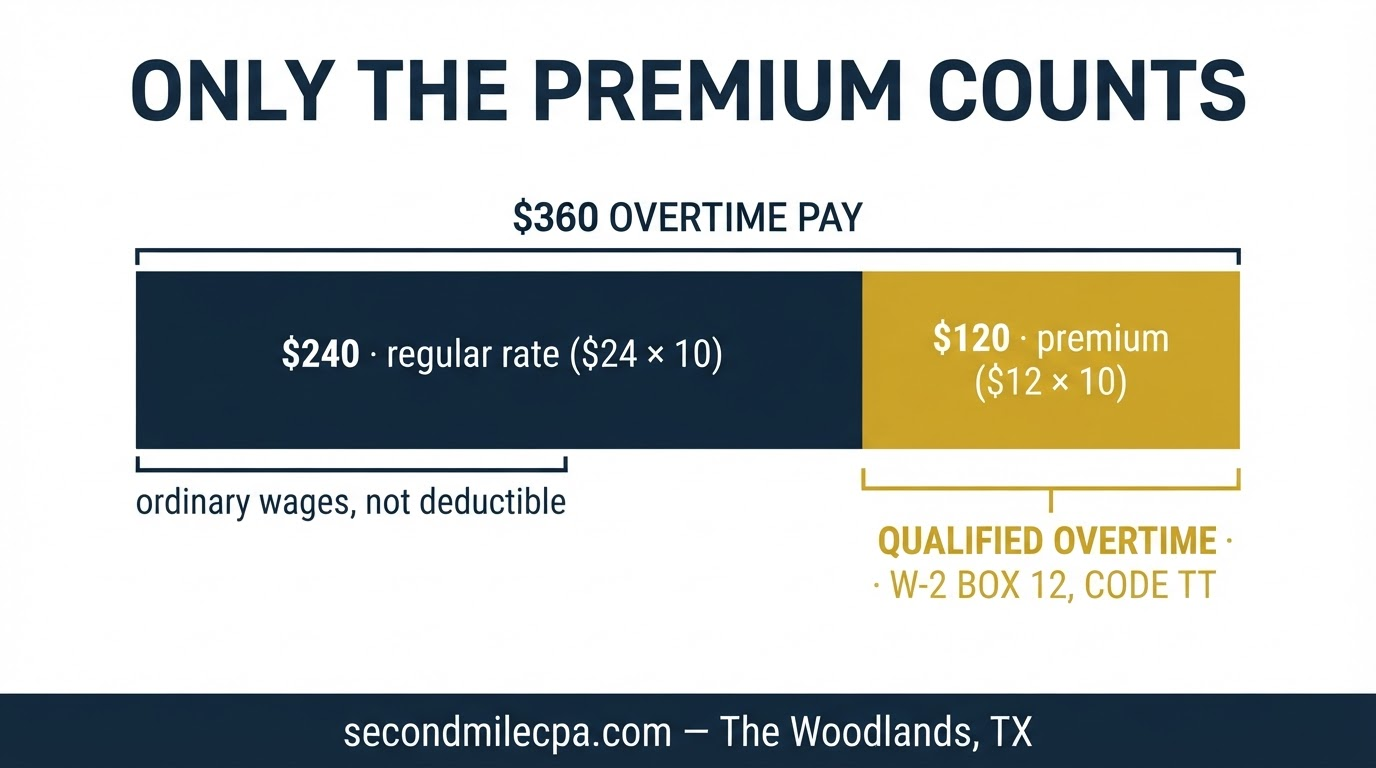
Qualified overtime is only the premium portion required by the Fair Labor Standards Act. It is not the employee’s total overtime pay.
Let us look at an example. An employee earns $24 an hour and works 10 hours of overtime at time and a half, which is $36 an hour. Total overtime pay for those hours is $360. Qualified overtime is $120. That is ten hours times the $12 premium above the regular rate. The other $240 is ordinary wages and does not go in code TT.
Over a year, an employee who averages five overtime hours a week for fifty weeks earns $9,000 of total overtime pay. The qualified overtime amount is $3,000. That is the number for box 12, code TT.
Several rules narrow this further.
- Only FLSA-required overtime counts. The deduction follows section 7 of the Fair Labor Standards Act. Overtime you pay because of company policy, a union contract, or a more generous internal rule does not qualify for the portion that exceeds the FLSA requirement.
- Exempt employees do not qualify at all. If you pay a salaried exempt manager extra for long weeks, that is not qualified overtime, regardless of how it is labeled on the pay stub.
- Double time only counts up to time and a half. If you pay double time on holidays, only the half above the regular rate qualifies.
- The regular rate is not always the base hourly rate. If you pay non-discretionary bonuses, shift differentials, or commissions, those generally go into the FLSA regular rate. The premium must be calculated on that blended rate. Many payroll systems compute overtime as one and a half times the base hourly rate and stop there. For this deduction, the premium has to follow the FLSA regular rate.
Texas does not layer its own overtime rules on top of federal law. That simplifies things for most employers here compared to states with daily overtime mandates. The FLSA calculation is the entire calculation.
If your payroll system reports total overtime pay in code TT, every employee with overtime gets a W-2 that overstates their deduction. That is not a small error, and it is the kind that comes back to haunt you.
The tips side
What counts as a qualified tip? Voluntary payments the customer decides on, in cash or charged to a card, debit card, gift card, or similar cash-denominated method. The customer must be free not to pay it.
What does not count? Mandatory service charges and automatic gratuities, unless the customer is expressly offered a way to remove or change them without consequence. A large-party gratuity printed on the check is generally not a qualified tip.
Then there is the occupation list. Treasury publishes a list of occupations that customarily and regularly received tips on or before December 31, 2024. The final list includes 68 occupations, each with a three-digit Treasury Tipped Occupation Code. That code is what goes in box 14b. Your job is to map each tipped role in your business to the correct code.
A quick rule for owners. Tips paid to someone who owns a significant interest in the business paying them, generally 5 percent or more, are treated as recharacterized income rather than qualified tips. An owner who works the floor and takes tips through their own company should not expect those to qualify.
There is also an unresolved question regarding businesses classified as specified service trades or businesses. For now, the IRS is applying transition relief. They are treating employees in traditionally tipped occupations as qualifying regardless of their employer’s classification, with further guidance expected. It is worth watching if you operate in a field that might be affected.
Who this hits hardest in the Houston area
For tips, think restaurants and bars, hotels and hospitality, salons, barbershops and spas, valet and car services, and delivery.
For overtime, look at construction, oilfield and petrochemical services, plant maintenance contractors, logistics and warehousing, manufacturing, and hourly healthcare staff. Houston has an unusually large hourly workforce in overtime-heavy industries. That means a lot of W-2s carrying a code TT number next February. It also means a lot of them will carry the wrong number if the premium calculation is not set up deliberately.
If you run a salon, barbershop, or spa: a credit you may be missing
The same legislation expanded the FICA tip credit. This credit used to apply only to food and beverage businesses. Now it covers beauty services like barbering, hair care, nail care, esthetics, and body and spa treatments. It applies starting with 2025.
The credit gives back part of the employer Social Security and Medicare tax you pay on employee tips. You claim it on Form 8846 with the business return. If you have tipped staff in those fields and nobody has mentioned this to you, it is worth asking about before your 2025 return is finalized or an amended one is filed.
What to do before the year closes
- Confirm your payroll system can track tips and qualified overtime as separate items. Ensure it calculates the overtime premium on the FLSA regular rate rather than the base hourly rate.
- Map every tipped role to its Treasury Tipped Occupation Code. Do this once, do it carefully, and document your reasoning.
- Separate mandatory service charges from tips in your point-of-sale and payroll records.
- Identify exempt employees who receive extra pay for long weeks. Make sure none of it flows to code TT.
- Run a test. Pull year-to-date figures for a handful of employees and verify that TP and TT would calculate correctly before January arrives, not during the rush.
- Talk to your payroll provider immediately. Their 2026 W-2 updates may depend on settings only you can confirm.
- Tell your employees. Many do not know this legislation exists, and the ones who do often have the numbers completely wrong.
The step-by-step setup and the reconciliation process before W-2s go out are covered in our companion piece on setting up payroll and the W-2 for tips and overtime.
What to tell your employees
Many of your staff have heard “no tax on tips” or “no tax on overtime” and assume it means much more than it actually does. A short, accurate note heads off most of the confusion. Here is language you can adapt and hand out or post in the break room. It deliberately avoids giving individual tax advice.
About the new tips and overtime tax deductions
Starting with 2025, eligible employees may be able to deduct qualified tips (up to $25,000) and qualified overtime (up to $12,500, or $25,000 for married couples filing jointly) on their federal income tax return. These are income tax deductions only. Social Security and Medicare taxes still apply.
For overtime, only the extra half of time-and-a-half pay required by federal law counts, not the full overtime paycheck.
Starting with your 2026 Form W-2, you will see your reported cash tips in box 12 with code TP, your qualified overtime in box 12 with code TT, and, if you work in a tipped role, an occupation code in box 14b. Your tax preparer will use these amounts.
The deductions phase out at higher incomes and have other eligibility rules. Please talk with your own tax preparer about how they apply to you. If you have questions about the amounts on your W-2, contact [payroll contact].
Frequently asked questions
Do employers have to report qualified tips and overtime on the W-2 for 2026?
Yes. For wages paid in 2026, the W-2 reports total cash tips in box 12 with code TP, the employee’s Treasury Tipped Occupation Code in the new box 14b, and total qualified overtime compensation in box 12 with code TT. For 2025, the IRS provided transition relief and separate reporting was not required, although employers were encouraged to provide the amounts in box 14 or a separate statement.
Is all overtime pay deductible under the new rule?
No. Only the premium portion required by section 7 of the Fair Labor Standards Act qualifies. For time and a half, that is the extra half above the regular rate, not the full overtime pay. An employee earning $24 an hour who works 10 overtime hours at $36 an hour has $120 of qualified overtime, not $360. Overtime paid to exempt employees, overtime beyond what the FLSA requires, and the portion of double time above time and a half do not qualify.
Do the deductions change payroll taxes or withholding?
The deductions reduce federal income tax only. Social Security and Medicare continue to apply to tips and overtime for both the employee and the employer. Employees who expect to claim the deductions can reflect them in the deductions step of Form W-4 to reduce income tax withholding.
Do automatic gratuities and service charges count as tips?
Generally no. Mandatory service charges and automatic gratuities are not qualified tips unless the customer is expressly offered a way to remove or change the amount without consequence. A qualified tip must be voluntary and determined by the customer.
What is a Treasury Tipped Occupation Code?
A three-digit code assigned by Treasury to each occupation on its list of jobs that customarily and regularly received tips on or before December 31, 2024. The final list has 68 occupations. Employers report the code for each tipped employee in box 14b of the 2026 W-2, up to two codes per employee.
Can salaried employees claim the overtime deduction?
Not if they are exempt from overtime under the FLSA. Extra pay given to an exempt employee for long weeks is not qualified overtime, regardless of how it is labeled. Nonexempt salaried employees who are paid FLSA overtime can qualify for the premium portion.
How long do the tips and overtime deductions last?
They apply to tax years 2025 through 2028. Unless Congress extends them, they end after 2028.
The bottom line
The employee gets the deduction. The employer carries the reporting burden. For 2026, that reporting lives on the W-2 in specific boxes with specific codes.
Two things will separate the employers who get this right from the ones who spend February fielding complaints. The first is whether the overtime premium is calculated on the FLSA regular rate rather than reported as total overtime pay. The second is whether the tracking started during the year or gets attempted in January.
Neither task is overly complicated. Both are much easier to handle in October than in the week W-2s are due.
Get in touch and we will review your payroll setup for tips and overtime before year-end. We will check the regular-rate calculation and the occupation codes so your 2026 W-2s go out right the first time.
Second Mile Financial Services is a licensed Texas CPA firm in The Woodlands, serving employers across greater Houston and nationwide. Call (281) 826-0100 or email [email protected].
This article is general information, not individualized tax or legal advice. Employment classification and FLSA overtime questions can have legal dimensions. Verify current guidance and discuss your specific situation with a qualified professional before acting.