
To report tips and overtime correctly on 2026 W-2s, your payroll system has to track four things during the year, not at year-end. Those four things are cash tips reported by employees, the FLSA overtime premium calculated on the regular rate, each tipped employee’s Treasury Tipped Occupation Code, and which employees are exempt.
If those exist and reconcile by the last pay run of December, the W-2s are routine. If they do not, January becomes a reconstruction project.
This is the practical companion to our employer’s guide to the tips and overtime deductions. That piece covers what the rules are. This one is a checklist. Print it, sit down with whoever runs your payroll, and work through it.
What the W-2 needs at the end
Three entries are new for wages paid in 2026.
| Entry | Contents | Built from |
|---|---|---|
| Box 12, code TP | Total cash tips reported to the employer | Tip reports and point-of-sale data, all year |
| Box 12, code TT | Total qualified overtime compensation | The FLSA overtime premium, every pay period |
| Box 14b | Treasury Tipped Occupation Code, up to two | Your mapping of each tipped role |
Box 14b is required whenever code TP reports cash tips. What used to be box 14 is now box 14a.
W-2s for 2026 are due to employees and the Social Security Administration by February 1, 2027. The transition relief that applied to 2025 does not carry forward.
Step 1. Separate the earnings
Most payroll systems were set up with a single overtime earning type and a single tip type. For the 2026 W-2, that is not enough. You want the system to be able to tell these apart.
- Regular wages
- Overtime, straight-time portion. The base pay for overtime hours.
- Overtime, FLSA premium. The extra half required by federal law. This is what feeds code TT.
- Overtime not required by the FLSA. Daily overtime, holiday double time above time and a half, overtime paid to exempt staff, anything you pay by policy beyond the federal requirement. Wages, but not code TT.
- Cash tips reported by employees. Including tips charged to cards.
- Service charges and automatic gratuities. These are wages, not tips, and they stay out of code TP.
Some systems do this with separate earning codes. Others calculate the premium inside a single overtime code and can report it separately. What matters is that the premium can be totaled per employee at year-end without anyone doing arithmetic by hand.
Step 2. Get the regular rate right
This is where most of the errors will come from. It gets its own step.
The FLSA premium is half the employee’s regular rate for each overtime hour. The regular rate is not always the hourly rate. Non-discretionary bonuses, production and attendance bonuses, shift differentials, and commissions generally go into it.
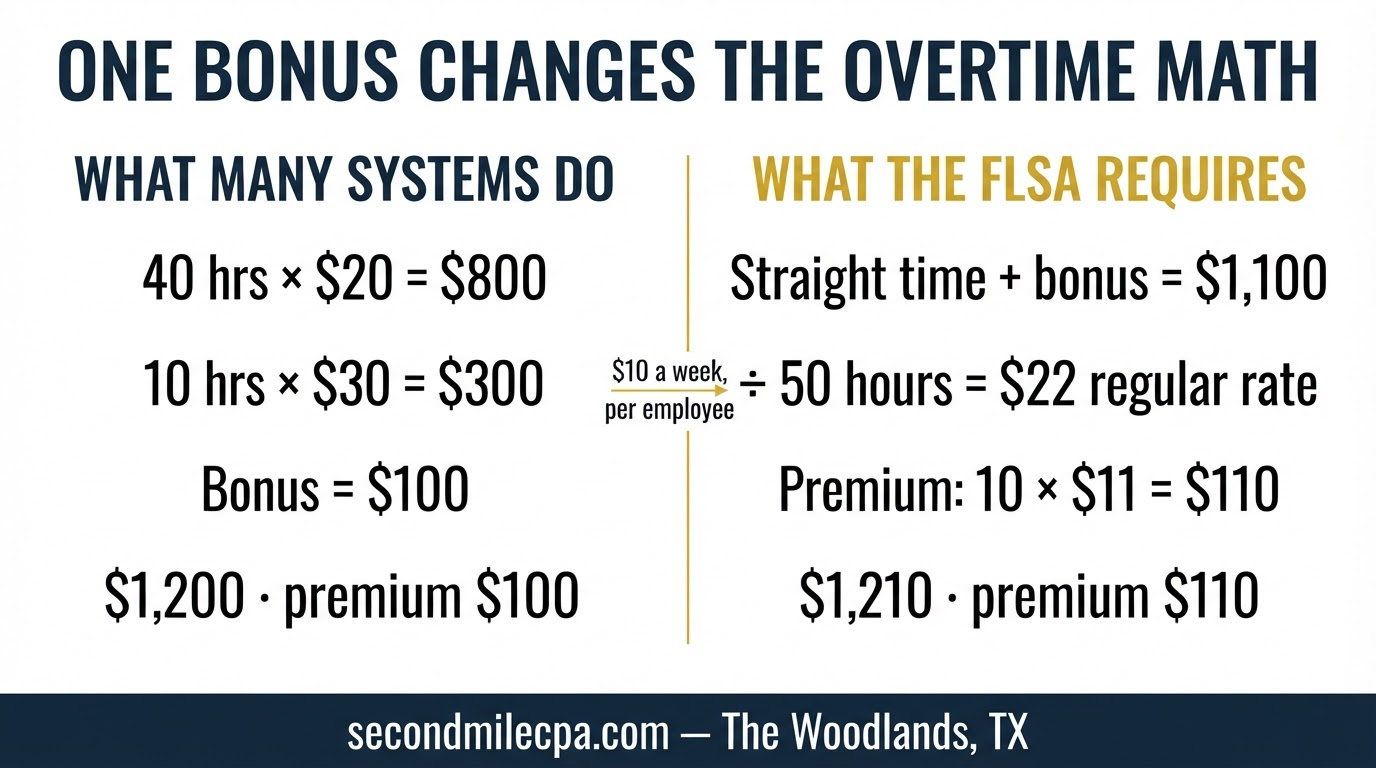
Here is what that looks like. An employee earns $20 an hour, works 50 hours in a week, and earns a $100 production bonus that week.
What many systems do: 40 hours at $20, plus 10 hours at $30, plus the $100 bonus. Total $1,200. Overtime premium $100.
What the FLSA requires: Straight-time earnings are 50 hours at $20 plus the $100 bonus, which is $1,100. The regular rate is $1,100 divided by 50 hours, or $22. The premium is half of $22, or $11, for each of 10 overtime hours: $110. Total pay $1,210.
The system that paid $1,200 underpaid the employee $10 under federal wage law. Its code TT figure would be $100 instead of $110. Over a year of similar weeks, that is a few hundred dollars per employee in both directions: wages owed and a W-2 that understates the deduction.
Bonuses paid later complicate things further. When a non-discretionary bonus covers a longer period, a quarter or a year, the FLSA requires it to be allocated back over the weeks it was earned. The overtime premium for those weeks gets recalculated. That adjustment changes qualified overtime too. If you pay quarterly or annual bonuses to nonexempt staff, the year-end bonus payroll needs to include this.
If this is already being done correctly in your payroll, good. If nobody has ever checked, it is worth checking now for wage law reasons alone, quite apart from the W-2.
Step 3. Confirm who is exempt
Exempt employees cannot have qualified overtime, whatever they are paid. If you give a salaried manager extra pay for a heavy month, it is wages. It does not belong in code TT.
Go through your employee list and confirm each person’s FLSA status is set correctly in the payroll system. Misclassification is a much bigger problem than the W-2. This is a reasonable moment to catch it.
Step 4. Map tipped roles to occupation codes
Treasury publishes a list of 68 occupations that customarily and regularly received tips on or before December 31, 2024. Each has a three-digit Treasury Tipped Occupation Code. The list is on IRS.gov.
For each tipped role in your business, assign the matching code in the payroll system. A server, a bartender, a hair stylist, and a valet each map to different codes.
Employees who work two roles need attention. Box 14b holds up to two codes. If someone bartends some shifts and serves others, both codes may apply.
Roles that are not on the list create a different problem. Not every job where someone occasionally receives a tip is on Treasury’s list. If a role does not map cleanly, flag it rather than forcing a code that does not fit.
Document the mapping once. Keep it with your payroll records. Update it when job titles change.
Step 5. Keep service charges out of tips
Check your point-of-sale setup. Automatic gratuities, large-party charges, and mandatory service fees are not qualified tips unless the customer can remove or change them without consequence. They are wages paid through payroll. They should not flow into code TP.
If your system currently lumps them in with tips, separate them now. Every week they stay merged is another week to unwind.
Step 6. Flag owners
Tips received by someone who owns 5 percent or more of the business paying them are treated as recharacterized income rather than qualified tips. If an owner works shifts and takes tips through the company, make sure the setup reflects that.
Step 7. Verify names and Social Security numbers
The deductions require a valid Social Security number. A mismatch between your records and Social Security’s now matters to the employee in a way it did not before.
The Social Security Administration offers a free online verification service for employers. Run your list through it before W-2s are generated. Ask employees to confirm their information in your self-service portal if you have one.
Step 8. Test before year-end
Do not wait for the W-2 preview to find out whether this works.
Pick five employees. A tipped employee. A nonexempt employee with regular overtime. A nonexempt employee who received a bonus. Someone who works two roles. An exempt employee. Pull their year-to-date figures and calculate by hand what codes TP and TT and box 14b should show. Compare with what the system will produce.
If they match, you are done. If they do not, you have found the problem in October rather than in the last week of January.
Step 9. Reconcile before the W-2s go out
The standard year-end reconciliation still applies, with two additions.
- Year-to-date wages and withholding should tie to your quarterly Forms 941.
- Total code TP should tie to your tip records and point-of-sale reports for the year.
- Total code TT should be meaningfully smaller than total overtime paid. If the two numbers are equal, the system is reporting overtime pay rather than the premium.
That last check takes thirty seconds and catches the most likely error.
If part of 2026 was recorded the wrong way
This is more fixable than most owners expect.
Overtime can be rebuilt from time records and pay rates. Calculate hours over 40 in each workweek, times half the regular rate for that week. If bonuses were involved, they have to be allocated back as described in step 2. Payroll registers and time-clock exports usually contain everything needed.
Tips can be reconstructed from point-of-sale reports and employee tip reports for the year.
Occupation codes can be assigned now. The code reflects the role, not a date.
Whatever method you use, document it. If an employee or the IRS ever asks how a number was derived, a written method is the difference between a five-minute answer and a problem.
If an error is found after W-2s have been issued, a corrected W-2c goes to the employee and the Social Security Administration. The IRS assesses financial penalties for every incorrect form filed after the February deadline. Fixing a configuration issue in the fall is free. Fixing it in the spring costs you time, money, and reputation.
Questions to ask your payroll provider
If you use an outside payroll service, you need to know where the software ends and your responsibility begins. Most major platforms like ADP, Gusto, or Paychex are rolling out the new W-2 fields for 2026 right now. But adding a new box on a screen does not mean the math behind it is correct. The automatic regular-rate calculation for bonuses often still requires manual setup or custom earning codes.
These six questions will tell you quickly whether you are actually covered.
- Will box 12, code TT show only the FLSA overtime premium, or total overtime pay?
- Is the premium calculated on the FLSA regular rate, including non-discretionary bonuses and shift differentials?
- How does the system handle a bonus paid for a prior period?
- Where do I enter Treasury Tipped Occupation Codes, and can an employee carry two?
- How are service charges and automatic gratuities kept out of code TP?
- Can I see a preview of box 12 and box 14b for my employees before year-end?
If the answer to the first question is anything other than “only the premium,” the rest of the conversation matters a great deal.
Frequently asked questions
What payroll changes do employers need for 2026 tips and overtime reporting?
The payroll system needs to track cash tips reported by employees separately from service charges. It needs to calculate the FLSA overtime premium separately from total overtime pay. It needs to record a Treasury Tipped Occupation Code for each tipped role and correctly flag exempt employees. These feed box 12 code TP, box 12 code TT, and box 14b on the 2026 Form W-2, which is due February 1, 2027.
How do I calculate qualified overtime when an employee gets a bonus?
Include the non-discretionary bonus in the FLSA regular rate. Add the bonus to straight-time earnings for the week, divide by total hours worked to get the regular rate, then multiply half that rate by the overtime hours. For an employee at $20 an hour who works 50 hours and earns a $100 bonus, the regular rate is $22 and qualified overtime is $110 for the week, not $100. Bonuses that cover longer periods are allocated back to the weeks they were earned.
What if my payroll system combined tips or overtime for part of 2026?
The figures can usually be rebuilt. Qualified overtime can be recalculated from time records and pay rates for each workweek. Tips can be reconstructed from point-of-sale reports and employee tip reports. Document the method used. Errors found after W-2s are issued are corrected with Form W-2c.
Is box 14b required on the 2026 W-2?
Yes, whenever box 12 code TP reports cash tips. Box 14b holds up to two Treasury Tipped Occupation Codes from Treasury’s list of 68 occupations that customarily and regularly received tips on or before December 31, 2024. The information previously reported in box 14 now goes in box 14a.
How can I tell quickly whether my code TT figures are wrong?
Compare total code TT with total overtime paid for the year. Qualified overtime is only the premium portion. For time and a half, it should be roughly one third of total overtime pay or less. If the two totals are equal, the system is reporting overtime pay rather than the premium.
The bottom line
None of this requires new software or a consultant. It requires the payroll system to keep four things apart that most systems were never asked to keep apart. It requires someone to check, before December, that they are being kept apart correctly.
The regular-rate calculation is the one most likely to be wrong. It is worth fixing for wage law reasons whether or not anyone ever looks at box 12.
Get in touch and we will review your payroll setup against this checklist before your last pay run of the year. We will check the regular-rate calculation and the occupation code mapping.
Second Mile Financial Services is a licensed Texas CPA firm in The Woodlands, serving employers across greater Houston and nationwide. Call (281) 826-0100 or email [email protected].