


Cleaning up messy business books follows a predictable five-phase sequence — diagnostic, triage, reconstruction, redesign, handover — and for most businesses between $500K and $20M it takes 30 to 90 days. Not forever. Not “burn it down and start over.” A finite project with a known shape, and it starts with a step that costs you nothing.
If your books are months or years behind, this is the map.
First: how books actually get this way
In our experience, nobody decides to fall two years behind on their books. It happens through one of three doors:
The bookkeeper left. Quit, retired, got sick, moved away — and took the mental map of your finances with them. What they left behind made sense only to them, and every month since has piled onto the mystery.
The business outgrew the system. The DIY-QuickBooks setup from the $300K days quietly broke somewhere around $1M. Transactions multiplied, entities appeared, and the Sunday-night catch-up sessions stopped being enough — so they stopped happening.
A letter arrived. From the IRS, from the bank, from a buyer’s due-diligence team — someone official asked for financials you can’t produce, and the fog you’d been living with became a deadline.
Notice what’s not on that list: laziness, stupidity, failure. Messy books are a growth symptom, not a character flaw — which is why our cleanup practice operates as a No-Judgment Zone. After years of reconstructing ledgers for growing Houston businesses, we can tell you with certainty: yours are not the worst books we’ve seen, and they are not beyond fixing.
Why waiting is the expensive option
A quick, honest accounting of what the backlog costs while it sits:
Penalties compound on a schedule. Unfiled returns accrue failure-to-file penalties of 5% of unpaid tax per month, up to 25% — plus interest, plus separate late-payment penalties. Behind books become behind filings; behind filings become IRS letters.
Every decision is made blind. Pricing, hiring, borrowing, owner draws — all decided on gut feel, because the reports don’t exist. The profit leaks that clean books would reveal keep leaking, unmeasured.
Money gets more expensive. Lenders read unavailable financials the same way as bad ones. Declined applications, worse rates, personal guarantees — messy books are priced into all of them.
The backlog itself grows. Twelve months behind is a bigger project than six, and twenty-four is bigger than twelve. This is the rare business problem that literally cannot improve on its own.
Catch-up vs. cleanup vs. reconstruction: know what you’re buying
These terms get used interchangeably by providers, and the confusion costs owners real money. Plain-English definitions:
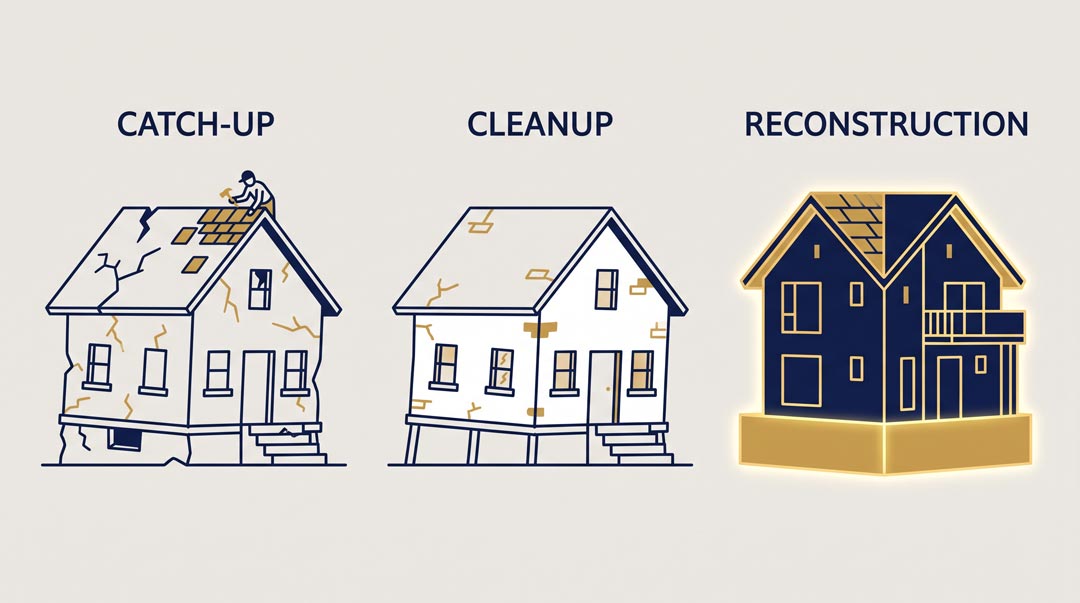
Catch-up means entering the missing months of transactions into your existing setup. It assumes the setup itself is sound. Fast, cheap — and if your chart of accounts is broken or old errors are baked in, catch-up simply records new transactions into old mistakes, faster.
Cleanup means correcting what’s wrong: re-categorizing miscoded transactions, completing missed reconciliations, fixing balances that don’t tie to reality. Cleanup fixes the records.
Reconstruction means rebuilding the system: verifying every account against bank reality, redesigning the chart of accounts so it can answer real questions (profit by job, by client, by line), and installing controls so the mess never re-accumulates. Reconstruction fixes the records and the machine that produces them.
The trap to avoid: paying for catch-up when you need reconstruction. A flat-fee “we’ll catch up your books” service that never examines why they fell apart delivers tax-ready numbers built on a foundation that’s still cracked — and eighteen months later, you’re behind again, minus the fee. Ask any provider which of the three they’re quoting. If they can’t say, they don’t know either.
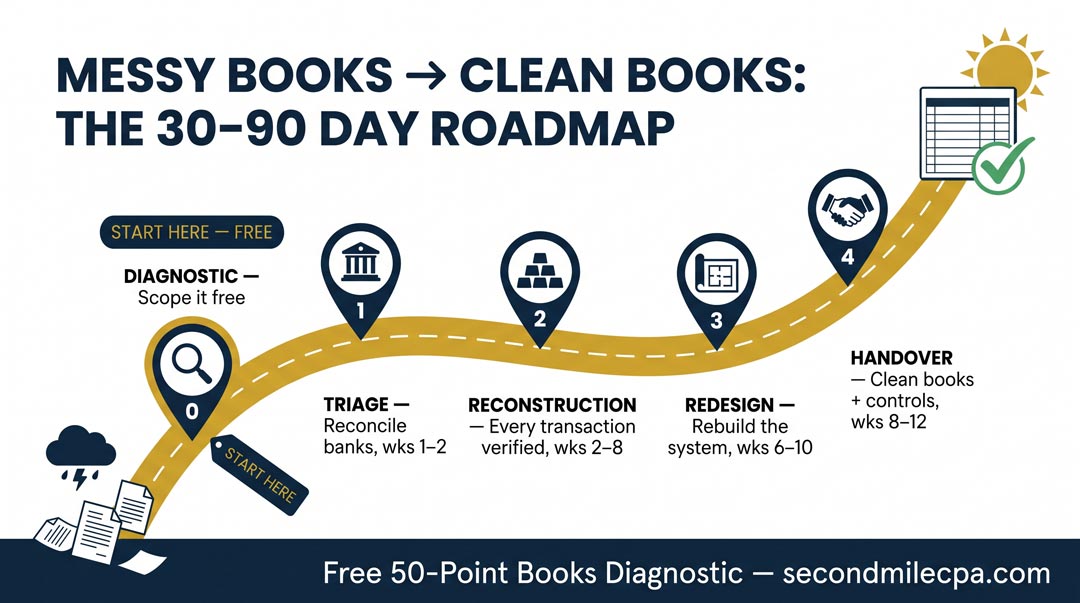
The roadmap: five phases from fog to clean
Phase 0: Diagnostic — know the scope before anyone quotes you
Before hiring anyone — including us — get an independent picture of what you’re actually dealing with. A structured diagnostic of your last 12 months establishes what’s broken, what’s salvageable, and whether you need catch-up, cleanup, or full reconstruction. This is the single highest-leverage step in the whole roadmap, for one reason: a quote given without a diagnostic is a guess, and you’ll pay for the guessing either way. Ours is free, takes days, and works from four exports you generate yourself — no logins, no judgment.
Phase 1: Triage and bank reconciliation (weeks 1–2)
Cleanup starts where certainty lives: the bank. Every business account and credit card gets reconciled against actual statements, establishing verified cash positions — the fixed stars everything else gets mapped to. High-impact, high-visibility: most owners see a trustworthy cash picture within the first two weeks, often for the first time in years.
Phase 2: Ledger reconstruction (weeks 2–8)
The heavy lifting. Every transaction in the backlog is located, categorized, and documented: uncategorized piles emptied, duplicates removed, personal-vs-business spending untangled, missing entries recovered from bank data, revenue matched to deposits, liabilities verified against statements. This is also where the buried treasure surfaces — missed deductions and billing gaps found during reconstruction routinely offset a meaningful share of the cleanup’s cost.
Phase 3: Architectural redesign (weeks 6–10)
The phase cheap catch-up skips — and the reason messes recur. The chart of accounts gets restructured to answer the questions you actually ask (which jobs make money? which clients cost money?), software settings get modernized so transactions flow correctly going forward, and internal controls get installed: who enters, who approves, who reconciles, who reviews.
Phase 4: Clean handover (weeks 8–12)
You receive reconciled, documented, GAAP-aligned financials that a lender, buyer, or the IRS can walk through — plus the operating rhythm to keep them that way, whether that’s training for your in-house person, ongoing monthly bookkeeping, or a hybrid. The test of a good cleanup isn’t the day of delivery; it’s whether the books are still clean a year later. Controls are what pass that test.
What actually determines the timeline (and the cost)
Every provider says “it depends.” Here’s specifically what it depends on, so you can estimate your own case:
Transaction volume and months behind — the base multiplier. A $700K single-entity business twelve months behind sits near the 30-day end; a $10M multi-entity group three years behind approaches 90 days or beyond.
Number of accounts and entities. Each bank account, card, loan, and legal entity multiplies reconciliation work — especially when money moves between them undocumented.
Missing records. Closed bank accounts, a departed bookkeeper’s private files, vanished receipts. Recoverable — banks retain statements for years — but recovery adds time.
Commingling. Personal spending threaded through business accounts (and vice versa) is the slowest thread to untangle, because someone has to decide what each transaction was.
The state of the foundation. A sound chart of accounts shortens everything; a broken one means reconstruction, not cleanup — see the definitions above.
Cost scales with the same factors, which is exactly why the Phase 0 diagnostic matters: it converts “somewhere between $2,000 and $30,000, who knows” into a scoped, fixed-shape project you can actually evaluate — and lets you compare any provider’s quote against a documented reality instead of their guess.
Can you do it yourself?
Sometimes — honestly, yes. DIY is realistic when: you’re under ~6 months behind, single entity, no commingling, the original setup was sound, and you (or someone on staff) can protect several focused hours weekly until it’s done. The sequence is the same roadmap: reconcile banks first, categorize the backlog month by month, chase the gaps, then close each month and don’t reopen it.
DIY stops being realistic when: you’re a year or more behind, entities or accounts multiplied, personal and business money crossed, records are missing, a deadline (IRS, lender, buyer) is attached — or the honest answer to “who has several free hours weekly?” is nobody, which is usually how the backlog happened. In that case the DIY plan isn’t a plan; it’s the same postponement wearing a to-do list.
Either way, run the diagnostic first. If it says your situation is DIY-able, the Findings Report is your work order — we’ll tell you so and wish you well. If it isn’t, you’ll know the true scope before anyone bills you.
Start with the free 50-point diagnostic — scope before you spend
Before you hire anyone to fix your books — us included — know what’s actually broken. Second Mile Financial Services, a licensed Texas CPA firm in The Woodlands, will run a complimentary 50-point diagnostic of your last 12 months, led by Dr. John Wesevich (DBA, CPA, CMA), and deliver a plain-English Findings Report: what’s broken, what it’s costing you, whether you need catch-up, cleanup, or reconstruction — and what it should honestly take.
- ✓ Independent professional review — scope from evidence, not a sales guess
- ✓ No accountant login required — four exports you generate yourself
- ✓ 100% confidential, No-Judgment Zone — messy books are a growth symptom, not a verdict
Limited diagnostics accepted each month so every file gets senior-level attention.
Request Your Free 50-Point Diagnostic →
Facing a deadline — IRS letter, loan application, tax filing? Call (281) 826-0100 and say so; deadlines change the sequencing, and we’ll tell you what to triage first.

Frequently asked questions
How much does bookkeeping cleanup cost?
It scales with months behind, transaction volume, number of accounts and entities, commingling, and missing records — which is why quotes given without examining your books are guesses. Market pricing runs from a few hundred dollars for light single-entity catch-up to five figures for multi-year, multi-entity reconstruction. The reliable approach: get a diagnostic review first, so any quote — from any provider — can be checked against documented scope. Cleanups also routinely surface missed deductions and unbilled revenue that offset part of the cost.
Can I just start a fresh QuickBooks file and leave the old mess behind?
Tempting, and almost always a mistake. A fresh file doesn’t erase your filing obligations for the messy years, destroys the transaction history that supports your tax positions in an audit, and breaks the continuity lenders and buyers expect. It also imports the real problem — the broken process — into a clean container. The legitimate version of “starting fresh” is reconstruction: verified history carried forward into a properly redesigned system.
Will reconstructed books hold up with the IRS and banks?
Yes, when done to professional standards. Proper reconstruction follows GAAP, ties every account to bank-verified reality, and documents the trail behind each balance — which is exactly what lenders, investors, and IRS examiners look for. Books rebuilt this way are typically stronger under scrutiny than books that were merely “kept up” without reconciliation.
Do I need to clean up my books before filing taxes?
Filing from messy books means filing wrong — usually overpaying through missed deductions, sometimes underpaying and building audit exposure with penalties on top. If a deadline is imminent, the practical sequence is: file an extension, clean up properly, then file accurately. An extension moves the paperwork deadline (not the payment deadline), and filing once, correctly, beats filing fast and amending later.
What if some of my records are missing entirely?
More recoverable than most owners fear. Banks and card issuers retain statements for years and can reissue them; payroll providers, payment processors, and vendors keep their own records; and a professional reconstruction can rebuild a defensible ledger from these external sources even when internal files are gone. Missing records lengthen the project — they very rarely doom it.
The bottom line
Messy books feel infinite from the inside — that’s why the backlog survives. From the outside, they’re a bounded project with a known shape: diagnose, triage, reconstruct, redesign, hand over. Thirty to ninety days. Businesses in worse shape than yours have walked this exact road and now get clean reports every month without thinking about it.
The road starts with knowing your actual starting point. Request the free 50-point diagnostic — and turn “someday, somehow” into a scoped plan with an end date.
Second Mile Financial Services is a licensed Texas CPA firm in The Woodlands, serving businesses across greater Houston and nationwide. Questions first? Reach us here or call (281) 826-0100.