


An independent books review is a structured examination of your business’s financial records by a professional who didn’t create them and has no stake in defending them. Think of it as a second medical opinion, but for your books: it tells you whether your numbers can be trusted, where money is leaking, and what to fix — without firing anyone, confronting anyone, or committing to anything.
Here’s everything the term means in practice: what a review covers, what it costs, how it differs from an audit, and how to get one without your bookkeeper ever knowing it happened.
Why “independent” is the operative word
Every set of books has an author. And authors — bookkeepers, accountants, office managers, sometimes the owner’s spouse — review their own work the way all humans do: through the assumptions that produced it. The categorization scheme that misprices your jobs looks correct to the person who designed it. The reconciliation that’s been skipped for a year doesn’t feel urgent to the person who’s been skipping it.
That’s not an accusation; it’s just how blind spots work. In accounting, the fix has a name — independent review — and larger companies buy it routinely in the form of audits and outside controllers. Businesses under $20M rarely get that layer, not because they need it less, but because nobody packaged it at their scale.
You’ve felt the need even if you’ve never named it. It’s the Thursday-night bank-app check. It’s signing the tax return you don’t fully understand. It’s wondering — quietly, guiltily — whether the person doing your books is doing them well, and having no way to find out that doesn’t feel like an accusation.
An independent review is that way.
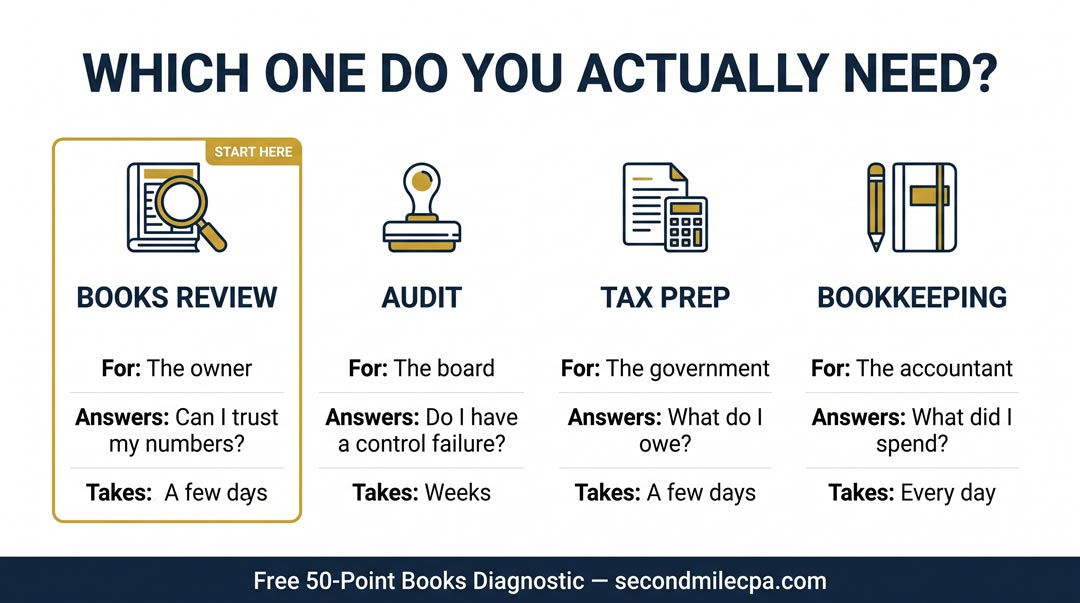
Books review vs. audit vs. tax prep vs. bookkeeping
These four get confused constantly, so here’s the plain-English distinction:
| Who it’s for | What it answers | Typical scope | |
|---|---|---|---|
| Independent books review | The owner | “Can I trust my numbers, and what’s leaking?” | Last 12 months, diagnostic, plain-English findings |
| Audit | Lenders, investors, regulators | “Do these statements meet formal standards?” | Formal opinion, extensive testing, weeks–months |
| Tax preparation | The IRS | “What does this business owe?” | Compliance filing built from the books as given |
| Bookkeeping | The business, ongoing | “What happened this month?” | Recording transactions accurately and on time |
The one most owners actually need first is the review — because everything else depends on it. A tax return built from wrong books is a wrong return. Monthly bookkeeping layered onto a broken foundation records new transactions into old errors. And an audit answers a question (“do these statements follow the rules?”) that isn’t the question keeping you up at night (“am I actually making money?”).
What a 50-point diagnostic actually covers
Our version of the independent review is a 50-point diagnostic of your last 12 months, and the fifty points fall into five areas:
1. Accuracy and integrity. Are bank and credit card accounts actually reconciled? Does the balance sheet make sense — no negative loans, no frozen inventory, no “Opening Balance Equity” ghosts? Do reported revenues match real deposits?
2. Revenue completeness. Is everything you delivered actually billed? Is everything billed actually collected — or is your receivables report quietly inflating your assets with invoices that will never pay?
3. Profit leaks. Miscoded costs hiding unprofitable jobs, vendor creep, duplicate payments, dead subscriptions, payroll and overtime errors — the nine leaks we’ve catalogued here, checked point by point against your actual ledger.
4. Tax risk and missed money. Uncategorized expenses that became unclaimed deductions. Commingled personal spending creating audit exposure. Filing and deposit timing that’s accruing penalties. Elections and strategies your situation qualifies for but nobody has used.
5. Structure and controls. Can your chart of accounts answer basic questions — profit by job, by client, by line? Is one person controlling everything with no oversight? Will these books survive a lender’s, buyer’s, or IRS’s scrutiny?
What you receive: the Findings Report
The deliverable is a plain-English Findings Report — not a spreadsheet of accounting jargon, but a document written for the owner:
- What’s solid. Often plenty is. If your bookkeeper is doing good work, the report says so — and now you know, instead of hoping.
- What’s leaking. Each finding in ordinary language: what we found, what it’s costing you, how urgent it is.
- What to fix first. A prioritized list, specific enough to hand directly to your current bookkeeper as a work order.
That last point matters: the report is yours. Fix things in-house, hand it to your existing accountant, or ask us to help — the diagnostic has no strings, and most findings can be fixed by whoever currently keeps your books, once they’re written down.
Seven signs it’s time for a second opinion
- You make decisions from your bank balance, not your reports — the surest sign you already distrust the books.
- A big decision is coming — a loan application, a major hire, an equipment purchase, a lease. Wrong numbers make expensive decisions worse.
- Tax season keeps bringing surprises — big unexpected bills, or a CPA who re-does the books every spring before filing.
- Margins are eroding and nobody can say why — revenue up, less left over, no explanation that survives questioning.
- One person has run your books unchecked for years. Even fully trusted, unreviewed work accumulates unchecked errors — and unreviewable arrangements deserve daylight on principle.
- You’re thinking about selling — even years out. Buyers re-derive your numbers, and every unverifiable figure discounts your price.
- You’ve simply never had one. If your books have never been independently examined, the first review is the highest-value look they’ll ever get.
What an independent books review costs
Market rates vary widely: software-only “health checks” are often free but shallow; paid diagnostic reviews from bookkeeping firms typically run $100–$500; CPA-led engagements go higher with scope.
Ours is complimentary — a genuinely free 50-point diagnostic, led by Dr. John Wesevich (DBA, CPA, CMA), with a written Findings Report at the end. Why free? Because it’s the most honest sales process we know: some owners take the report and fix things themselves (great — the report was built for that), and some discover problems they’d rather have professionals handle. Either way, you learn the truth about your books, and we meet businesses at the exact moment we’re most useful. No invoice changes hands for the truth.
The only constraint: we take a limited number of diagnostics each month, because every file gets senior-level review rather than a software scan. If a month fills, you’re first in line for the next.
How it works — no logins, no confrontation
The fear that stops most owners isn’t the review; it’s the imagined conversation with their bookkeeper about why someone’s checking. So we removed that conversation entirely:
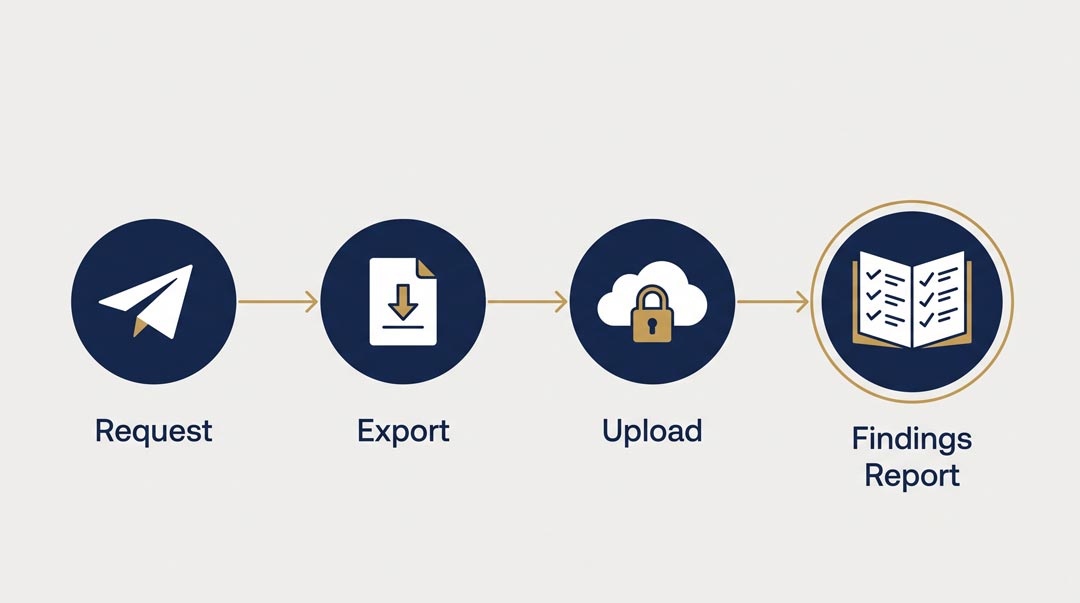
- You request the diagnostic and answer a few short questions about your business.
- You export four reports yourself — P&L, balance sheet, general ledger, and bank statements. Every accounting system produces these in minutes; we send click-by-click instructions for QuickBooks and others.
- You upload them through a secure private link. No logins, no passwords, no contact with your bookkeeper or accountant — they simply never need to know.
- We review and walk you through the Findings Report — in plain English, at your pace, with zero obligation afterward.
And a word about the thing many owners feel but rarely say: embarrassment. Messy books feel like a personal failing. They aren’t. Nearly every growing business we review arrived in some version of financial fog — it’s what happens when a company outgrows the systems it started with. We call our process a No-Judgment Zone because after reconstructing books far messier than yours, we mean it literally: you cannot show us a file that shocks us.
Get your second opinion: the free 50-point books diagnostic
Stop wondering whether your numbers are telling the truth. Second Mile Financial Services — a licensed Texas CPA firm in The Woodlands — will review your last 12 months against all 50 diagnostic points and hand you a plain-English Findings Report: what’s solid, what’s leaking, what to fix first.
- ✓ Independent professional review — led by Dr. John Wesevich, DBA, CPA, CMA
- ✓ No accountant login required — you export the reports; nobody else needs to know
- ✓ 100% confidential, No-Judgment Zone — and the report is yours, no strings attached
Limited diagnostics accepted each month so every file gets senior-level attention.
Request Your Free 50-Point Diagnostic →
Prefer to talk to a human first? Call (281) 826-0100 — The Woodlands, greater Houston, and remote nationwide.

Frequently asked questions
What documents do I need for an independent books review?
Four exports, all of which you can generate yourself in minutes: a profit & loss statement, a balance sheet, a general ledger, and bank statements for the review period — typically the last 12 months. No accounting-system logins or passwords are required, and no one on your team needs to be involved.
How long does a books review take?
Exporting your reports takes most owners under thirty minutes. The professional review itself typically takes a few business days, depending on the volume of transactions, after which you receive the written Findings Report and a walkthrough conversation in plain English.
Will my bookkeeper or accountant find out about the review?
Not unless you tell them. The review works entirely from read-only exports you generate yourself, so there’s no login access, no third-party contact, and no trace in your accounting system. Many owners share the Findings Report with their bookkeeper afterward — as a work order rather than a confrontation — but that choice is entirely yours.
Is a free books review just a sales pitch in disguise?
A fair question to ask of any free offer. The honest answer: a free diagnostic is how a CPA firm demonstrates competence to owners who would never respond to an ad — and it only works as marketing if the review itself is rigorous and the report is genuinely useful with no obligation attached. Judge any provider on that: whether the findings are specific, documented, and usable without hiring them. If the “report” is three vague bullet points and a contract, you’ve found a pitch, not a review.
Do I need a books review if I trust my bookkeeper?
Trust and verification serve different purposes. Most bookkeeping problems come from workload and outgrown systems, not dishonesty — meaning even excellent, fully trusted bookkeepers accumulate unreviewed errors over years of unchecked work. A clean independent review is also the fastest way to turn private trust into documented confidence, which is exactly what lenders and buyers will eventually ask for anyway.
The bottom line
You wouldn’t accept a single opinion before surgery, and your business finances carry the same stakes spread over more years. An independent books review answers, once and definitively, the question every owner carries: can I trust these numbers? — and hands you the fix-list either way.
Twelve months of history. Fifty points. One plain-English report. Request your free diagnostic and find out what your books have been trying to tell you.
Second Mile Financial Services is a licensed Texas CPA firm in The Woodlands, serving businesses across greater Houston and nationwide. Questions first? Reach us here or call (281) 826-0100.