


You can verify your business books without your bookkeeper’s knowledge, permission, or login — using read-only reports you export yourself. No confrontation, no accusation, no awkward conversation. This article explains how, and — just as important — why doing it quietly is often the kindest option for everyone involved, including the person keeping your books.
Let me describe two owners. See if you recognize either one.
The first runs a $2M contracting business. His wife has done the books since the company was a kitchen-table startup — unpaid for years, then barely paid, always faithfully. Lately the numbers don’t feel right to him. He will never say so out loud. There is no version of “honey, I’d like someone to check your work” that he knows how to say.
The second owns a $9M professional services firm. Her office manager has run the books for fifteen years — first name known by every client, remembers every birthday, cried at the owner’s father’s funeral. The books are always late and the answers are always vague, and every time the owner opens her mouth to ask, she hears how it will sound: after everything Karen’s done for us.
Both owners are flying blind. Neither has a bookkeeping problem, exactly. They have a loyalty problem — and it’s the single most common reason capable, decisive business owners go years without ever verifying their own numbers. (Both are composites, drawn from more conversations than I can count. The details change; the trapped feeling doesn’t.)
If that’s you, this article is the way out.
Why “just ask questions” doesn’t work
Every article about bad bookkeeping warning signs — including ours — eventually advises: ask your bookkeeper to walk you through it. Fine advice for a healthy, professional, arm’s-length relationship. Useless for the situations that actually keep owners up at night, for three reasons:
The accusation trap. When the bookkeeper is family, a friend, or a long-loyal employee, there is no neutral phrasing. “Can you show me the reconciliation reports?” lands as I don’t trust you — not because the question is hostile, but because in twelve years you’ve never asked it. The relationship history converts curiosity into indictment.
You don’t know what to ask. Questions only work when the asker can evaluate the answers. “Everything’s reconciled” sounds identical whether it’s true or not. Owners sense this, which is why the questioning fantasy usually dies before it’s spoken: what would I even do with the answer?
The author can’t grade their own paper. Even a fully honest, fully cooperative bookkeeper reviews their work through the assumptions that produced it. The errors that matter are precisely the ones they can’t see — that’s how blind spots work, and it’s true of every profession, including mine.
So the honest advice isn’t “ask better questions.” It’s: take the questions out of the relationship entirely.
Verification isn’t suspicion. It’s how healthy companies work.
Before the how, one reframe that owners tell us lifts more weight than anything else:
Every public company on earth has its books examined by outsiders — not because their accountants are suspects, but because unreviewed financial work is unfinished financial work. Boards call this governance. Banks call it prudence. Nobody calls it betrayal.
The double standard is worth noticing: we accept that a $50B company’s CFO — credentialed, salaried, supervised — needs independent review, while a spouse doing the books at 10 p.m. after a full day, with no training and no backup, supposedly doesn’t. If anything, the kitchen-table bookkeeper deserves review more: they’ve been carrying sole responsibility, unchecked and unsupported, for years.
Which leads to the part almost nobody says out loud: verification protects your bookkeeper too. A clean independent review converts “I assume Karen’s doing fine” into documented proof that Karen is doing fine — the strongest professional compliment she’ll ever receive, and permanent armor if anyone (a partner, a buyer, the IRS) ever questions her work. And if the review finds fixable problems? Karen gets a specific, blame-free work list instead of vague, growing distrust she can feel but can’t answer. Ask any honest bookkeeper which they’d prefer.
Distrust that stays unspoken doesn’t stay harmless. It leaks — into shortness, into second-guessing, into the decision you quietly made to stop delegating. The quiet review doesn’t create the tension. It ends it.
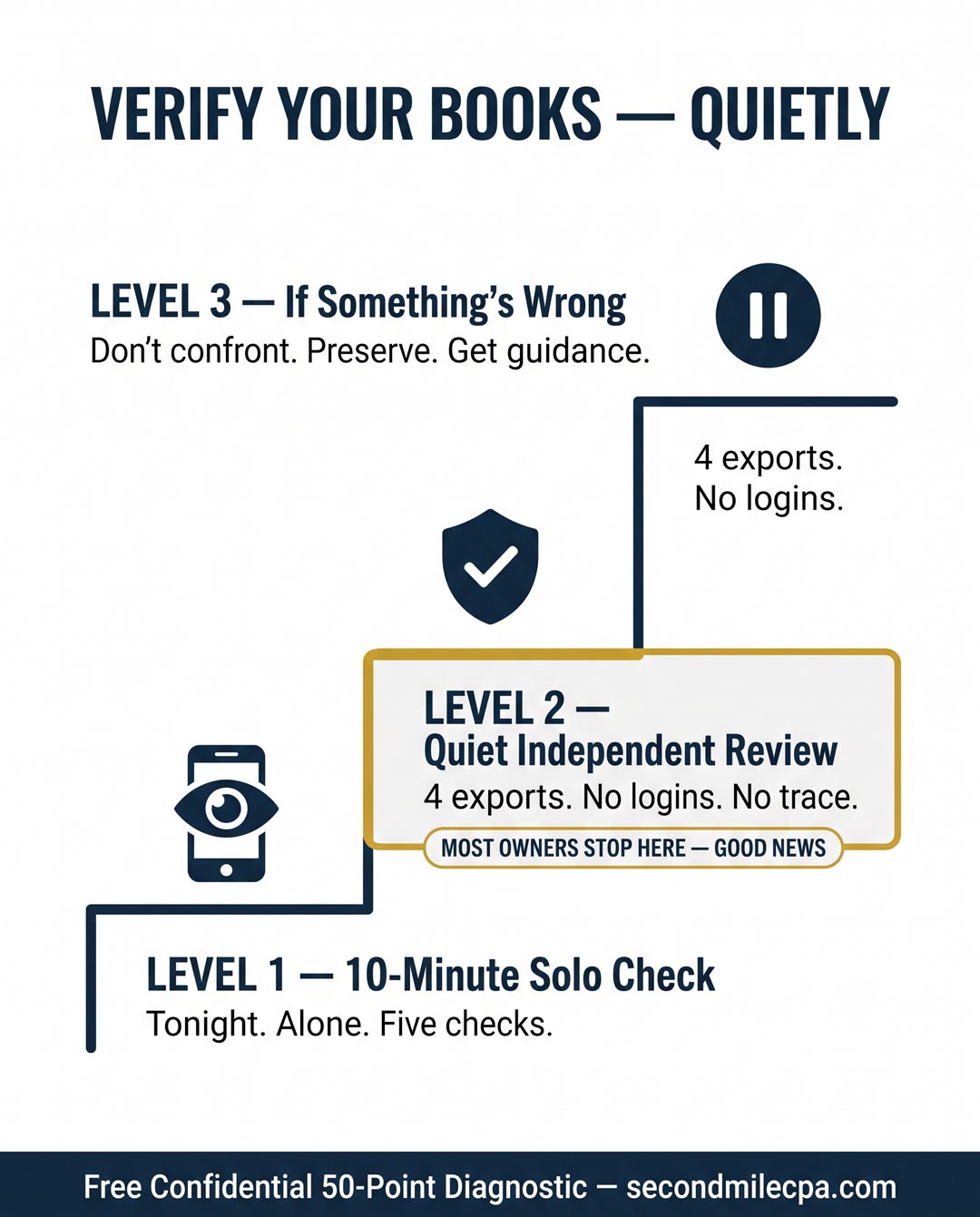
How to verify quietly: three levels
Level 1: The 10-minute solo check (tonight, alone)
No exports, no conversations. Open your accounting system’s viewer access — or just your own bank portal — and run the five checks from our warning-signs guide: profit vs. actual cash movement, balance-sheet sanity, the size of the uncategorized bucket, whether reconciliation reports exist, one month of deposits vs. reported revenue. Two or more red flags means proceed to Level 2. Zero red flags is real information too — you may sleep better tonight.
Level 2: The quiet independent review
This is the answer to the whole dilemma, and it requires exactly four documents — all of which you, as the owner, can export yourself in under thirty minutes: profit & loss, balance sheet, general ledger, bank statements. Every accounting system produces these; we send click-by-click instructions.
Note what’s not on that list: logins, passwords, accountant cooperation, or anyone’s awareness. A 50-point independent diagnostic runs entirely on read-only exports, leaves no trace in your accounting system, and involves zero contact with your bookkeeper. Within days you have a plain-English Findings Report and, for the first time in years, an answer instead of a feeling.
Level 3: If something looks seriously wrong
Rare — most reviews find ordinary, fixable mess, not misconduct. But if a review surfaces genuine irregularities: do not confront anyone. Confrontation before evidence is how documents disappear and how innocent people get wrongly accused. Quietly preserve records, restrict nothing yet, change nothing visible, and get professional guidance on next steps — this is forensic accounting territory, where sequence matters enormously. You’ll be profoundly glad the verification happened quietly first.
What happens after — the four endings
Every quiet review ends one of four ways, and it’s worth knowing all four are good endings:
1. The books are fine. The most common outcome, and wildly underrated. The fog lifts, the 2 a.m. doubt dies, and many owners finally give their bookkeeper the raise, the thank-you, or the vote of confidence they’d been withholding without realizing it. Several have shown the clean report to their bookkeeper as exactly that — a compliment.
2. Fixable habits. Missing reconciliations, categorization drift, a few quiet profit leaks. You hand over the Findings Report as a work order — “had an outside firm do a health check, here’s the punch list” — and the conversation is about the list, never about trust. Bookkeepers almost universally receive this better than owners fear: specific and written beats vague and suspected, every time.
3. Structural problems. The books need professional cleanup and reconstruction — typically 30 to 90 days — usually because the business outgrew the bookkeeper’s tools, hours, or training years ago. Notice the framing: the system failed, not the person. Many families and teams come through this with the relationship intact and the bookkeeper relieved: they knew they were drowning long before you did.
4. Serious irregularities. The rarest ending, and the one where quiet verification pays for itself a thousand times over — because you learned the truth while your options were still open.
When the bookkeeper shares your last name
The kitchen-table case deserves its own words, because it’s the one owners carry heaviest.
If your spouse, parent, or sibling keeps the books, understand what they’d tell you if they could: most of them know they’re in over their head, and have known for years. They took the books on when the business was small enough to manage. It isn’t anymore. They can’t say so — because admitting it feels like failing you, and because there’s no obvious way out that doesn’t feel like being fired from the family.
A quiet independent review, gently introduced afterward as “the bank/our CPA suggested a routine health check,” is very often the door they’ve been waiting for someone to open. In our experience the most common private reaction from a family bookkeeper isn’t hurt. It’s relief — someone finally shares the weight.
We built our process as a No-Judgment Zone for exactly these files: books kept with love, at midnight, without training. There is nothing your family’s ledger can show us that we haven’t reconstructed before, and nothing about it that makes anyone in your house a failure.

The quiet answer: a free, confidential 50-point diagnostic
Second Mile Financial Services — a licensed Texas CPA firm in The Woodlands — will review 12 months of your books from four read-only exports you generate yourself, and deliver a plain-English Findings Report. Led by Dr. John Wesevich (DBA, CPA, CMA).
- ✓ No accountant login required — no logins, no contact with your bookkeeper, no trace
- ✓ 100% confidential, No-Judgment Zone — nobody knows unless you choose to tell them
- ✓ Independent professional review — an answer, instead of a feeling
Limited diagnostics accepted each month so every file gets senior-level attention.
Request Your Free 50-Point Diagnostic →
Rather talk it through first — including the family dynamics? Call (281) 826-0100. We’ve had this conversation many times, and it stays between us.

Frequently asked questions
Is it wrong to check my bookkeeper’s work without telling them?
No — independent review of financial work is standard governance in every well-run company, not an act of suspicion. Public companies review their accountants’ work as a matter of routine, and the review protects the bookkeeper as much as the owner: a clean result becomes documented proof of their good work, and problems arrive as a specific fix-list rather than vague distrust. What damages relationships isn’t quiet verification; it’s unspoken doubt that compounds for years.
How can I verify my books without access to the accounting software?
As the owner, you can request or generate four read-only exports without anyone’s login: a profit & loss statement, a balance sheet, a general ledger, and your bank statements — which you can pull directly from your bank. An independent reviewer works entirely from these documents, leaving no trace in the accounting system and requiring no contact with whoever keeps your books.
What if my spouse or a family member does the books?
Treat it with extra care and extra kindness — and still verify. Family bookkeepers usually inherited the role when the business was much smaller, and many privately know they’re overwhelmed but can’t say so without feeling they’re failing you. A quiet review, introduced afterward as a routine health check, frequently lands as relief rather than insult: it either documents that they’re doing well or gives them the structured help they couldn’t ask for.
What should I do if a review finds evidence of fraud?
Do not confront anyone, and change nothing visible. Confrontation before evidence is preserved is how records disappear — and how innocent people get wrongly accused when the real explanation is error, not theft. Quietly secure copies of records and get professional forensic accounting guidance on sequencing before taking any action. The overwhelming majority of bookkeeping problems are honest mess, not misconduct, but the rare exception must be handled deliberately.
Should I tell my bookkeeper about the review afterward?
That’s entirely your choice, and both paths are legitimate. If the review is clean, many owners share it as a compliment — documented proof of good work. If it finds fixable issues, sharing the Findings Report as an outside “health check punch list” turns a trust conversation into a task conversation, which bookkeepers consistently receive better than owners expect. And if it stays private, that’s fine too: the review exists in your files, no one else’s.
The bottom line
You’ve been treating this as a choice between two bad options: confront someone you care about, or keep flying blind. It was never that choice. Quiet, independent verification is the third option — the one that answers your question, protects your business, spares the relationship, and very often turns out to be a kindness to the person keeping your books.
Four exports. A few days. An answer instead of a feeling. Request your free confidential diagnostic — nobody needs to know but you.
Second Mile Financial Services is a licensed Texas CPA firm in The Woodlands, serving businesses across greater Houston and nationwide. Questions first? Reach us here or call (281) 826-0100.