


Revenue is up. Headcount is up. So why is there less left over than two years ago? Research by EY estimates companies lose 1–5% of EBITDA every year to leakage — money earned but never kept. Here’s where it hides in your books, and how to find it.
A few months ago I sat with the owner of an $8M services company — sharp operator, great reputation, revenue up 30% over two years. He slid his P&L across the table and asked the question that had been keeping him up at night:
“Where is it all going?”
Two years earlier, his net margin was a healthy number he was proud of. Now it was several points thinner, and nobody could tell him why. Not his bookkeeper — the books were technically “done.” Not his bank balance — it just confirmed the symptom. (He’s a composite of many owners I’ve sat across from, but the question is word-for-word real. I hear it weekly.)
Here’s what makes profit leaks dangerous: no single leak looks like a problem. An unbilled change order here, a forgotten subscription there, a vendor price creep nobody caught. Each one is a rounding error. Together, they’re the difference between the margin you used to have and the margin you have now. Research firm MGI estimates that 42% of companies experience revenue leakage — and in our experience reviewing the books of growing businesses, the real number among companies that have never looked is much closer to all of them.
The good news: every leak below leaves a trail in your books. If the books are accurate, you can find them. (If you’re not sure your books are accurate, start with that question first — you can’t find leaks with a broken flashlight.)
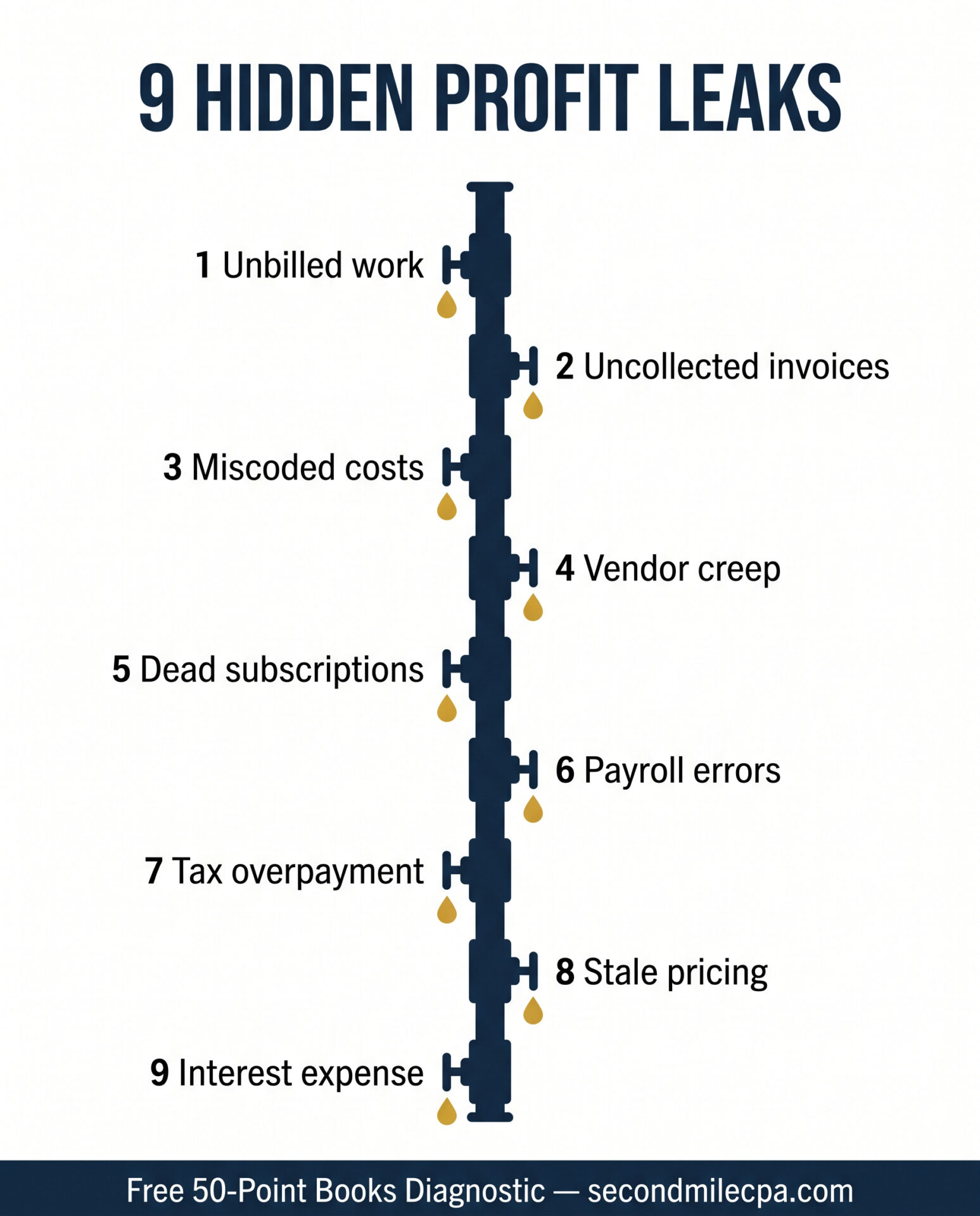
Leak #1: Work you did but never billed
Where it hides: Nowhere — that’s the problem. Unbilled work doesn’t appear in your books at all, which is why it’s the biggest and least visible leak.
Change orders done on a handshake. Scope creep absorbed to “keep the client happy.” Hours worked but never logged. Retainage everyone forgot to collect. In service businesses and construction, unbilled and underbilled work is routinely the single largest leak — and it compounds, because clients quickly learn what they don’t get charged for.
How to spot it: Compare what your operations records say you delivered (jobs closed, hours worked, change orders approved) against what your invoicing system says you billed, for one recent month. Any gap is money you gave away.
Leak #2: Invoices you sent but never collected
Where it hides: Accounts receivable aging report — the columns to the right of “90+ days.”
An invoice isn’t revenue; a deposit is. Aging receivables quietly rot: industry data consistently shows that the older an invoice gets, the less of it you’ll ever collect. Worse, old uncollectable invoices sitting in AR inflate your reported assets, so your books look healthier than your bank account will ever feel.
How to spot it: Run an AR aging report. Total everything over 60 days. That number should shock you into a collections routine — or into a hard look at why nobody owns collections in your company.
Leak #3: Costs coded to the wrong jobs, clients, or departments
Where it hides: In plain sight — spread across miscategorized line items in your general ledger.
When materials, labor, and subcontractor costs land in generic buckets instead of against specific jobs or service lines, every job looks vaguely fine and no job looks bad. You keep selling the unprofitable service, keep serving the unprofitable client, and keep quoting the price that loses money — because the books physically cannot show you which one it is.
How to spot it: Ask for a profitability report by job, client, or department. If the answer is “our books aren’t set up that way,” you’ve found not just a leak but the pipe it flows through. This is a chart-of-accounts architecture problem, and it’s fixable.
Leak #4: Vendor creep and duplicate payments
Where it hides: Accounts payable and your credit card statements.
Vendors raise prices 3–5% a year assuming nobody’s watching — and usually nobody is. Add duplicate payments (an invoice paid from the email and the statement), auto-renewing contracts for services you stopped using, and freight or surcharge line items that appeared one day and never left.
How to spot it: Pull your top ten vendors and compare this year’s unit pricing to two years ago. Then search your ledger for double payments to the same vendor in the same month. Ten minutes, routinely worth thousands.
Leak #5: The subscription graveyard
Where it hides: Recurring charges on cards and bank drafts — often across multiple cards, which is why nobody sees the total.
Software seats for employees who left. Two tools that do the same thing. The “free trial” from 2023. Individually trivial, collectively a salary. This is the easiest leak to find and the most commonly found — we have yet to review a growing company’s books without discovering at least a few dead subscriptions.
How to spot it: List every recurring charge across all accounts and cards for the last 90 days, and put a name next to each one — who uses it, for what. Anything without a name gets cancelled.
Leak #6: Payroll and overtime errors
Where it hides: Payroll registers and quarterly filings.
Misclassified employees, miscalculated overtime, paying for hours that were never worked, and payroll tax deposits that land late — where IRS penalties start at 2% and climb to 15% just for timing. For most growing businesses payroll is the single largest expense, which means even a 1–2% error rate outweighs almost any other leak on this list. Payroll compliance isn’t glamorous; it’s just where the money is.
How to spot it: Reconcile one quarter’s payroll register against timesheets and against what was actually filed and deposited. Gaps in any direction are leaks — or brewing penalties.
Leak #7: Taxes you overpaid — or penalties you didn’t need to pay
Where it hides: In the deductions your ledger never captured, and on the IRS notices in someone’s drawer.
Messy books leak in both tax directions at once. Uncategorized expenses become unclaimed deductions. Missed elections and reactive, April-only tax thinking leave legitimate strategies unused. Meanwhile late filings trigger penalties of 5% of unpaid tax per month, up to 25%. We routinely find five figures in a single year’s ledger sitting in this leak alone — it’s usually the largest number in the Findings Report.
How to spot it: Honestly? This is the one place on this list where self-diagnosis rarely works — you can’t spot a deduction you don’t know exists. This is what an independent professional review is for.
Leak #8: Pricing built on stale numbers
Where it hides: Not in a transaction — in the absence of a recalculation.
Your prices were set when materials, labor, insurance, and fuel cost what they cost then. If costs have crept 15% since your last pricing review and your prices moved 5%, the 10-point difference comes straight out of your margin on every single sale. This is the leak that turns busy years into disappointing ones: revenue records, margin erosion.
How to spot it: Take your three best-selling services or products and rebuild their cost from today’s actual numbers — current wages, current materials, current overhead. Compare against current pricing. If your books are well-kept, this takes an afternoon; if it takes weeks, see Leak #3.
Leak #9: Interest on money you shouldn’t have needed to borrow
Where it hides: Interest expense on the P&L — the leak that other leaks cause.
When leaks 1 through 8 drain your cash, the line of credit fills the gap, and now you’re paying interest on the money your own processes leaked. It’s the compounding penalty on all the others: businesses with clean books and a working cash flow forecast borrow less, later, and cheaper — banks price sloppy financials as risk because they are.
How to spot it: Compare this year’s interest expense to two years ago, as a percentage of revenue. If borrowing is growing faster than the business, the leaks upstream are funding it.
Why your bookkeeper hasn’t caught these
Not because they’re bad at their job. Because finding leaks isn’t the job you hired them for.
Bookkeeping is recording: capturing transactions accurately and on time. Leak-hunting is analysis: comparing what happened against what should have happened — operations against billing, pricing against costs, filings against obligations. A bookkeeper records the forgotten subscription perfectly every month; recording it correctly is their job. Noticing that nobody uses it belongs to a different discipline — the kind of analytical financial oversight most businesses under $20M have never had, because a full-time CFO never made sense at their size.
That’s the real reason margins erode in growing companies: the business scaled, but nobody’s watching the water level.

Find your leaks: get a free 50-point diagnostic of your last 12 months
Second Mile Financial Services offers a complimentary 50-point diagnostic review covering every leak in this article — billing gaps, aging receivables, miscoding, vendor creep, payroll exposure, tax overpayment, and more. Led by Dr. John Wesevich (DBA, CPA, CMA), our team reviews your last 12 months and delivers a plain-English Findings Report: what’s leaking, what it’s costing you, and exactly what to fix first.
- Independent professional review — a licensed Texas CPA firm, not a software scan
- No accountant login required — you export the reports; nobody else needs to know
- 100% confidential, No-Judgment Zone — leaks are normal; ignoring them is optional
We accept a limited number of complimentary diagnostics each month so every file gets senior-level attention — if this month is full, you’ll be first in line for the next one.
Request Your Free 50-Point Diagnostic →
Prefer to talk to a human first? Call (281) 826-0100 — we’re in The Woodlands, serving greater Houston and businesses nationwide.
Frequently asked questions
What is a profit leak?
A profit leak is money your business earns but never keeps, lost through operational and accounting gaps rather than deliberate spending: work performed but never billed, invoices never collected, duplicate or creeping vendor charges, payroll errors, missed tax deductions, and pricing that hasn’t kept up with costs. Individually small, leaks compound — EY research estimates companies lose 1–5% of EBITDA to leakage every year.
Why is my revenue growing but my profit shrinking?
Usually a combination of three leaks: costs creeping faster than prices (stale pricing), unprofitable jobs or clients hidden by generic cost coding, and expense creep — subscriptions, vendor increases, and borrowing costs — growing quietly alongside revenue. Growth masks all three, because rising top-line numbers make everything feel healthy while margin erodes underneath.
How do I find profit leaks in my business?
Start with five checks: compare work delivered against work billed for one month; run an accounts receivable aging report and total everything over 60 days; ask for profitability by job or client; list every recurring charge across all cards and name its owner; and compare your top vendors’ pricing today against two years ago. These find the visible leaks. Tax-side leaks — missed deductions and overpayments — generally require a professional review of your ledger.
How much money do businesses actually lose to profit leaks?
EY research estimates 1–5% of EBITDA lost annually to leakage, and MGI research found about 42% of companies experience revenue leakage — figures based mostly on companies that measure it. For a $5M business at typical margins, even the low end represents tens of thousands of dollars a year, recurring until found.
Can’t my bookkeeper just find these leaks?
Bookkeepers record transactions; leak-hunting is analysis — comparing operations against billing, pricing against current costs, and filings against obligations. It’s a different discipline, closer to CFO-level review than bookkeeping, which is why leaks persist even in businesses with diligent, honest bookkeepers. An independent diagnostic covers that analytical layer without requiring you to hire anyone full-time.
The bottom line
Profit leaks don’t announce themselves — no invoice arrives labeled “money you’re giving away.” They surface only when someone deliberately goes looking, with clean books and a checklist. The nine above are where we find them, over and over, in businesses from $500K to $20M.
Your books already contain the answers. Request the free 50-point diagnostic, and within days you’ll have a plain-English list of exactly where your margin went — and how to get it back.
Second Mile Financial Services is a licensed Texas CPA firm in The Woodlands, serving businesses across greater Houston and nationwide. Questions first? Reach us here or call (281) 826-0100.