


Your P&L says you had a great quarter. Your bank account says otherwise. If you’ve ever stared at both screens wondering which one is telling the truth — this guide is for you. Fifteen warning signs, in plain English, plus a way to check your books without touching anyone’s login.
Here’s a conversation I have more often than any other.
A business owner sits down across from me — sometimes a contractor, sometimes a physician who owns her practice, sometimes the founder of a $10M professional services firm. The company is growing. The team is busy. And then, usually with a little embarrassment, comes the sentence:
“I honestly don’t know if I can trust my own numbers.”
They’re not accusing anyone of anything. Their bookkeeper might be a longtime employee, a family member, or a perfectly pleasant outsourced service. But somewhere along the way, the owner stopped believing the reports — or stopped reading them altogether — and went back to running the business off the bank balance and gut feel.
If that’s you, two things you should know before we go any further. First, you’re in the majority: most businesses we review at Second Mile Financial Services arrive in some version of this “financial fog,” and it’s almost never anyone’s fault — it’s what happens when a business outgrows the systems it started with. Second, this is checkable. You don’t need an accounting degree to spot unreliable books. You need to know what to look for.
Here are the fifteen signs we check first, grouped into three places they hide: your reports, your processes, and the answers you get when you ask questions.
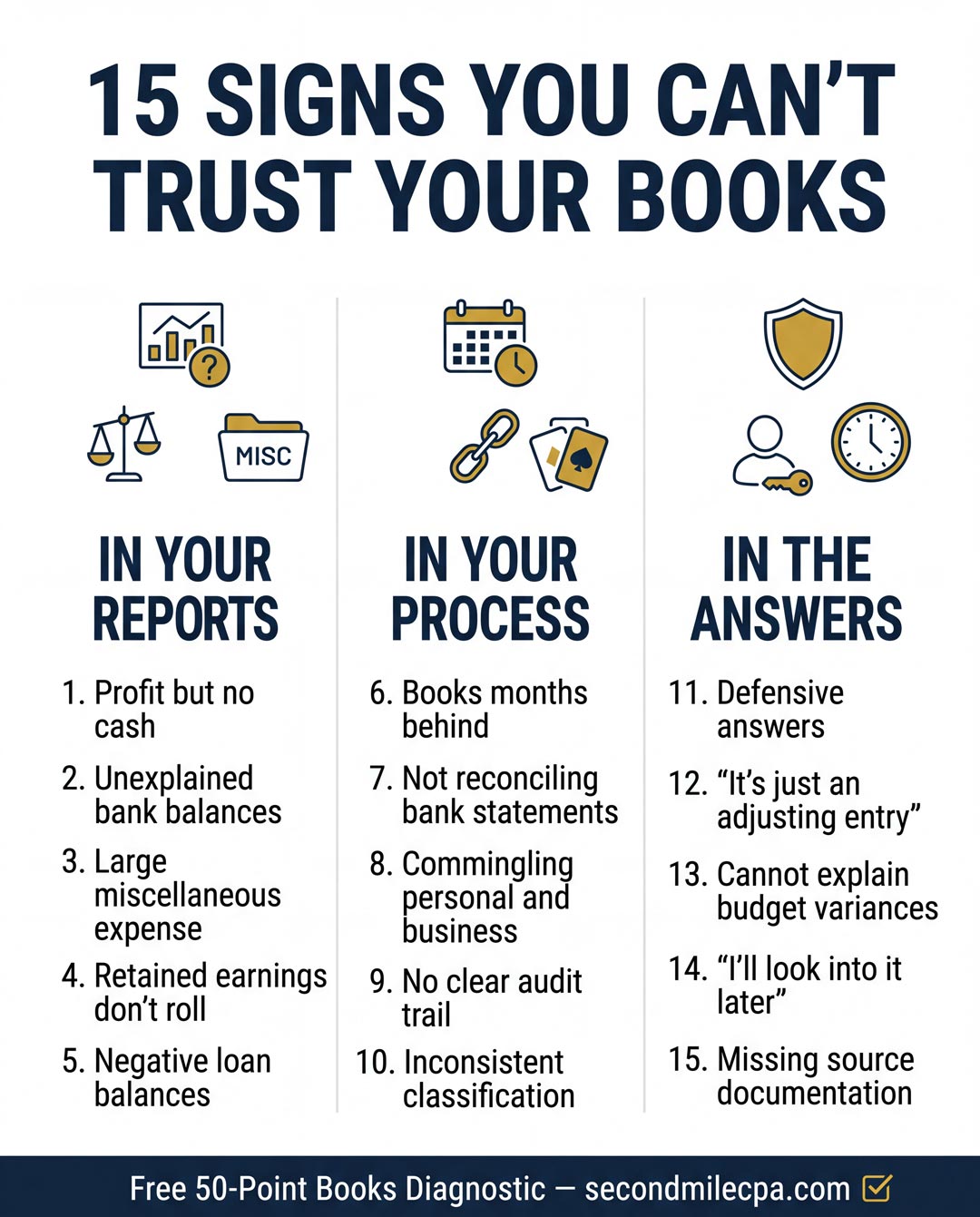
Signs hiding in your financial reports
1. The P&L shows profit, but there’s never any cash
The classic. Your profit and loss statement says you made $40,000 last quarter, but payroll still feels like a cliffhanger. Sometimes there’s an innocent explanation — timing, growth eating cash, loan principal that doesn’t show on the P&L. We wrote a whole plain-English guide to cash flow forecasting about exactly that. But a persistent, unexplained gap between reported profit and actual cash is the single most common symptom of books that are misstating reality — revenue recorded twice, expenses missing, or transactions sitting uncategorized for months.
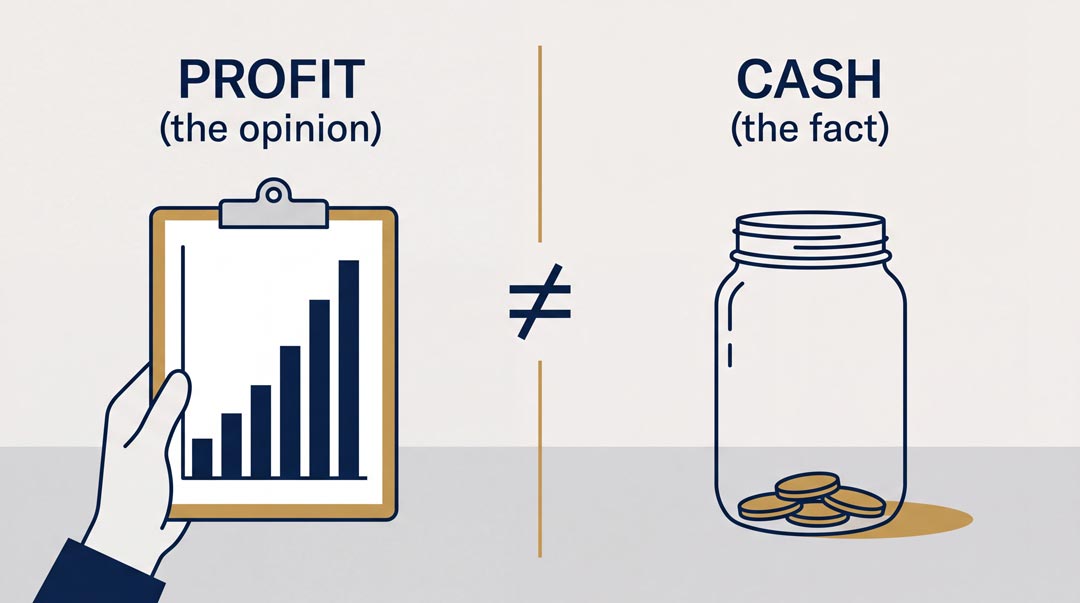
Profit is an accounting opinion. Cash is a fact. When the two tell wildly different stories for months on end, the books owe you an explanation.
2. Your balance sheet has numbers that make no sense
Most owners never look past the P&L — which is unfortunate, because the balance sheet is where bad bookkeeping goes to hide. Open yours and look for: negative loan balances, a credit card balance that doesn’t match the actual statement, “Opening Balance Equity” that never went away, or an inventory number that hasn’t moved in two years. Any of these means transactions are being parked somewhere instead of recorded properly.
3. There’s a giant “Miscellaneous” or “Ask My Accountant” bucket
Every bookkeeping file has a junk drawer. A healthy one is small and gets emptied monthly. If yours contains five figures of uncategorized expenses — or a category literally named “Ask My Accountant” that nobody ever asked the accountant about — your reports are built on guesses. That’s also where missed tax deductions go to die: an expense that never gets categorized correctly never gets deducted correctly.
4. Reported revenue doesn’t match what actually hit the bank
Pull your merchant processor or invoicing report for one month and compare it to revenue on the P&L for the same month. They won’t match to the penny — refunds, fees, and timing get in the way — but they should reconcile with a clear trail. If nobody can explain the difference, revenue is being double-counted, missed, or recorded in the wrong period. All three distort every decision you make downstream.
5. Your margins swing wildly with no operational explanation
Gross margin of 42% in March, 19% in April, 55% in May — while the business itself ran the same jobs with the same crew at the same prices? Real margins don’t behave like that. Erratic swings usually mean costs are landing in the wrong month or the wrong category, which makes it impossible to know which jobs, clients, or product lines actually make you money.
Signs hiding in how your books are kept
6. The books are months behind
If it’s July and your last closed month is February, you don’t have books — you have an archive. Every decision you’ve made since February was made on stale data. Falling behind is also self-reinforcing: the deeper the backlog, the more intimidating the catch-up, the longer it gets postponed. (This is the number-one reason businesses come to our financial cleanup and reconstruction team — and no, yours are not the worst books they’ve ever seen. Not even close.)
7. Nobody can show you a reconciliation report
Reconciliation — matching the books against actual bank and credit card statements — is the seatbelt of bookkeeping. It’s how errors get caught. Ask one simple question: “Can I see the last bank reconciliation report?” A well-kept file produces one in thirty seconds. If the answer involves hesitation, excuses, or “the software does that automatically” (it doesn’t — it suggests, a human confirms), your books have no seatbelt.
8. Personal and business spending share the same accounts
The family cell phone plan on the business card. A materials run paid from the personal account, reimbursed “eventually.” Every crossover forces someone to guess later, and guesses accumulate into misstated profit, missed deductions, and audit exposure. The IRS treats commingled finances as a red flag precisely because it makes records unreliable.
9. Old invoices and surprise bills keep floating around
Your accounts receivable report shows invoices from fourteen months ago that everyone quietly knows will never be collected — inflating your assets. Meanwhile, a vendor bill nobody recorded shows up and blows a hole in this month’s plan. Both are the same disease: the books reflect what someone entered, not what’s actually owed to you and by you.
10. Big mystery adjustments appear at year-end
If your tax preparer makes large “correcting entries” every spring — thousands of dollars moved around with a journal entry you’ve never had explained — that’s the annual confession that the books were wrong all year. You paid for twelve months of bookkeeping and got one month of accuracy, backdated.
Signs hiding in the answers you get
11. Questions get defensive answers
You ask why software expenses doubled. A healthy answer sounds like: “Two annual renewals landed in the same month — here they are.” An unhealthy one sounds like: “Do you not trust me?” Good bookkeepers welcome questions, because questions are how errors surface. Defensiveness isn’t proof of wrongdoing — usually it’s insecurity, not theft — but it reliably means nobody’s been double-checking the work.
12. One person controls everything, and no one checks their work
The same person enters bills, pays them, reconciles accounts, and runs reports — and nobody else has ever looked. In accounting this is called a segregation-of-duties failure, and it’s the setting in which nearly every small-business embezzlement story begins. To be clear: the overwhelming majority of solo bookkeepers are honest. But honest people make unchecked errors too, and an arrangement where mistakes can’t be caught deserves an independent set of eyes on principle, not suspicion.
13. Reports arrive late, or only when you ask
Financial reports should show up on a schedule — the same week every month, without prompting. If you have to request them, and then wait, and then remind, the reports probably aren’t ready because the books behind them aren’t ready. Silence has a story.
14. Tax season always brings a cleanup bill
Every spring, your CPA charges extra hours to “get the books ready for the return.” That invoice is a measurement, in dollars, of how far your books drifted from reality over the year. It’s also the expensive way to find out — because by tax time, the mispriced jobs, the margin leaks, and the quarterly estimates you overpaid or underpaid have already happened.
15. You run the business from your bank app, not your reports
This one is the tell, and it’s about you, not your bookkeeper. If you check the bank balance before every decision — hiring, buying a truck, taking a draw — you’ve already concluded, somewhere deep down, that the official numbers can’t be trusted. Your instincts filed this report long before you read this article. The question is what you do with it.
What unreliable books actually cost you
It’s tempting to treat messy books as a cosmetic problem — annoying, but survivable. The data says otherwise. Cash flow problems remain a leading cause of small business failure, and unreliable books make cash invisible until it’s gone. Beyond survival risk, bad books quietly bill you four ways:
Overpaid taxes. Miscategorized and uncategorized expenses are deductions you earned but never claimed. We routinely find five figures of them in a single year’s ledger.
Penalties and interest. The IRS failure-to-file penalty runs 5% of unpaid tax per month up to 25%, with separate penalties for late payment and late payroll deposits. Books that run behind schedule tend to file behind schedule.
Expensive money. When a lender asks for financial statements and gets sloppy ones, the answer is a decline or a worse rate. Banks read messy books as management risk — because statistically, they are.
A discounted exit. If you ever sell, buyers will re-derive your EBITDA from your records. Every number they can’t verify becomes a number they discount. Unreliable books at exit time can cost more than every bookkeeping fee you ever paid, combined — which is why exit planning starts with clean history, not a listing.
How to verify your books — without an accounting degree
You have three options, in escalating order of certainty.
Option 1: The 10-minute self-check. Do these five things today: (1) compare last month’s P&L profit to what your bank balance actually did; (2) skim the balance sheet for negative or frozen numbers; (3) check the size of your uncategorized/miscellaneous bucket; (4) ask to see the latest bank reconciliation report; (5) compare one month of merchant deposits against reported revenue. Two or more red flags out of five means the fog is real.
Option 2: Ask your bookkeeper to walk you through it. Sincerely — this works when the relationship is healthy. The awkward part: the person who made the errors is rarely the person who finds them, and if the relationship has any tension, the questions themselves feel like accusations. Which leads to the option most owners actually want but don’t know exists:
Option 3: Get an independent diagnostic. A structured review of your last 12 months by a professional who has no stake in defending the current books — the accounting equivalent of a second medical opinion. It doesn’t require firing anyone, confronting anyone, or even telling anyone. It just answers the question you’ve been carrying around: can I trust these numbers?
Stop flying blind: get your free 50-point books diagnostic
Second Mile Financial Services offers a complimentary 50-point diagnostic of your last 12 months of books. Led by Dr. John Wesevich (DBA, CPA, CMA), our team checks every item on the list above — and 35 more — then hands you a plain-English Findings Report: what’s solid, what’s leaking profit, what’s creating tax risk, and exactly what to fix first.
- ✓ Independent professional review — a licensed Texas CPA firm, not a software scan
- ✓ No accountant login required — you export the reports; nobody else needs to know
- ✓ 100% confidential, No-Judgment Zone — we’ve reconstructed books far messier than yours
We accept a limited number of complimentary diagnostics each month so that every file gets senior-level attention — if this month is full, you’ll be first in line for the next one.
Request Your Free 50-Point Diagnostic →
Prefer to talk to a human first? Call us at (281) 826-0100 — we’re in The Woodlands, and we work with businesses across greater Houston and remotely nationwide.

What happens if the diagnostic finds problems?
Then you’ll know — which puts you ahead of where you were yesterday. Most findings fall into three buckets, each with a clear path:
Fixable habits. Missing reconciliations, commingled accounts, categorization drift. Often your current bookkeeper can fix these, given a specific list. The Findings Report is that list — many owners simply hand it over, and the relationship improves because expectations finally got written down.
Structural problems. Books months behind, a chart of accounts that can’t answer basic questions, years of accumulated errors. That’s a cleanup and reconstruction project — typically 30 to 90 days — after which properly maintained monthly bookkeeping keeps it from ever piling up again.
Serious irregularities. Rare, but real. If the numbers suggest something deliberate, that becomes a careful, confidential forensic accounting conversation — and you’ll be glad it started with a quiet independent review rather than an accusation you couldn’t back up.
Frequently asked questions
How do I know if my bookkeeper is doing a good job?
Three quick tests: reports arrive monthly without being requested, bank reconciliation reports exist and can be produced on demand, and questions get specific, documented answers rather than defensiveness. If all three hold, your bookkeeper is likely doing well. If none do, an independent review of your last 12 months will tell you what the reports have been hiding.
Can I get my books reviewed without my bookkeeper or accountant knowing?
Yes. An independent diagnostic like ours requires only read-only exports you can generate yourself — P&L, balance sheet, general ledger, and bank statements. No logins, no passwords, no contact with your current bookkeeper or accountant. Many owners use a quiet review to confirm everything is fine before ever raising a question internally.
What’s the difference between a books diagnostic and an audit?
An audit is a formal, standards-driven engagement — typically required by lenders or investors — where a CPA firm issues a signed opinion on your financial statements. A diagnostic review is faster, less formal, and built for the owner: it identifies errors, profit leaks, and tax risks in plain English and tells you what to fix, without the cost or scope of a formal audit.
My books are years behind and a total mess. Is it too late for a review?
No — messy books are the normal starting point, not the exception. Most businesses we review arrive mid-fog, usually because growth outpaced their systems, and a typical full reconstruction takes 30 to 90 days. The diagnostic simply establishes what shape you’re actually in. We call it a No-Judgment Zone because we mean it: disorganized books are a sign of a growing business, not a failing owner.
Does bad bookkeeping usually mean my bookkeeper is stealing?
Rarely. The vast majority of bookkeeping problems trace to workload, outgrown systems, and missing oversight — not dishonesty. But the same conditions that let errors accumulate (one person, no review, no reconciliation) are also the conditions where fraud goes undetected, which is why periodic independent review is a best practice even when you fully trust your team.
The one-sentence takeaway
If you’ve read this far, your gut has probably already voted. Trust, but verify — your business runs on these numbers. Export your last 12 months, request the free 50-point diagnostic, and within days you’ll know exactly where you stand — no confrontation, no judgment, no more Thursday-night guessing.
Second Mile Financial Services is a licensed Texas CPA firm in The Woodlands, serving businesses across greater Houston and nationwide. Questions first? Reach us here or call (281) 826-0100.